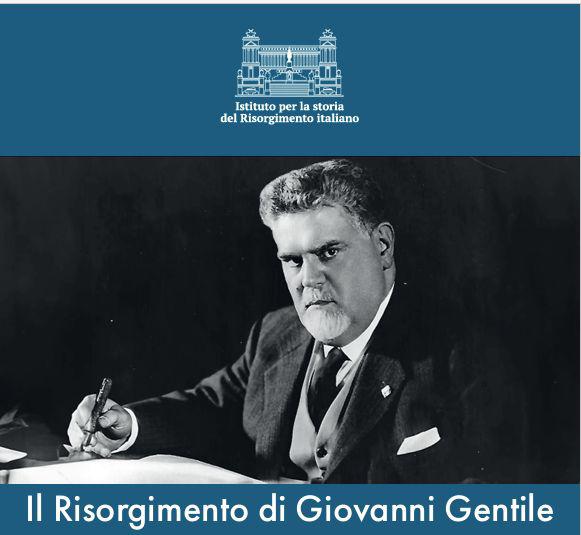
Three days to delve deeper into a central but still insufficiently investigated aspect of Giovanni Gentile’s work: the role played by the Risorgimento in his philosophical, historical, pedagogical and political reflection. This is the meaning of the international study conference “Il Risorgimento di Giovanni Gentile”, scheduled for 24 to 26 June 2026 in Rome. The initiative is promoted by the Institute for the History of the Italian Risorgimento with the patronage of the Ministry of Culture and the Treccani Italian Encyclopedia Institute, in collaboration with the National Historical Council, the National Institute of Renaissance Studies, the Italian Association of the History of Political Thought and the Association of Italianists. The conference also obtained the support of the Presidency of the Council of Ministers – Mission structure for anniversaries of national interest.
The initiative intends to delve deeper into a central but still insufficiently investigated aspect of Giovanni Gentile’s work: the role played by the Risorgimento in his philosophical, historical, pedagogical and political reflection. Through a broad comparison between scholars from Italian and international universities and research institutions (almost fifty), the conference aims to reconstruct the way in which Gentile interpreted the process of national unification and its significance in the formation of contemporary Italian identity.
The conference was opened by speeches by Carlo Ossola, president of the Treccani Italian Encyclopedia Institute, Francesco Perfetti, president of the National Historical Council and Alessandro Campi, director of the Institute for the history of the Italian Risorgimento. The three days of study will first of all analyze the relationship between regional history and nation building, with particular attention to the cultural roots of the Risorgimento and the contribution that Gentile attributed to the different territorial traditions in the formation of the unitary State. A second thematic nucleus will be dedicated to Gentile’s reading of the Great War and the complex relationships between the Risorgimento, nationalism and fascism, a theme that continues to spark a lively historiographical debate.
Ample space will also be reserved for the educational and cultural dimension of Gentile’s thought. His commitment to the organization of historical studies, the promotion of research on the Risorgimento, the conception of school as a civil training tool and the role played by the famous school reform in the construction of a shared national conscience will be explored in depth.
A significant part of the conference will be dedicated to the interpretations that Gentile developed of the main protagonists of Italian history and culture between the eighteenth and nineteenth centuries. Through the analysis of his readings of figures such as Mazzini, Cavour, Garibaldi, Cattaneo, Cuoco, Gioberti, Rosmini, Manzoni, Leopardi and De Sanctisthe centrality attributed by the philosopher to the Risorgimento as the culminating moment of the spiritual and political development of the Italian nation will emerge. The final sessions will finally address the historiographical success of Gentile’s interpretations, comparing them with those of other protagonists of twentieth-century Italian culture, from Benedetto Croce to Gaetano Salvemini, from Adolfo Omodeo to Augusto Del Noce, up to the critical readings developed in the context of anti-fascist and republican culture.
The conference will take place in three prestigious locations in the capital: the Institute of the Italian Encyclopedia, the Italian Historical Institute for the Middle Ages and the Ministry of Culture. The initiative – explains Alessandro Campi – “represents an important opportunity for reflection on one of the most influential and controversial figures of contemporary Italian culture, offering new tools for understanding the relationship between philosophy, national history and the construction of collective identity”.
Android
Android
Android
Android
Android
Android
Android
Android
Android
Android
Android
Android
Android
Android
Android
Android
Android
Android
Android
Android
Android
Download
Android
Download
Download