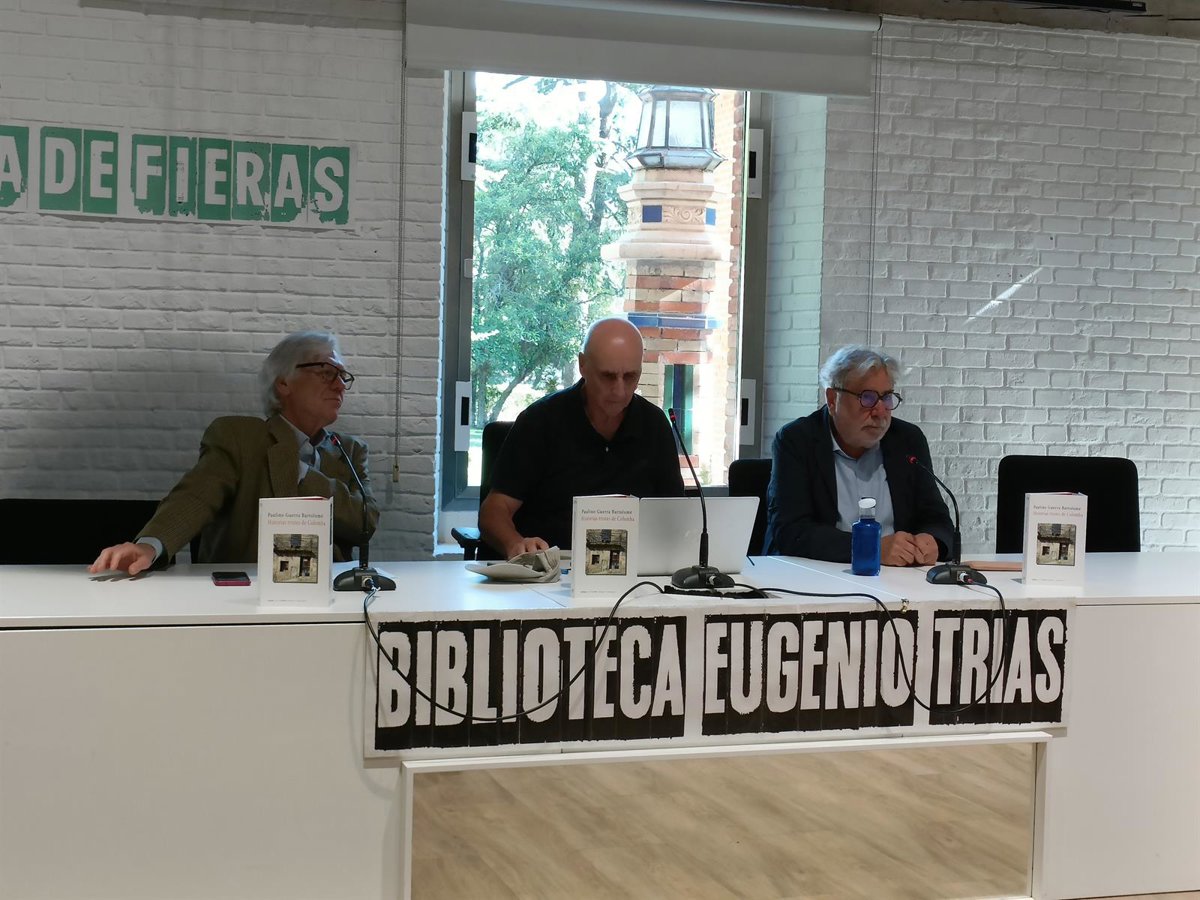
The journalist Paulino Guerra lamented this Thursday, during the presentation of his book ‘Historias tristes de Colomba’ (Huerga y Fierro), the forgetting of the “rural priority” on the governments’ agendas.
“The rural world is still not on the priority agenda of any Government. The reasons? Well, its inhabitants are few, they barely bother and they do not decide elections either. There are national priorities and other nationalist ones, but the rural priority has vanished from all the agendas,” Guerra warned, at the presentation of his book, which took place at the Eugenio Trías Public Library, in Madrid.
Guerra, who is a native of Fermoselle (Zamora), has criticized that the “worst” thing is that people are not even allowed to “agonize in peace” and that “hand in hand with new religions, in the style of radical environmentalism, a generation of urban preachers and apostles has emerged, determined to save farmers and ranchers from themselves.”
“They are those types of urban people who ignore everything about the countryside. They don’t know any land other than that of their neighborhood park where they take an obese greyhound for a walk, which has lost the instinct of its breed. But they have more and more influence in the offices and since their vocation and their ideological heritage is to prohibit everything, they have built a supremacist discourse that tries to decide the lives and property of the few brave people who still resist with their livestock or their land in the towns,” he pointed out. the journalist, who worked for 35 years at Europa Press and was its deputy director.
This is the message, as detailed, of one of the 14 stories that make up ‘Sad Stories of Colomba’. “Everything is controlled or prohibited,” the book reads. “Farmers and ranchers are no longer the guardians of the nature in which they live. Now they are the suspects, the ones who are watched as if they were confined to an Indian reservation. A wolf, an eagle, a simple dog that appears dead generates more stir and media attention than the decline and progressive death of entire regions.”
Furthermore, he has criticized “the bureaucracy, that insatiable State within the State” that “decides everything without consulting with those affected.” The “drama”, as he has indicated, is that “where before there were plowed fields or grazed cattle, now there is old age, decay, abandonment, dry grass, bushes and all the fuel necessary for the catastrophe to break out.”
In this sense, he has applied Julius Caesar’s famous phrase ‘Alea iacta est’ to the rural world. “Unfortunately, for hundreds of towns in depopulated Spain, there is no future and their fate is definitively cast,” he concluded.
During the presentation, the writer Iñaki Ezkerra took part, highlighting the author’s “austere, direct and at the same time polished” style. “We needed a book like Paulino’s that shows you reality,” he said, while adding that his characters “ring true.” He has also highlighted the “vindication” he makes of rural civilization and the problems and solutions he points out.
For his part, the journalist and writer Javier Rioyo has indicated that the book “is neither sad nor very happy” but “with a very interesting hyperrealism” about what is “the largest geographical part of Spain”, which “for a long time generated wealth for imperial Spain” and from whose “abandonment” later “peripheral Spain” was “fed”. “It is a book with a perhaps melancholic claim but with an eye toward the small stories that make up the way of being,” he emphasized.
3D CHAT WELT – KOSTENLOS MITMACHEN
& – Alles für Ihren Kaffeevollautomaten – Profil von spinsoffgllory
Spinsoffgllory
spinsoffglory Westspinsoffglory auf Regionaljournal
spinsoffgllory Creator Profile | Civitai
spinsoffgllory
Novinky, zajímavosti a tipy ze světa seriálů a filmů | Edna.cz
spinsoffgllory at My poetic side
spinsoffgllory « Giveaway of the Day Forums
VirtualDJ – Spinsoffgllory
spinsoffgllory
Elephant Journal
CODAP
spinsoffgllory (@spinsoffgllory) | Hashnode
spinsoffgllory | Rybolov Norsko
spinsoffgllory by betsomnia
Find A Spring – Members
spinsoffgllory
Chordie Guitar Chords and Lyrics
spinsoffgllory | Magic.ly
spinsoffgllory — Steemit
@spinsoffgllory-272026
spinsoffgllory – riverock
Free Checklists By spinsoffgllory
Spinsoffgllory