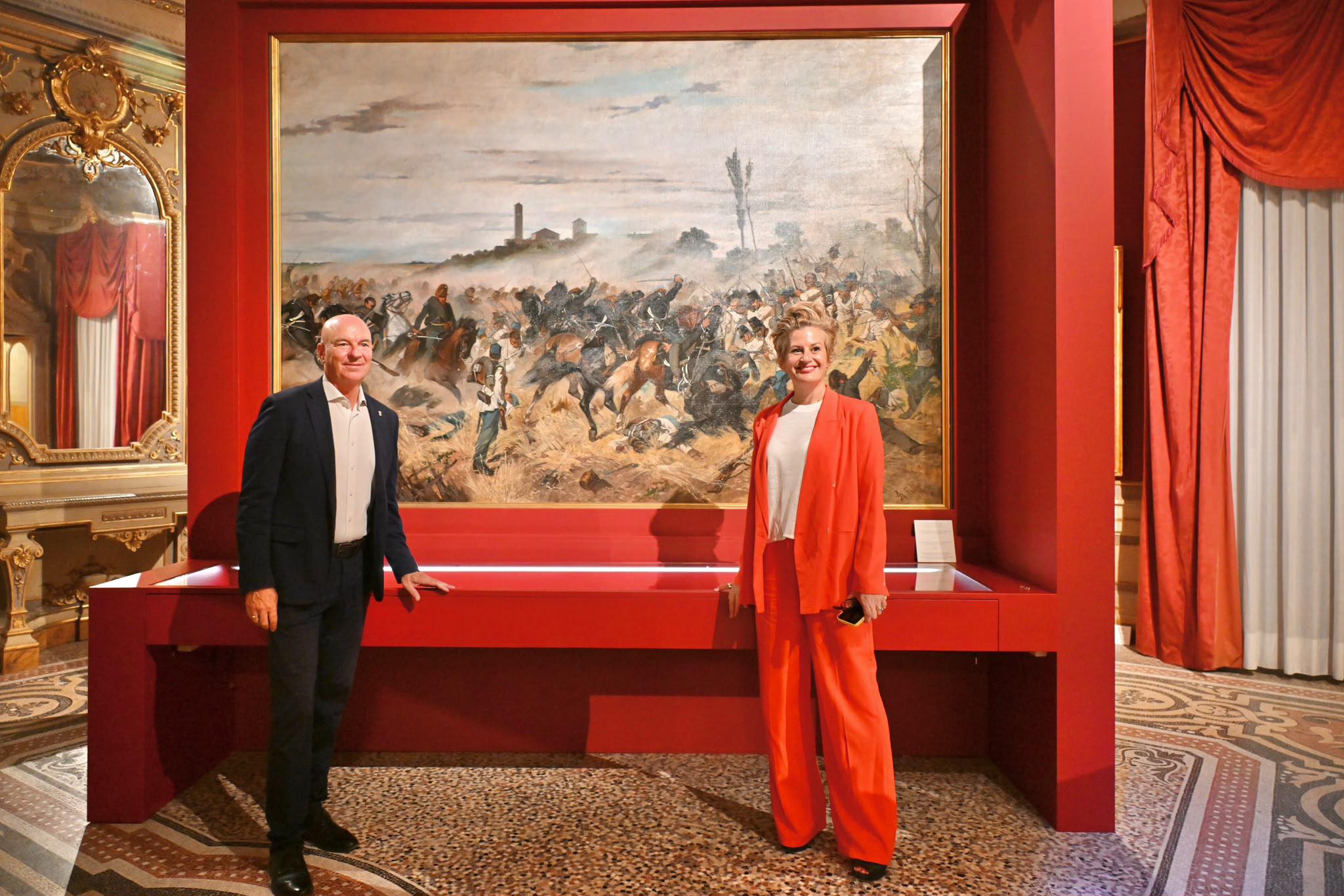
Almost 400 works, including paintings, drawings and engravings, with an extraordinary nucleus dedicated to the master of the Macchiaioli Giovanni Fattori, and a path that retraces the history of art in Livorno and Tuscany from the mid-nineteenth century to the 1940s. It is the renewed face of the “Giovanni Fattori” Civic Museum of Livorno, which reopens to the public tomorrow, Friday 10 July, in the historic Villa Mimbelli, following an important restyling project. 32 years after the first installation in the Villa Mimbelli headquarters and after six months of work, the museum presents itself with an exhibition itinerary completely revised by the scientific director Vincenzo Farinella, professor of Art History at the University of Pisa, according to a new scientific approach. The collection valorises, alongside the works of Fattori, important nuclei dedicated to Livorno artists, including Vittorio Corcos and Plinio Nomellini, and to the great protagonists of Tuscan painting such as Silvestro Lega, Telemaco Signorini and Giovanni Boldini. Among the main innovations, the entry into the collection of a significant work by Giovanni Fattori stands out, acquired thanks to the liberal donation of Erredue Spa through the Art Bonus instrument. Also making its debut is a room entirely dedicated to Leonetto Cappiello, the famous internationally renowned artist from Livorno, considered the father of modern advertising and author of some of the most iconic posters of the twentieth century.
In the splendid nineteenth-century residence surrounded by greenery, it will be possible to take a renewed journey into the art of Livorno and Tuscany, from the mid-nineteenth century to the 1940s with important groups of artists from Livorno (Giovanni Fattori with around 50 works, Vittorio Corcos, Plinio Nomellini) and Tuscans (Silvestro Lega, Telemaco Signorini, Giovanni Boldini). Many of the works have undergone careful restoration. The restyling of the museum focused on inclusive and modern spaces, with new LED lighting and a neutral color palette designed to enhance the works without conflicting with the original decorations of the villa.
As the scientific director Vincenzo Farinella explains in detail, the new project to reorganize the Fattori Museum started from the need to be able to create a linear and consequent exhibition itinerary, always based, where possible, on a tight chronological sequence of the works and artists: a route, that is, which, starting from the ground floor, could unwind without interruptions along the rooms of the first and then the second floor, ideally leading the visitor on a diachronic journey through the decades that extend from the mid-nineteenth century to the 1940s, when the Second World War and the collapse of Fascism caused a dramatic and very clear fracture in the development of the arts in Italy.
The overall reorganization of the museum’s artistic collections, which range from painting to sculpture and graphics, began already during the Fattori exhibition, which closed in January this year. On that occasion, in fact, some works were moved that were also known to be functional for the new exhibition project: in particular the complex relocation of the large “two-faced” painting by Fattori, depicting on one side a Medici theme (Clarice Strozzi ordering the Medici to leave Florence, left unfinished in 1859), on the other a new subject of contemporary history (A cavalry charge in Montebello, completed in 1862), transported from the second floor on the ground floor, to allow the itinerary to be opened, after the background consisting of the works of Enrico Pollastrini, with a masterpiece capable of constituting a perfect start to the artistic career of Fattori.
Visitors to the new museum, after this start, will encounter a large anthology of Fattori’s pictorial and graphic works in the rooms on the first floor, immediately comparing themselves with his other great masterpiece in the genre of military painting: the Assault on the Madonna della Scoperta. After a series of paintings by the main protagonists of the Macchia (Lega, Signorini, Cabianca, De Tivoli, Banti, Boldini), another great work with a Risorgimento theme, The Livorno volunteers by Cesare Bartolena, will ideally close the journey of this plan, reflected in Fattori’s historical compositions.
The new layout aimed to safeguard as much as possible the prestigious “container” that hosts it: the splendid Villa Mimbelli, the most fascinating example of architectural and decorative eclecticism of the second half of the nineteenth century preserved in Livorno. The modern staircase that provides access to the second floor will instead be used to present some of the most interesting pieces from the museum’s sculptural collection.
The second floor, where the exhibition structures imagined for the Fattori exhibition have been largely reused, opens with a contrasting dialogue between the master Fattori and his pupil Nomellini, to then present an anthology of works by this great protagonist of Labronic painting (preceded, on the first floor, immediately before the stairs, by a work by Nomellini – Incipit Nova Aetas – which due to its colossal dimensions could not be transported to the upper floor). The rooms on the second floor will therefore allow you to follow the events of painting in Livorno, in the transition between the nineteenth and twentieth centuries, with insights into the three Tommasis – Adolfo, Angiolo and Lodovico -, the Cappiello case which exploded in Paris and fashionable portraiture (Corcos and Michele Gordigiani), placed visually in contrast with Gambogi’s social painting (The Emigrants).
Finally, in the last room, dedicated to those post-Macchiaioli who were able to reread the tradition of the nineteenth-century masters in the light of new twentieth-century research, the itinerary will open with an auroral work by Modigliani, to reach, through Ghiglia, Puccini, Giovanni Bartolena, Viani and Natali, the image, taken from a photo by Miniati from May 1943, which symbolically marks the end of an era (but also the survival, to Livorno, of the teachings of Fattori).
The Villa Mimbelli building as already mentioned is worth a visit in itself. Built in 1865 by the Modenese architect Vincenzo Micheli on commission from the merchant Francesco Mimbelli, the sumptuous villa in eclectic style was inaugurated in 1875, surrounded by a park with rare plants. The interiors distributed over two main floors reflect the stylistic variety of nineteenth-century Eclecticism: on the ground floor the Smoking Room in Moorish style stands out; the staircase is adorned with glazed terracotta cherubs inspired by Della Robbia and Donatello (completely restored); on the first floor the Hall of Mirrors, a former ballroom with mirror games and a fresco by Annibale Gatti, and a second Smoking Room with an ostrich-caryatid fireplace and a painted homage to the city of Livorno.
Luca Salvetti, mayor of Livorno, declared: “The restoration of Villa Mimbelli, the great exhibition on Fattori visited by 42 thousand people, the choice of the scientific director and the new layout, have transformed the “G. Fattori” in a cultural center of importance thanks to the high level of works that are kept there. In the two periods of closure, before and after the exhibition, the museum has changed, transformed, many interventions have been carried out. The Fattori works owned by the Municipal Administration have been restored and recovered. And now the Fattori museum is reopened to the public, becoming an authoritative and influential place in the artistic and cultural panorama. A true flagship of the local and national museum system”.
Angela Rafanelli, Councilor for Culture of the Municipality of Livorno, underlined: “The reopening of the “G. Fattori” is a great emotion for Livorno and for all those who love art and culture. We are giving back to the city a museum renewed in its scientific path, enriched by an important new acquisition and even more capable of telling our history and our identity. We want the “G. Fattori” is a lively, open, welcoming place, where our cultural heritage is in constant dialogue with the city and its visitors. This result was also possible thanks to private individuals and businesses from Livorno who, through the Art Bonus, have chosen to invest in our cultural heritage. It is a gesture of trust and love for Livorno which demonstrates how culture is truly a common good, to be safeguarded and grown together. A special thanks to Erredue, a leading Livorno company in its sector, which has recognized itself in our vision and allowed this new start with the purchase of a new work, Gli Eccidi di Livorno, fundamental for fully understanding the path of Giovanni Fattori and the history of our city”.
mariitomson – Swap-bot
Spielbankseeveta Public profile | SquarePlanet
8543812 Spielbankseeveta Spielbankseeveta
kenneddoughe – Mitglieder – Fahrzeugpflegeforum.de
Benutzer spielbanktrier – tomedo-Nutzerforum
spielbanktrier Official Homepage | PubHTML5
yivimax617
Profile – Hanson
Member Profile: spielbankwolfsburg spielbankwolfsburg | Blurb-Bücher Deutschland
spielbankwolfsburg's Profil
spielbankeipzig | gambling Profile | LinkCentre
Spielbankwolfsburg
spielbankwolfsburg's Profile | Beautifully Diverse Stock Photos
Fahrerlaubnisrecht.de – Profil von spielbankcottbu
WarpMyMind • Viewing profile – spielbankcottbus
spielbankcottbus | Magic.ly
Spielbankcottbus
@Spielbankheri
Disqus Profile – spielbankheringsdorf
Voir le profil: spielbankheringsdorf – Forum du club des développeurs et IT Pro
Kenzer & Company
Member.Php
casinoajaccioonline – Le Salon Beige
Nintendo-Master, actu Nintendo et Nintendo Switch
Voir le profil: casinoajaccioonline – Forum du club des développeurs et IT Pro