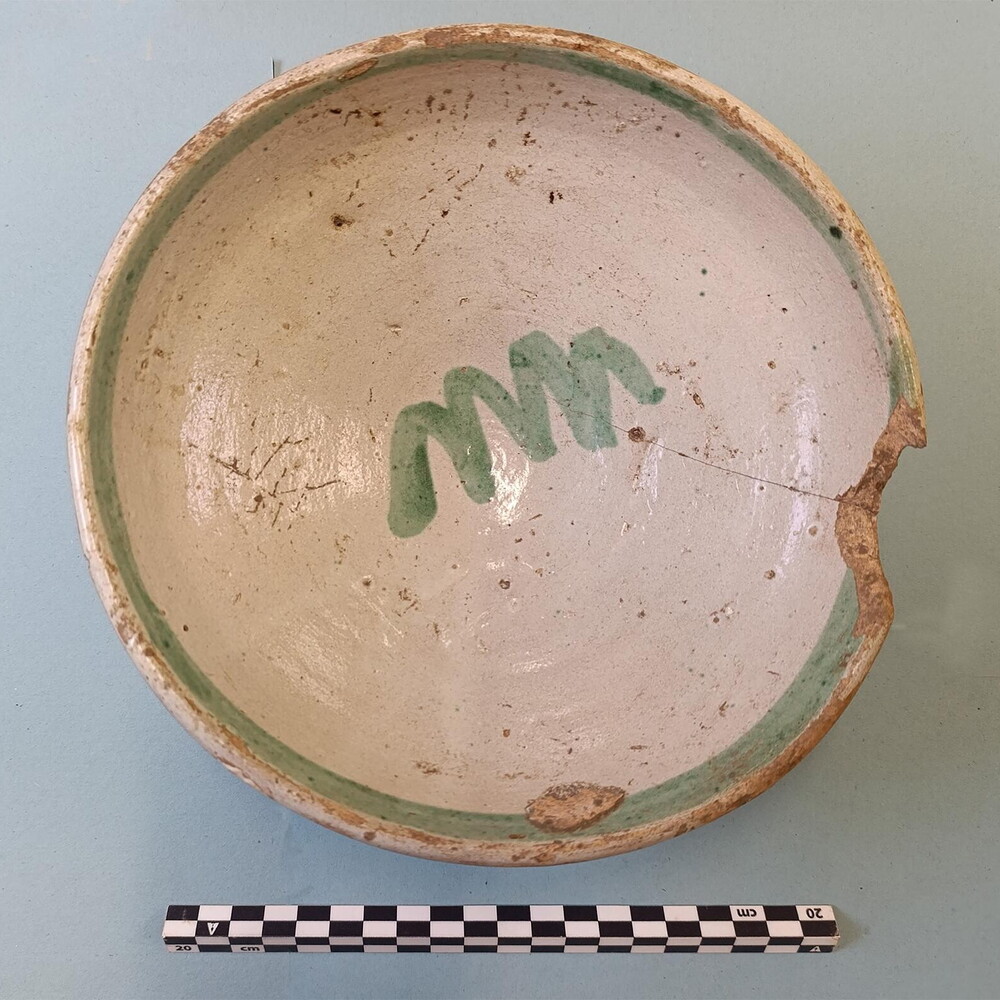
Pompeii and the Renaissance: an impossible bond? At first glance it would seem so. Nevertheless, traces of materials and ceramic finds from the 15th-16th century they were found in a construction site area of Pompeii, the Insula Meridionalis, evidence of the presence in the Renaissance period of the ancient city buried by the Vesuvian eruption. The discovery strongly attests to this bond and the continuity of a historical memory that has never been interrupted over time.
In the common imagination, the history of Pompeii is broken into two clear and apparently separate blocks: on the one hand the Roman city, crystallized over time by the eruption of 79 AD and on the other its ‘second life’, which began only in 1748 with the Bourbon excavations, after almost seventeen centuries of total oblivion. In the middle, a temporal space in which, however, the memory of the buried city had never completely fadedbut it had been looked after by a rural community that had actually never abandoned that territory.
Pompeii as a post-apocalyptic landscape
“The docu-drama ‘Pompeii out of time’ with Tom Hiddleston and the study of archaeologist Steven Tuck – explains the director of the Archaeological Park of Pompeii, Gabriel Zuchtriegel – show how the theme of survivors is finally becoming the subject of research and dissemination initiatives. After the eruption, Pompeii presented itself as a post-apocalyptic landscapeyet we find traces of people who returned here, and a relationship that extends over time: but they are fleeting traces of precarious lives, in the shadow of official history, and for this reason they have often risked being forgotten or erased”.
Life in Pompeii after the eruption of 79 AD
Today, the search for ‘Pompeii after Pompeii’ is strengthened by some recent material and artistic discoveries. Some finds that emerged during the excavation, restoration and safety activities of the so-called Insula Meridionalis, a neighborhood on the southern edge of the city, date back to between the 15th and 16th centuries. This thus attests to a presence in that era, approximately the same in which the ‘Deposition of Christ’ attributed to Andrea Mantegna and recently rediscovered in the Sanctuary of the Blessed Virgin of Pompeii was created. These are historically independent events, which however show how the perception and presence of this place over the centuries have been much more complex and interconnected than we were used to thinking.
Zuchtriegel: “Pompeii has always been part of the collective memory”
“Without taking anything away from researchers like Gioachino Alcubierre, who arrived from Spain and promoted the first archaeological excavations in Pompeii in 1748 – added Zuchtriegel – we must acknowledge that here there existed a local community that has continued to live in Pompeii since the day after the eruption and cherish its memory. This emerges not only from archaeological discoveries, but also from the toponym Civita, which attests to the memory of a city buried at a local level. Of course the farmers and shepherds who lived among the ancient ruins did not have the means to transmit their knowledge of the ancient in a scientific way, but this does not mean that it was non-existent knowledge. Pompeii is and has always been a true heritage community and if today it bears the name of the ancient city, it is not because Pompeii resurrected from nothing, but because it has always been part of the collective memory in this area”. It is possible to visit the Insula Meridionalis construction site together with the archaeologists and restorers of the construction site by reservation every day from Monday to Friday from 11 to 12 by calling the telephone number 327 2716666.