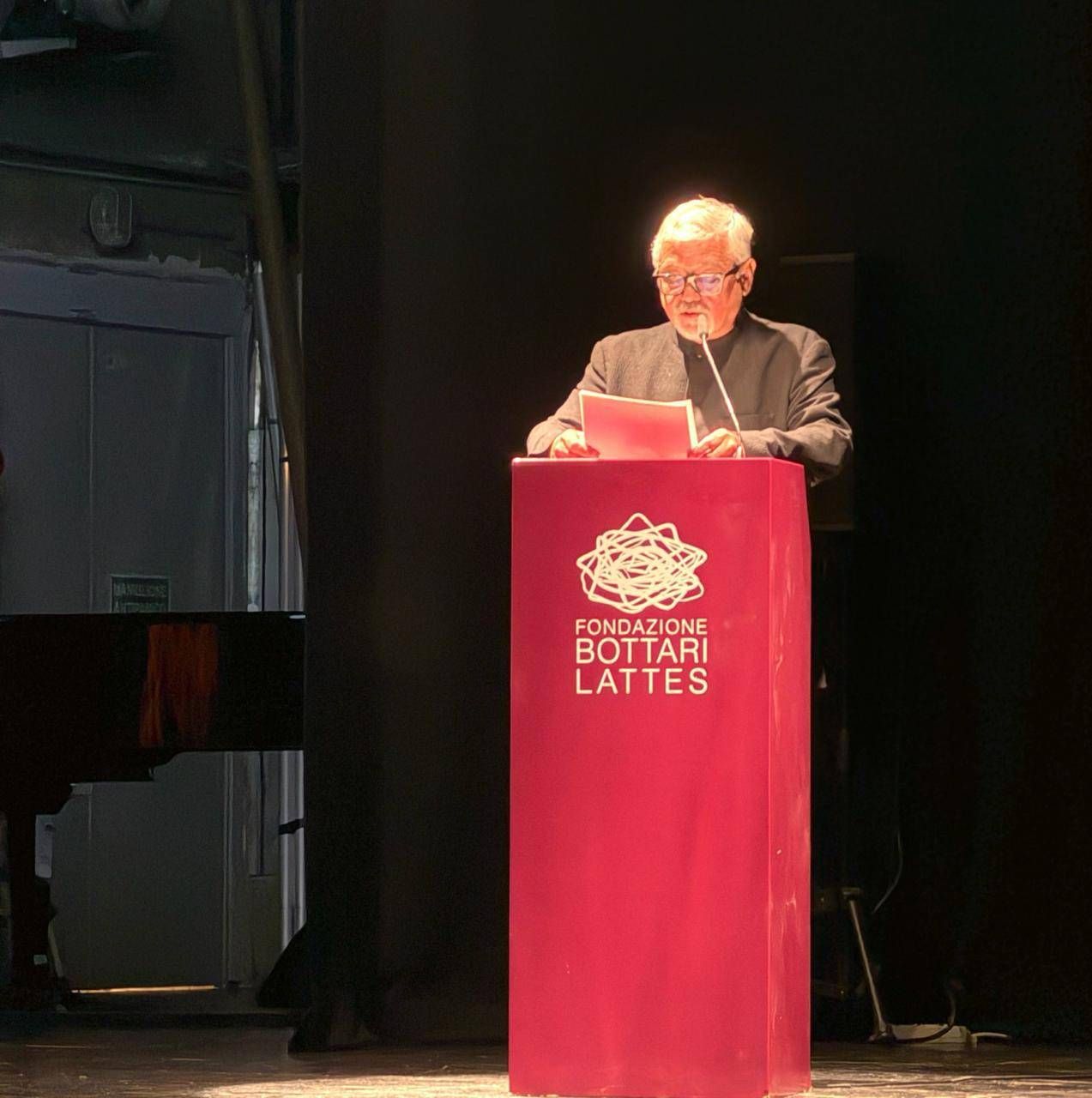
The story of a precious spice and a question that concerns the future of the entire planet. It is from here that Amitav Ghosh, an internationally renowned Indian writer, developed his reflection at the Teatro Sociale ‘Giorgio Busca’ in Alba (Cuneo), on the occasion of the 2026 Lattes Grinzane Award ceremony, during which he received the Lattes Grinzane Special Award. A lectio magistralis that intertwined history, literature, philosophy and environmental crisis, bringing the relationship between human beings and the Earth back to the centre. “Salvation comes from the connection with the Earth”, he admonished.
The starting point is nutmeg – already the subject of Ghosh’s book “The curse of nutmeg. Parables for a planet in crisis” (Neri Pozza, 2022) – once among the most precious products in the world, originating from the Banda islands, in present-day Indonesia. The desire to control trade pushed European powers to compete for the archipelago, until the Dutch conquest of 1621, which ended with the massacre of the local population, the deportation of the survivors and the transformation of the islands into plantations. “The Bandanese, once a proud and enterprising commercial community, ceased to exist as a people”, recalled Ghosh, reconstructing a story in which natural wealth turned into a condemnation for those who inhabited that territory. This is the “curse of resources” to which the writer dedicated a central part of his speech: the paradox whereby what a land offers can become the cause of the destruction of the communities that inhabit it. In the case of the Banda Islands, nutmeg ceased to be an inseparable element from the territory and local culture to become a commodity to be produced and marketed on a global scale.
“Colonialism, and then capitalism, are the processes that transformed the gifts of the land into resources totally divorced from their places of origin,” said Ghosh. A transformation that not only concerns the past, but still affects the way ecosystems, raw materials and human communities are conceived and exploited today. The reflection then broadened to the meaning of place in human culture. For centuries, the author observed, the value of many products has remained linked to their origin, the natural conditions in which they were generated and the knowledge of local communities. This is the case of Piedmontese wines, truffles (such as the white one from Alba), spices and other products that bring with them a history and territorial identity.
“A nutmeg was not a nutmeg if it did not come from the area of the Banda Islands, cultivated by the Bandanese,” explained Ghosh, drawing a parallel with wine produced in Piedmont. The connection with the land, in this perspective, is not an accessory detail, but an integral part of the value of a product and the culture that surrounds it. It is precisely this relationship that is threatened by globalization and the transformation of nature into a reserve of interchangeable goods. And the writer’s question also concerns the territory hosting the ceremony: «In a world in which everything – animals, plants and fungi – are eradicated, we must ask ourselves how long the ancient and irreplaceable bond between people, products and places will resist, even in Piedmont».
The theme of uprooting led Ghosh to the thoughts of the German philosopher Martin Heidegger, according to whom «Being man means… living». Living doesn’t just mean having a home, but maintaining a deep relationship with the land, recognizing yourself as part of an environment and a community. A relationship which, according to the reading proposed by the writer, risks dissolving in a society dominated by technology and the search for increasingly efficient functioning. Ghosh recalled in particular the words spoken by the German philosopher Martin Heidegger in 1966: «Everything works. This is precisely the disturbing aspect, that everything works and that functioning always pushes towards further functioning, and that technology increasingly tears and uproots man from the earth.” Progress, therefore, does not necessarily coincide with an improvement in the relationship between human beings and the world. Behind technological efficiency and material growth a deeper loss may hide: that of the ability to consciously inhabit the Earth.
Another central passage of the lectio concerned the way in which modern societies conceive nature. Ghosh recalled indigenous cultures, in which rivers, mountains and forests are not considered simple inert elements of the landscape, but presences endowed with meaning and vitality. A concept that European colonialism often fought and repressed, imposing a vision of the world in which nature was intended above all to provide resources to human beings. The writer questioned this separation between humanity and the environment, indicating in the ecological crisis also a cultural crisis: «It has been clear to me for some time that the planetary crisis is, essentially, a crisis of culture and perceptions». Hence the importance attributed to the movement for the rights of nature, which aims to recognize legal protection for rivers, forests, mountains and other ecosystems. For Ghosh, this is one of the signs of hope in an era of profound upheaval, because it opens up the possibility of redefining the place of the human being within the natural world.
The environmental issue is also intertwined with the food issue. Food, the author observed, represents one of the fundamental ways through which people enter into relationships with the environment and the places in which they live. Disruptions to food systems, combined with the loss of traditional knowledge, risk further compromising this link. It is no coincidence that the territory, traditions and relationships between human beings and other forms of life also occupy an important space in his most recent novels, “The Island of Rifles” and “The Phantom Eye”, published by Einaudi. In Ghosh’s narrative, literature thus becomes a tool for interrogating the contradictions of modernity and imagining different ways of coexisting with the planet.
The conclusion of the speech summarized the meaning of a path that leads from colonial history to the challenges of the present. Ghosh recalled the Latin phrase engraved under the large dome of the Basilica of Santa Maria della Salute in Venice: «Unde Origo Inde Salus», «From where the origin, from there salvation». Not a simple invitation to look back, but the proposal to recover an awareness that modernity seems to have progressively lost: human beings are not separated from nature, nor can they ignore the territories, communities and other living beings with which they share their existence. (by Paolo Martini)
ALPINISMO CERRO DE LOS MACHOS – AL BORDE DE LO INCONCEBIBLE
Encuentro Ascobi: El compromiso como estrategia para vincular a las personas – ASCOBI – BIEBA
Argentina venció a Chile y se metió en el podio de la Copa América – Notas de Actualidad
Joker's Jewels en el celular: Android e iOS
Joker's Jewels: estrategias y volatilidad real
Ciencia Canaria – Reconocimiento internacional para las momias de Canarias
Actividades formativas de la Casa de la Miel 2016 | Casa de la miel
Encuentro Ascobi: CONSTRUYENDO EMPLEO ETORKIZUNA EPSV. COMIENZO DEL PLAZO PARA REALIZAR LAS CONTRIBUCIONES EL 18 DE NOVIEMBRE – ASCOBI – BIEBA
Pages
Casino Argentina App: bono al instalar desde la fuente
4270 Olinda House By Bent Architecture
Fecha 18 :: Arsenal 0 – Racing Club 0
SUBIDA PICO PEÑABON – AL BORDE DE LO INCONCEBIBLE
https://fpabramo.org.br/wp-content/pgs/c_mo_descargar_casino_application_en_argentina__gu_a_android_e_ios.html
Catálogo de tragamonedas en Casino Application AR
https://ville-barentin.fr/wp-content/pgs/ce_site_web_propose_une_exp_rience_de_divertissement_en_ligne_tr_s_fluide.html
https://controverses.minesparis.psl.eu/wp-content/pgs/casino_en_ligne___comment_une_navigation_fluide_change_tout_.html
https://www.ch-dole.fr/wp-content/pgs/navigation_fluide_sur_un_casino_en_ligne__les_cl_s_de_l_accessibilit_.html
https://eguidemagazine.com/wp-content/pages/jeux_en_ligne___comment_reconna_tre_les_meilleures_options.html
https://www.maliterie.com/modules/pgs/casino_en_ligne_en_france_comment_valuer_une_plateforme_de_jeu.html
Avis Spin Aura Casino Comment Bien Les Lire Avant De Jouer.Html
Aphtes Signification Emotionnelle
Pgs
https://www.dombes-cotiere-tourisme.fr/wp-includes/pgs/guide_du_jeu_fluide_analyse_des_performances_d_un_casino_en_ligne.html
Acc S Spin Aura Fr Org Guide Pour Une Navigation Fluide.Html
https://ultimainformatica.com/docs/pgs/tendances_du_divertissement_num_rique_trouver_les_meilleurs_jeux.html
Exp Rience De Jeu En Ligne La Fluidit Au Service Du Joueur.Html
https://blaulicht-giessen.de/pgs/?navigation_fluide_igaming_lergonomie_au_service_du_joueur.html
Parcours au fil du temps : Sylviane et Nadia |
Spin Aura: navigation, jeux et fonctionnalités du site