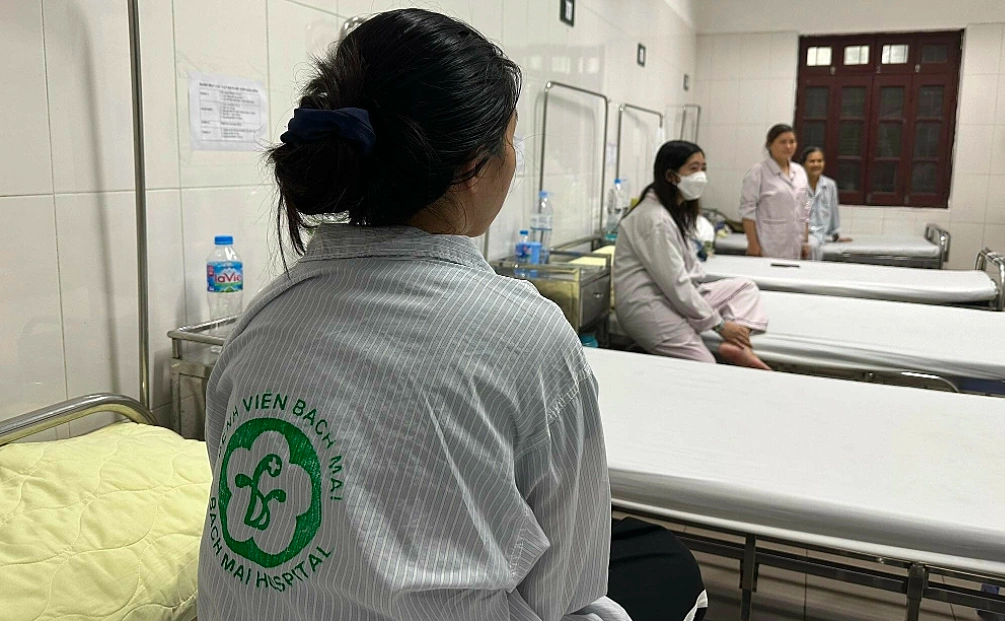
A 35-year-old woman with schizophrenia, suffering from hallucinations for 5 years, has just recovered thanks to a combination of medication and transcranial magnetic stimulation techniques by Bach Mai Hospital doctors.
The patient has now been discharged from the hospital, maintained outpatient monitoring and returned to work after treatment at the Institute of Mental Health, Bach Mai Hospital. Before that, she was hospitalized in a state of physical and mental exhaustion. The doctor diagnosed the patient with paranoid schizophrenia with severe hallucination syndrome, notably treatment-resistant hallucinations.
Family members recounted that this paranoid state had lasted for the past 5 years. Initially, the patient hears vague whispers. Later, the voices appeared more densely, constantly praising, criticizing, threatening and inciting action. Thinking that a relative was suffering from spiritual factors, the family took him to the ceremony, but the symptoms became increasingly severe, forcing the patient to quit work. She used to take antipsychotic medication at the local health facility, but when she saw improvement, she immediately stopped taking medication, leading to multiple relapses at a more serious level.
A patient treated at the Institute of Mental Health. Image: But Nga
Doctor Nguyen Thi Hoa, Deputy Head of the Clinical Psychology Department, explained that about 60–80% of people with schizophrenia experience the phenomenon of hearing voices in their heads. Many people take at least two medications and still cannot control their symptoms. In order to completely resolve this condition, the doctor’s team prescribed repetitive transcranial magnetic stimulation (TMS) combined with medication adjustment. This non-invasive technique uses high-intensity magnetic fields to impact the area of the brain that processes language and sound, helping to correct abnormal activities.
Thanks to the individualized regimen, the patient gradually stops hallucinations, stabilizes his emotions, and significantly improves the quality of sleep and meals. Associate Professor, Dr. Nguyen Van Tuan, Director of the Institute of Mental Health, assessed that TMS technique provides very good support for drug-resistant cases. Many international studies prove that the combination of TMS and medication helps control symptoms more effectively than taking medication alone. However, Mr. Tuan warns that this method absolutely does not replace medication. Only a specialist has the right to prescribe, and experts must carefully assess the risk if the patient has a history of epilepsy or wears a metal device in the brain.
https://millerrecords.us/arrest-records
https://millerrecords.us/court-records
https://millerrecords.us/criminal-records
https://millerrecords.us/divorce-records
https://millerrecords.us/inmate-search
https://millerrecords.us/property-records
https://millerrecords.us/warrant-search
https://mifflinrecords.us/
https://mifflinrecords.us/arrest-records
https://mifflinrecords.us/court-records
https://mifflinrecords.us/criminal-records
https://mifflinrecords.us/divorce-records
https://mifflinrecords.us/inmate-search
https://mifflinrecords.us/property-records
https://mifflinrecords.us/warrant-search
https://nezpercerecords.us/
https://nezpercerecords.us/arrest-records
https://nezpercerecords.us/court-records
https://nezpercerecords.us/criminal-records
https://nezpercerecords.us/divorce-records
https://nezpercerecords.us/inmate-search
https://nezpercerecords.us/property-records
https://nezpercerecords.us/warrant-search