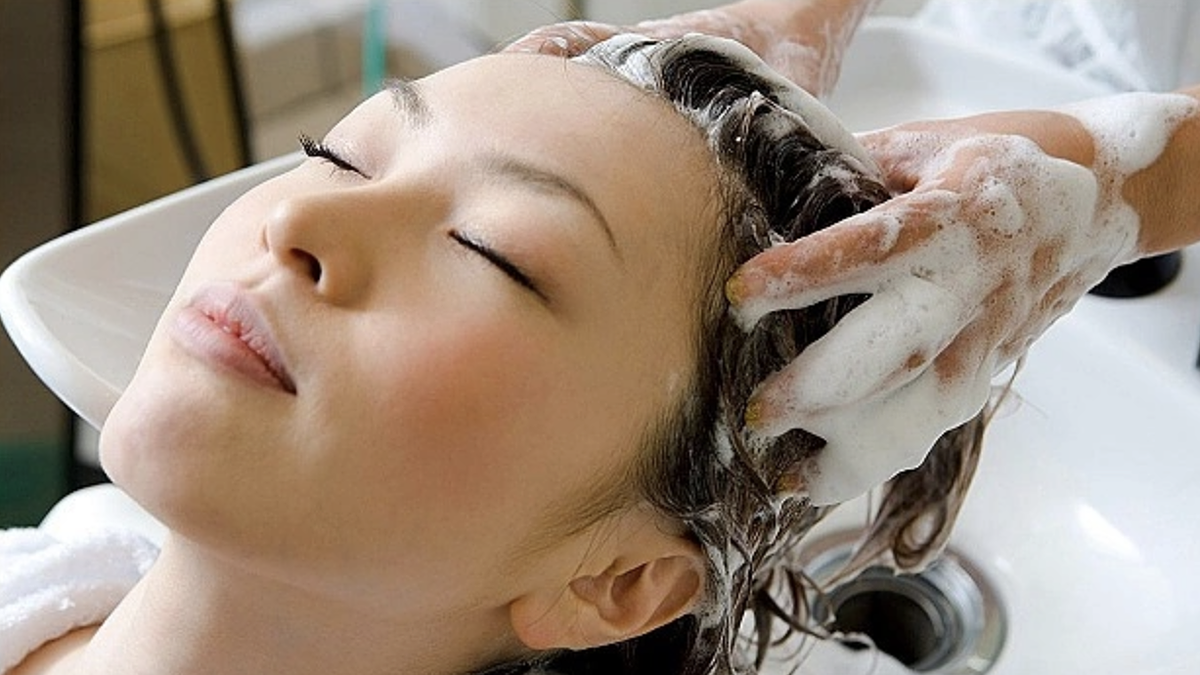
Mistakes when washing your hair such as leaving your hair wet, using water that is too hot/cold or scratching vigorously… can cause hair loss, headaches and facial paralysis.
Washing your hair is something we do every day, but it contains many hidden risks. Implementing the wrong method not only seriously affects scalp health, causing dandruff, allergies, excess oil secretion, and hair loss, but more dangerously, it can also lead to facial paralysis.
Here are 8 mistakes when washing your hair to avoid:
Do not blow dry your hair after washing
Recently, channel Tan Dao Urban Area (China) reported on a clinical case shared by Dr. Vuong Que Quyen, Chief Doctor of Acupuncture Department at the No. 1 Practice Hospital of Henan University of Traditional Medicine. Accordingly, a 20-year-old girl suddenly suffered facial paralysis on the way to work. After arriving at the office and sitting in front of the air conditioner, the next day she had symptoms of mouth distortion and eye deviation – commonly known as “facial paralysis”.
Doctor Vuong pointed out that the girl has a habit of washing her hair in the morning before going to work. Sometimes, without drying her hair in time, she rides a motorbike directly to the company. Not only did she catch a cold on the way, but when she got to the office, she also sat exposed to the cold air from the air conditioner pointing directly at her, leading to a distorted mouth and eyes the next day.
In fact, there have been many similar cases that have happened before. Most of the victims are female office workers who go out when their hair is not completely dry, or little girls who get sick after cycling with wet hair.
Dr. Luu Huc Thang, a Traditional Medicine Physician registered in Hong Kong, once wrote an article pointing out that one of the causes of facial paralysis is letting down wet hair after washing or being exposed to cold wind blowing directly. This causes cold wind to penetrate directly into the facial meridian system. The coldness causes spasms and poor blood circulation, thereby causing facial paralysis.
From the perspective of Traditional Medicine, the treatment method is usually acupuncture combined with Oriental medicine to regulate the body.
The ideal shampoo water temperature is about 37-38 degrees Celsius, equivalent to human body temperature. Image: PP
Let hair dry naturally
Many people believe that letting their hair dry naturally after washing is best for their hair. However, the reality is quite the opposite, letting your hair dry naturally is what causes the most damage to your hair.
Not drying your hair immediately will create favorable conditions for fungi and bacteria to continuously grow mold on the scalp. This leads to itching, dandruff, scalp infections, and even an unpleasant odor.
Hair hasn’t dried yet so go to bed
The scalp contains many blood vessels and nerves. When hair is wet, the process of water evaporation will take away heat from the scalp, causing blood vessels and muscles in the head area to spasm, reducing blood circulation and easily leading to headaches or migraines.
Therefore, after each wash, the scalp and hair roots need to be 100% dried to avoid headache problems.
Wash your hair with hot water
The surface of the scalp has a layer of natural sebum that helps protect the skin. If you use water that is too hot (over 40 degrees Celsius), this natural protective layer will be washed away, causing the scalp to feel tight and itchy; Too dry scalp will cause dandruff.
When the scalp is too dry, the sebaceous glands will have to secrete more oil to compensate, leading to a more severely oily scalp. At the same time, hot water also opens the cuticles (hair scales) in the outer layer of the hair. The higher the water temperature, the wider the cuticles open, causing the natural moisture and protein inside the hair to be seriously lost, causing the hair to become frizzy and easily tangled.
Wash your hair with cold water
Cold water cannot effectively dissolve sebum and dirt on the scalp. Washing your hair with cold water for a long time will lead to the accumulation and clogging of excess oil, making the scalp susceptible to infection and hair loss.
Because cold water causes blood vessels in the head to suddenly constrict, it can also easily cause headaches. The ideal shampoo water temperature is about 37-38 degrees Celsius, equivalent to human body temperature.
Pour shampoo directly onto the scalp
Shampoo contains many chemical ingredients, including high concentrations of surfactants. If it has not been diluted with water and created into foam, direct contact with the scalp will cause strong irritation, making the scalp susceptible to sensitivity, redness and swelling.
If the shampoo is not rinsed completely, the chemical ingredients remaining on the scalp for a long time can also cause hair loss. The correct way to do it is to put shampoo in your hands, add water to create foam first, then apply evenly to your hair and scalp.
Use your fingernails to scratch your scalp vigorously
Many people like to scratch their scalp with their fingernails when shampooing because they think that doing so is clean and comfortable. However, the scalp is much more fragile than you think. Scratching the scalp can lead to bacterial infections, folliculitis, and other problems.
The correct way is to use the fleshy part of the finger (finger tip) to gently massage the scalp.
Let the conditioner come into contact with the scalp
Conditioner and hair treatment cream (hair mask) both contain highly moisturizing ingredients. If they come into direct contact with the scalp, there is a high risk that the scalp will become oily, the hair will fall flat, and even clog pores leading to hair breakage and loss.
The correct way to do it is to wet your hair, apply conditioner focusing on the ends of your hair and make sure to rinse thoroughly with water.