Ms. Vy, 42 years old, recently got married and had reduced ovarian reserve, so she had to collect eggs in many cycles for IVF to give birth.
Dr. Le Duc Thang, Reproductive Support Center, Tam Anh General Hospital Hanoi (IVF Tam Anh), noted that Ms. Vy’s uterus was normal, her two fallopian tubes were clear, but her ovarian reserve index (AMH) was still 0.52 ng/mL – meaning her eggs were gradually depleted. The husband has normal reproductive health.
Doctors advise couples to use in vitro fertilization (IVF) early to avoid the risk of having to ask for donated eggs to have children. Ms. Vy was prescribed a regimen of cumulative oocyte collection for multiple cycles to increase the chance of creating embryos.
An embryologist performs intracytoplasmic sperm injection (ICSI). Image: Tam Anh General Hospital
In the first cycle, Ms. Vy used ovarian stimulation medication at the appropriate dose for 12 days but did not receive any mature oocytes qualified for fertilization. Dr. Thang said this condition may occur in elderly patients or reduced ovarian reserve. As age increases, oocyte quality declines due to the effects of cellular aging, mitochondrial dysfunction, genetic damage and errors in chromosome division. Therefore, even though the follicle develops on ultrasound, the ovum inside may still not mature and degenerate.
In the next two cycles, Dr. Thang continued to adjust the medication dosage for Ms. Vy to both increase the ability to recruit eggs and avoid excessive intervention when the ovaries responded poorly. Ms. Vy could only collect 3 oocytes, the doctor decided to stop ovarian stimulation because the effectiveness was not commensurate with the psychological pressure, time and cost of treatment.
With 3 oocytes, the embryologist performed intracytoplasmic sperm injection (ICSI) and cultured them in a time-lapse cabinet system, helping to maintain a stable environment and continuously monitor embryo development. As a result, Vy and her husband had a good quality day 5 embryo.
When the endometrium reached the appropriate shape and thickness, Dr. Thang transferred a single embryo into Ms. Vy’s uterus. She had a successful pregnancy and gave birth by cesarean section to a son weighing 2.8 kg.
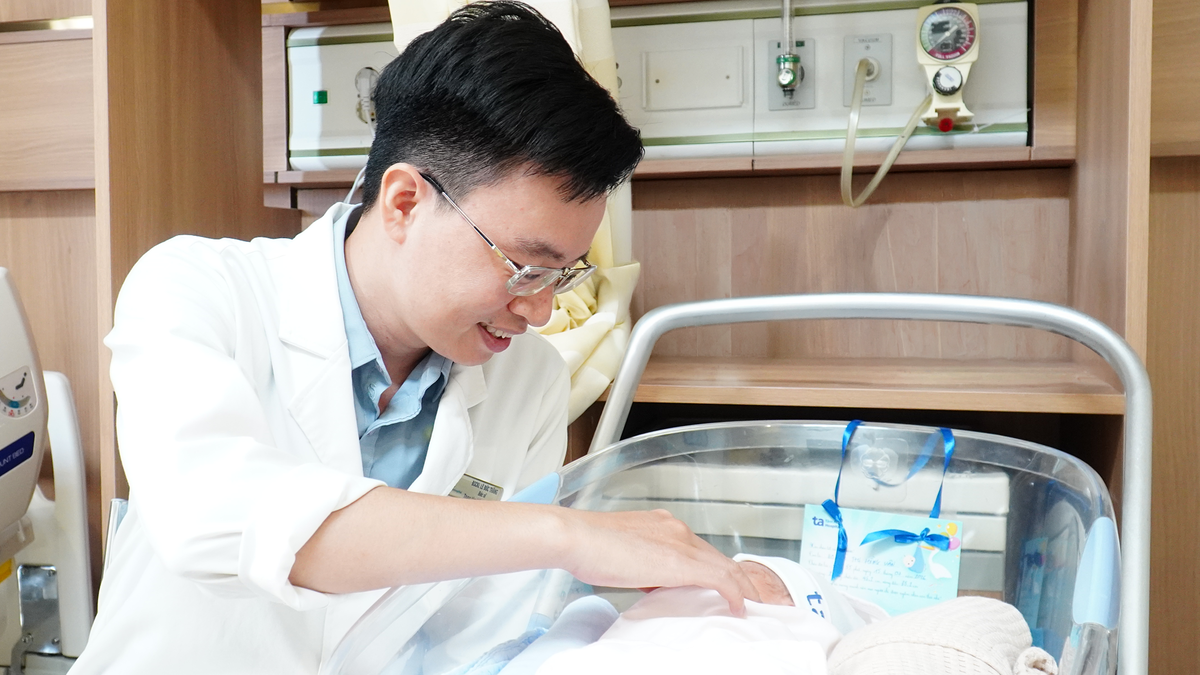
Doctor Thang visits Ms. Vy’s newborn baby. Image: Tam Anh General Hospital
According to data from the General Statistics Office, the average first marriage age of Vietnamese people tends to increase rapidly. Meanwhile, Dr. Thang said that women are born with a finite number of eggs and cannot create more throughout their lives. Egg quality is also proportional to age. Eggs in older women have a high risk of abnormal chromosomal division, leading to a reduced rate of healthy embryo formation, reduced implantation ability and increased risk of miscarriage.
Therefore, women who get married late, especially after the age of 35, should have a reproductive health check-up early. If you have had sex regularly for 6 months and have not yet gotten pregnant, you should go see a doctor instead of waiting a full year like younger groups. Oocyte collection method is the optimal solution in in vitro fertilization for older women with low AMH index. People who are not ready to get married or plan to have children later should check their ovarian reserve status and consider appropriate fertility preservation options.