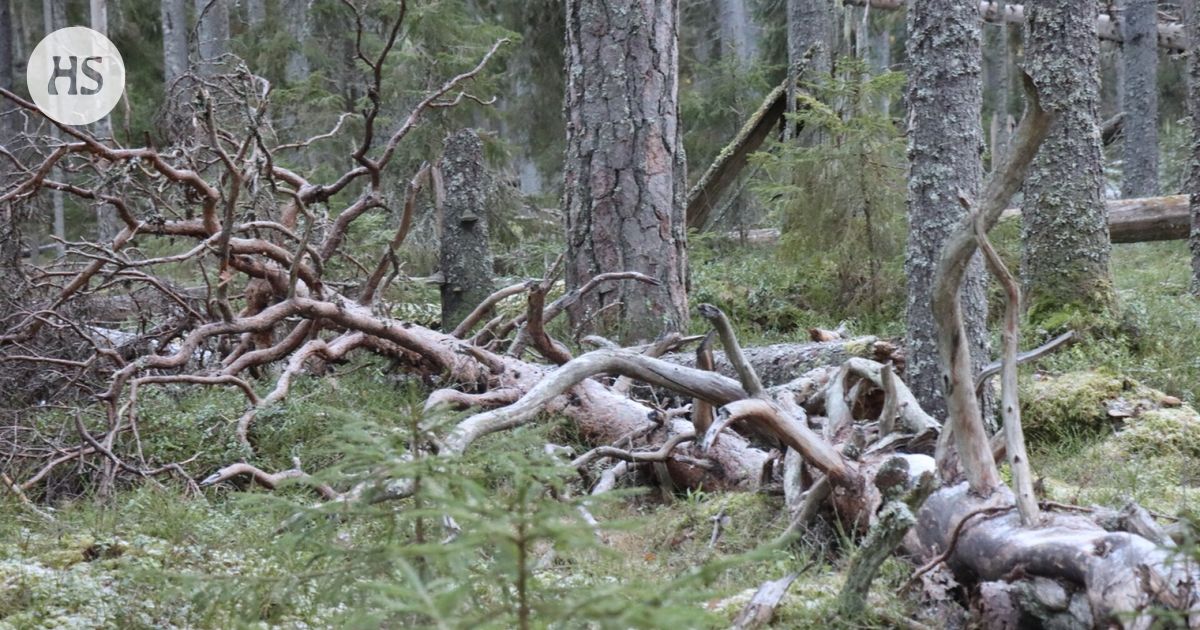
Research|The difference between natural and commercial forests was many times bigger than in previous calculations.
According to a Swedish study, a natural forest stores more than 70 percent more carbon than a managed commercial forest.
The study was published in the journal Science on Thursday.
The difference to commercial forests was 2.7–8 times larger than previously estimated.
Scientists say that protecting northern forests may be a more effective way to curb climate change than previously thought.
North The natural forests of the coniferous forest zone may be a more important factor in stopping climate change than has been realized, according to a study published in the journal Science on Thursday research Swedish forests.
According to the study, a natural forest stores more than 70 percent more carbon than a managed commercial forest.
The northern coniferous forests are an essential carbon sink in the world, but also a source of raw materials and energy. Even old and natural forests are cleared and renewed into commercial forests in both Sweden and Finland.
Logging and the impact of intensive forest management on the size of the carbon sink and storage is debated. Clear-cutting, thinning, fertilizing, draining and plowing affect the ability of the forest and soil to bind and store carbon in different ways.
Fast growth binds a lot of carbon, but it is released during logging and tillage.
Comparisons have been made difficult by the fact that there has been a lack of information on the carbon sequestration of natural forests. The research team obtained it by combining data from Sweden’s national forest inventory, forest land inventory and targeted field measurements.
The carbon stock was measured not only from trees but also from dead wood, forest soil and products made from wood.
Using several different methods, the group estimates how large the carbon stock of Sweden’s natural forests is and how it differs from managed commercial forests.
The group defined a forest with little or no human influence as natural.
Result was that throughout Sweden, natural forests store 72 percent more carbon than managed commercial forests. The biggest carbon store was not the trees in the forest but the forest soil.
The difference to commercial forests arose to a large extent from the fact that the land stores much more carbon in natural forests than in commercial forests.
On average, natural forests store 9.9 kilograms more carbon per square meter than managed commercial forests. The difference was 2.7–8 times larger than previously estimated.
Untouchables cutting down old forests and turning them into intensively managed economic forests shrinks the carbon stock much more than has been calculated in previous studies, the group writes.
“Our results suggest that protecting Europe’s northern forests may be a more effective strategy for mitigating climate change than previously thought.”
Update on 19 March 2026 at 20:05: Products made of wood were also included in the carbon storage.
https://slides.com/d/cIkO3eY/speaker/dmXdy2Q
https://pastelink.net/clolytnx
https://www.haikudeck.com/bigboxratio-uncategorized-presentation-140a137fe0
https://openlibrary.org/people/sasaidoloko/lists/OL327472L/bigboxratio.com
https://exchange.prx.org/playlists/438565
https://500px.com/photo/6439357/casino-by-chris-yates
https://www.ganjingworld.com/s/NVwEB3ag4A
https://www.rctech.net/forum/groups/chatting-d6652-games.html#gmessage22756
https://padlet.com/futureenglish/famous-people-dating-profiles-9dg81wyc8582qrqz/wish/j40PQDYKA13JZvXB
https://www.allkpop.com/article/2021/09/victons-hanse-reveals-striking-concept-photos-for-blaze-digital-album/1951762
https://www.aabevirginia.org/group/mysite-200-group/discussion/2a6ba960-23a5-4f9f-b3cf-9b439a491af5
https://signup.com/client/invitation2/secure/1416469900112/false?popup=true#/invitation
https://www.brownbook.net/business/54907746/dk88official
https://www.diigo.com/item/note/b3e05/m9q2?k=b8c71bf8a3fdbe4a42a31b04265123ca
https://www.onesweetmess.com/2017/04/21/weekly-meal-plan-april-24th-2017/#comment-843005
https://odysee.com/@nesteroid:7/live-less-ordinary:9
https://www.myminifactory.com/users/live-less-ordinary
https://gamejolt.com/p/hey-so-i-was-casually-watching-some-streams-when-a-chat-link-popp-3rseibcw
https://www.isidewith.com/discuss/5559344716
https://www.plurk.com/p/3ifihf10pt
https://medium.com/@parhomeliankill/scuderiafans-cc749150e9a7