Artemis II|The four-person crew makes the first flyby of the Moon since 1972. The flight breaks several records.
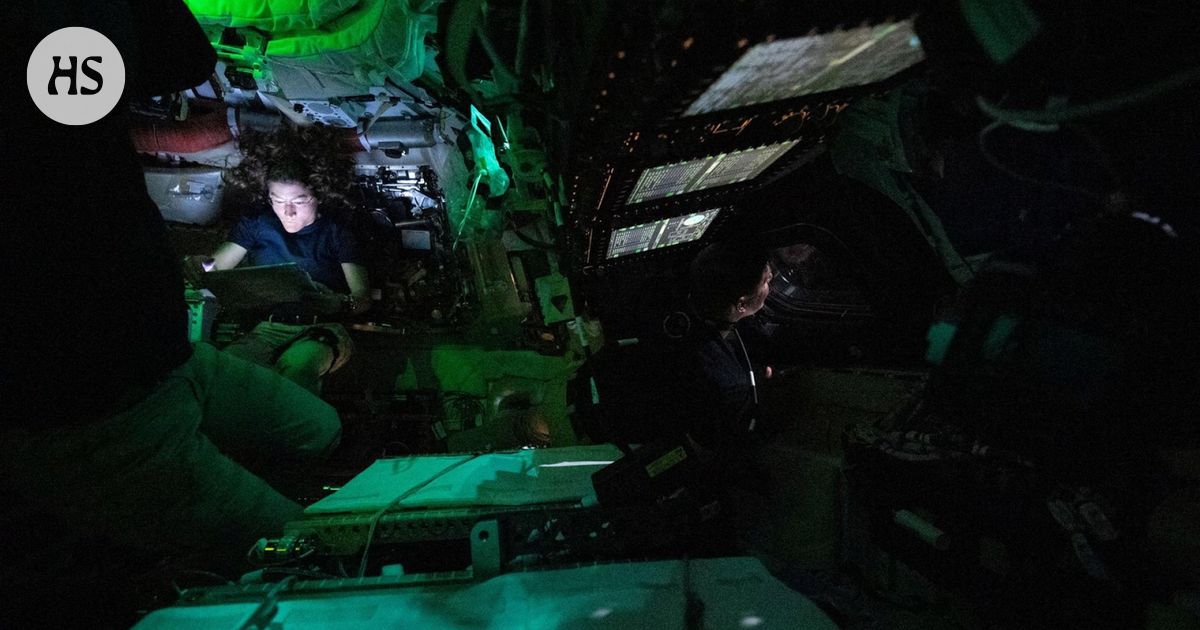
Astronaut Christina Koch on the Orion spacecraft last Friday.
On Monday, the four-person crew of the Artemis 2 probe will make the first flyby of the Moon since 1972.
Several records are broken during the flight: the astronauts travel more than 400,000 kilometers from Earth, which is further than any human before.
For the first time, a black person, a woman and a non-American will be on the crew of a flight around the moon.
The US space agency Nasa is testing the functionality of the Orion spacecraft in flight before the planned manned landing on the moon in 2028.
Artemis II -hearing astronauts have reached the area of influence of the Moon’s gravity, says the US space agency Nasa.
The moon’s gravity became the force controlling the trajectory of the Orion ship at 7:52 Finnish time. At that time, Orion was about 63,000 kilometers from the Moon and more than 373,000 kilometers from Earth.
Artemis II was launched on Thursday from the Kennedy Space Center in Florida. The flight lasts ten days. Astronauts won’t land on the moon, but they will travel farther from Earth than any human before.
Monday will be an important day, when the crew of the probe will fly to the dark side of the Moon for the first time in more than half a century. The last flyby of the moon was done in 1972.
Nasa will show a live broadcast of the most important stage of the hearing from Monday evening. The broadcast starts on Monday evening at 20:00 Finnish time. HS shows the broadcast live in this story.
During the mission, the crew is expected to break the record for the furthest human distance from Earth. The previous record was set by the Apollo 13 flight in 1970. Orion is scheduled to reach a distance of more than 400,000 kilometers from Earth.
Broadcast schedule (updated at 1:13 p.m.):
-
at 20:00: NASA’s live broadcast begins
-
at 20:56: The crew passes humanity’s distance record from Earth
-
at 21.10: Crew comments on the record (audio only)
-
at 21.15: Preparing the ship for a flyby
-
at 21:45: Moon flyby begins
-
at 23:35: Inside view of the crew during the flyby
-
at 1:47 a.m. (on Tuesday): The connection is lost for about 40 minutes when the ship moves behind the Moon
-
at 2:02 am: Closest pass of the Moon’s surface
-
at 2:05 a.m.: The maximum distance from Earth is reached
-
at 2:27 a.m.: The connection is restored when the ship comes from behind the Moon
-
at 3:35 a.m.: The ship moves into the solar eclipse
-
at 4:20 a.m.: The flyby ends
-
at 4:32 am: The solar eclipse ends
-
at 4:45 a.m.: NASA’s live broadcast ends
Artemis II -hearing breaks several records on its way, also for the crew.
There are four astronauts on board: the commander Reid Wiseman, Victor Glover, Christina Koch and Jeremy Hansen. Glover is the first black person to fly around the moon. Koch, on the other hand, is the first woman and Hansen the first non-American to reach this milestone.
On Sunday, the crew was the first to see the entire Orientale collision basin with human eyes.
“It is very distinctive. No human has ever seen this crater before today. We were privileged to see it,” Koch said at an event hosted by the Canadian Space Agency, according to news agency AFP.
At the end of the flyby, the astronauts will see a solar eclipse when the Sun is behind the Moon. At that time, only the Sun’s outer gas ring, or corona, is visible.
Artemis II -the most important tasks of the flight are to test the functionality of the Orion ship and its safety systems in space.
The crew has been preparing for the flyby for years, and scientific observations are also made during the flight. According to Nasa, the researchers have in advance modeled exactly which areas of the Moon the sunlight will illuminate during the flyby, so that the observations could be used as well as possible.
Information and experience play an important role when thinking about the next flights of the Artemis program. The next flight will take place next year. If all goes well, 2028 will see the first manned lunar landing since Apollo 17 in 1972.
Correction 6.4. 1:28 p.m.: In the article earlier, it was wrong to talk about the outermost atmosphere of the Sun, when it is a gas atmosphere.
Correction 6.4. 1:44 p.m.: When Orion passed under the Moon’s gravity, the ship was more than 373,000 kilometers away from Earth. Earlier in the story, it was wrongly claimed that the distance to Earth was 232,000 kilometers. That was the distance in miles.
https://onlinevetjobs.com/author/breakroast92/
https://www.ozodagon.com/index.php?subaction=userinfo&user=lanpest42
https://pikidi.com/seller/profile/pepperdancer13
https://lostdogs.co.za/user/profile/canvasgoose04
http://jobboard.piasd.org/author/summergoose37/
https://aryba.kg/user/schooljail65/
http://mindwellnessforum.com/user/foxelbow20
https://sonnik.nalench.com/user/ratebeetle05/
https://may22.ru/user/framecymbal48/
http://techou.jp/index.php?riceroast76
https://p.mobile9.com/supplyself11/
https://www.hulkshare.com/seatkayak23/
https://illinoisbay.com/index.php?page=user&action=pub_profile&id=10687
https://apunto.it/user/profile/791294
https://intensedebate.com/people/framecoke04
http://amur.1gb.ua/user/breakseal98/
https://citytoads.com/user/profile/89703
http://volleypedia-org.50and3.com/index.php?qa=user&qa_1=rategoose79
https://www.fanficoverflow.com/profile/view/81477
https://www.chordie.com/forum/profile.php?id=2494370
http://www.neighborhoodlink.com/people/MariogdFrench
http://www.drugoffice.gov.hk/gb/unigb/gigianolaw.com/
https://moeamine.com/author/eggchina91/
https://www.rvparking.com/user/506160