Advantages:
Excellent sound
Good noise filtering
Good quality phone calls
Design improvements
Disadvantages:
The case grew and became more prominent
The ear adapters are not suitable for everyone
A successful application, but busy and requires an improvement in the interface
About every two years, Sony launches new flagship headphones in the TWS category – wireless headphones. Every time Sony changes the design or at least significantly improves it, this time too Sony did it, along with other improvements in the field of audio and noise filtering, so that the WF-1000XM6 offer an upgraded experience.
Design and control: Sony – WF-1000XM6 new look
Sony makes sure to change the design of the headphones every time it launches a new model, while the changes between the WF-1000XM3 and WF-1000XM4 were the most significant, in the last three generations these are less bombastic changes but ones that help a lot with comfort. It is still a button structure, like the previous models and not a stem design like Samsung’s AirPods and Galaxy Buds.
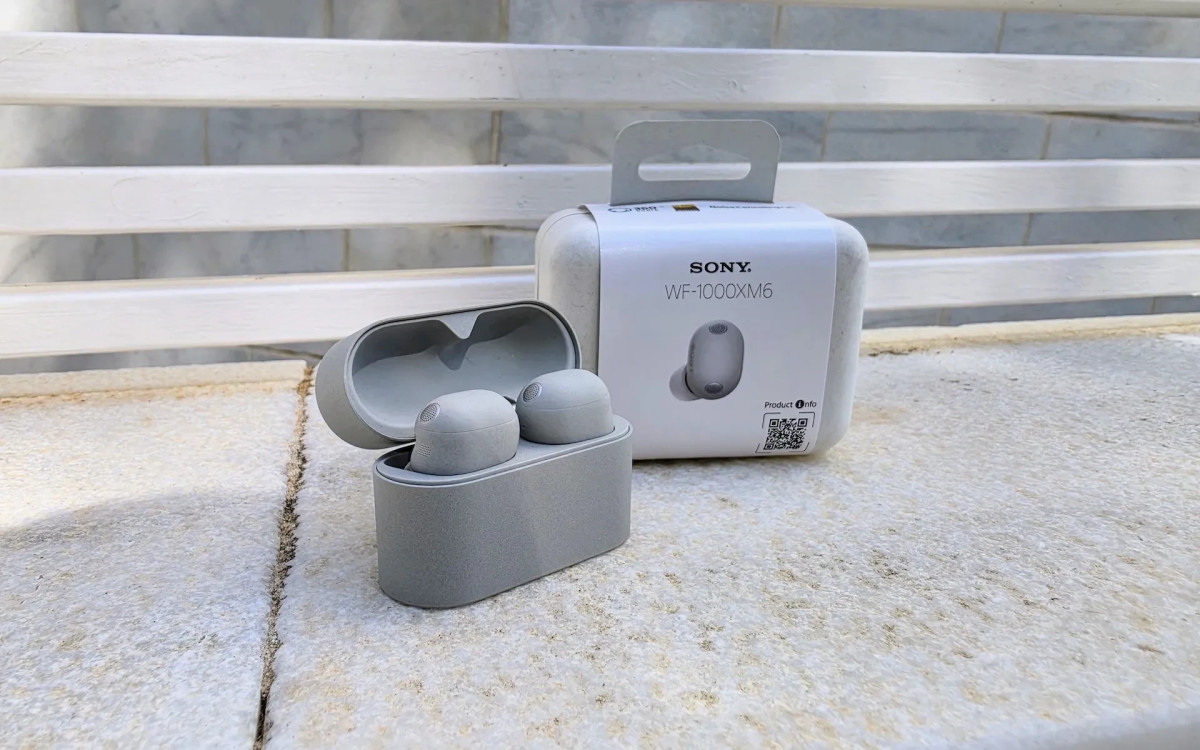
The XM6 have been stretched a little more horizontally and they no longer come with a shiny and slippery finish, but with a rough matte shade, which is less likely to slip out of your hands. Sony says that the new body is about 11% thinner than the previous model and has a new ventilation structure that reduces internal noises such as footsteps and chewing. This was indeed felt in my experience and the feel on the XM6 is improved, but I must also note that the test was conducted with the original foam adapters of the XM6 versus the non-original silicone adapters on the XM5 (for the full review).
The headphones themselves come with IPX4 water protection that provides resistance against sweat and splashing water, along with protection against dust. It is not a very high standard, but it will probably be enough for you in sports training or walking in the rain.
If the headphones have become even more comfortable, the case itself has grown and become a little thicker and bigger. It is not a critical fattening, but it destroyed the case structure that I liked so much from the previous generation, which was extremely compact.
The headphones are controlled by light touches on their touchpad. There are all kinds of profiles that allow adjustment of the buttons. For example, I chose that the right earphone would allow a single touch – play/pause, a double touch – go forward a song, a triple touch – go back a song and a long touch should change the audio source, but for me it activated Google Jimny and a square touch – increase the volume.
On the left earpiece, a single touch switches between active noise filtering (ANC) and ambient/transparency mode, the double and triple touch do nothing and a long touch activates the Quick Attention mode that allows you to be aware of your surroundings and talk to people as long as your finger touches the earpiece. A square touch lowers the volume.
In general, I think this is a relatively convenient way to operate the headphones, except for the square touch option to increase/decrease the volume.
Sony has an app called Sound Connect that includes lots and lots of features for operating the XM6. For example, you can choose a Background Music mode that simulates listening to music in a cafe, which does not place the music in the foreground and allows you to concentrate better at work (at least in my experience, it helped me keep my concentration on the task and not on the songs). There is also a 10-channel equalizer, including defined profiles, automatic adjustment of the noise filtering according to the place and environmental conditions in which they are (an option I liked less and disabled it, because it canceled the noise filtering in the places I actually preferred it to operate) and many other capabilities. While this is an app that seems to me to probably offer everything you need, it’s busy and sometimes it’s hard to find what you’re looking for.
Sound and calls: Sony – WF-1000XM6 is a delight for audiophiles
The XM6 come with Bluetooth 5.3, 8.4 mm drivers, multipoint support for connecting two devices at the same time and support for the basic SBC and AAC codecs alongside Sony’s LDAC which provides high audio quality and also Sony’s DSEE Extreme technology, which is used to reproduce compressed music files.
The processor present here is Sony’s V2 found both in the previous generation and in the company’s over-ear headphones – WH-1000XM6. The processor includes an adaptive noise cancellation optimizer, this is a technology that analyzes external noises and wearing conditions in real time, and makes personal adjustments to the ear structure of each user (more on noise filtering later).
In terms of sound, the headphones work with two processors at the same time, which according to Sony help produce a clearer and more accurate sound. The V2 processor is able to support 32-bit processing, compared to 24-bit in the previous generation, which provides higher resolution and richer sound, but you will have to find 32-bit music.
Personally, I’m a fan of Sony’s sound signature, it knows how to produce a rich and warm sound that I love. It is no different with the XM6, when they provide a natural, bright sound with depth and well-perceived bass, but not such that they interfere with the other sounds. The headphones also managed to provide a good sound stage, which provided a good sense of the space and the placement of the instruments in the songs.
There is an improvement in the XM6 compared to the XM5, mainly in a wider, more detailed sound and a deeper bass, but not something you feel if you don’t put them next to each other.
For phone calls, the XM6 features two microphones and a bone conduction sensor on each side, using AI beamforming noise reduction algorithm for more accurate voice capture. This is a technology in which the AI focuses on the speaker’s voice, using microphones, so that the headphones can recognize and separate the user’s voice from the background noise.
How does it actually sound? At home they heard me perfectly and even when I was on the street they heard me perfectly fine and clear, but my voice was a bit muffled, probably in order to overcome the background noise and this is a result of the processing.
Another significant ability in the XM6 is the active noise filtering, Sony has incorporated a new noise filtering processor here – QN3e which according to it allows precise control of a number of microphones to improve performance, when they include four microphones (compared to three in the previous model), a total of eight microphones.
The filter itself succeeds in muting the low sounds like the noise of a fan, but not high sounds like people talking (similar to other companies). Which means, if you’re at home, you won’t hear background noise, but screaming children will be heard clearly (I’m waiting for a company to provide a solution to this, so that it’s possible to work at home more calmly). In short, this is a high level of noise filtering, which together with music will separate you from the environment. What will happen if you want to hear what is happening near you or talk to someone who is near you? For there is the ambient/transparency mode, which starts working automatically as soon as you start talking (called Speak to Chat) and it sounds clear here and less muffled than the previous generation.
Battery: 8 hours of music with noise filtering
The battery time is good and is up to 8 hours with active noise filtering and up to 24 hours together with the case that supports wireless charging.
Bottom line, two and a half years have passed since the previous generation and Sony managed to improve their flagship headphones. This is a very successful sound, along with noise filtering and good quality phone calls, as well as improvements in design and the ability to be aware of the environment. The price is also a little cheaper than the launch of the previous generation, it’s just a shame that the case has become bigger.
https://carltonrecords.us/property-records
https://carltonrecords.us/warrant-search
https://carolinerecords.us/
https://carolinerecords.us/arrest-records
https://carolinerecords.us/court-records
https://carolinerecords.us/criminal-records
https://carolinerecords.us/divorce-records
https://carolinerecords.us/inmate-search
https://carolinerecords.us/property-records
https://carolinerecords.us/warrant-search
https://carrollrecords.us/
https://carrollrecords.us/arrest-records
https://carrollrecords.us/court-records
https://carrollrecords.us/criminal-records
https://carrollrecords.us/divorce-records
https://carrollrecords.us/inmate-search
https://carrollrecords.us/property-records
https://carrollrecords.us/warrant-search
https://carsonrecords.us/
https://carsonrecords.us/arrest-records
https://carsonrecords.us/court-records
https://carsonrecords.us/criminal-records
https://carsonrecords.us/divorce-records
https://carsonrecords.us/inmate-search
https://carsonrecords.us/property-records