Researchers found a bronze jar containing more than 3.7 liters of beer brewed from millet, wheat or barley and yeast in a Qin Dynasty tomb near the Great Wall.
Archaeologists excavated tomb M39 at Son Giap Bao cemetery near Co Nguyen city, Ningxia autonomous region, about 1.5 km south of the Great Wall, and discovered a bronze jar containing 3,740 ml of clear, light green and odorless liquid. The tomb dates to the end of the Warring States period (547-221 BC). According to the article published in the magazine Journal of Archaeological Science: Reportsthe research team analyzed the ingredients of beer in a jar with a garlic-shaped mouth, thereby better understanding how beer was brewed during the Qin Dynasty.
Theo Biosciencethe liquid in the bottle is in a well-preserved state, not evaporating or leaking into the surrounding soil for 2,300 years thanks to a two-layer seal including a cloth stopper inserted at the mouth of the bottle and an organic mud layer on the outside. This combination sealed off both air and groundwater for two millennia, keeping the ancient fermented grain beverage intact.
Son Giap Bao Cemetery includes 183 burial pits, of which 179 belong to the Qin Dynasty. This area is a burial ground for soldiers and civilians along the border line. The garlic-shaped mouth of the vase is a characteristic of Qin Dynasty ceramics, associated with alcoholic beverages. The researchers sampled both the liquid and the small amount of sediment in the vessel, then applied a series of analytical techniques.
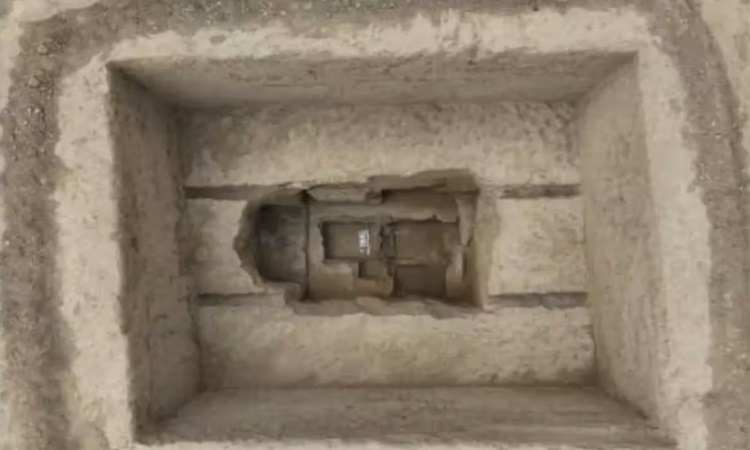
The tomb containing the 2,300-year-old stele jar is located in Son Giap Bao cemetery in Ninh Ha autonomous region. Image: Reached Chen
Analysis using Fourier transform infrared spectroscopy initially identified groups of organic matter, and rapid discrimination modeling compared the ancient sediment with modern samples, revealing it to be traces of alcoholic beverages. The research team then used tandem mass spectrometry and high-resolution orbitrap mass spectrometry to quantify the metabolites. They discovered more than 2,400 unique compounds, eliminating the possibility that the liquid in the jar was just groundwater that had seeped in over the centuries. The identified compounds belong to 24 chemical groups, including amino acids, fatty acids, and carbohydrates. Lactic acid predominates while tartaric acid is only present in low concentrations, indicating that the liquid is a grain-based beer, not a fruit wine.
The results of microscopic analysis of starch granules and vegetable mineral granules separated from the sediment were consistent with millet and plants in the Triticeae group, which includes wheat and barley. The sediment sample also contained 8,571 yeast cells, reflecting the intentional use of a fermenting agent. There are no historical documents that accurately describe a beer recipe that combines millet with wheat or barley and yeast. The high level of lactic acid reveals a distinctly sour flavor and the overall composition suggests this is a nutritious fermented beverage.
In the tomb, the bronze vase acts as an offering, expressing the belief that the dead need food and drink in the afterlife. According to Popular Sciencethe existence of large quantities of carefully sealed and preserved beer proves that beer brewing techniques and storage technology during the Qin Dynasty were not limited to the upper class. Brewers of the Qin Dynasty mastered fermentation and flavor shaping techniques, creating a drink that was accessible to many people.
https://www.goldencoirvietnam.com/blogs/coir-parasol/why-an-8-ft-patio-umbrella-is-the-choice-for-cozy-outdoor-corners
https://www.goldencoirvietnam.com/es/blogs/mulch-mat/how-coconut-fiber-mats-eradicate-weed-growth-and-prevent-soil-dehydration
https://www.goldencoirvietnam.com/blogs/coir-parasol/what-size-umbrella-for-6-person-table-guide-2025
https://www.goldencoirvietnam.com/blogs/coir-shade-sail/how-to-clean-shade-sails
https://giphy.com/channel/stockbroker45
https://www.goldencoirvietnam.com/es/blogs/coir-shade-sail.atom
https://www.goldencoirvietnam.com/vi/blogs/coir-shade-sail?page=4
https://www.goldencoirvietnam.com/blogs/coir-parasol?page=2
https://www.goldencoirvietnam.com/vi/collections/coconut-umbrellas
https://www.goldencoirvietnam.com/es/blogs/coir-parasol/how-to-hang-string-lights-for-patio-umbrella
https://www.goldencoirvietnam.com/blogs/coir-shade-sail/how-to-install-shade-sail-poles
https://www.goldencoirvietnam.com/es/blogs/coir-shade-sail/how-to-install-coir-shade-sails-on-poles-and-walls
https://www.goldencoirvietnam.com/fr
https://www.goldencoirvietnam.com/vi/blogs/mulch-mat/what-is-coconut-mulch-why-your-plants-need-coconut-coir
https://www.goldencoirvietnam.com/products/sliding-coir-curtain-with-loops?jdgm_referral_location=widget&ref=judge.me&utm_campaign=judgeme-review-site&utm_medium=referral&utm_source=judgeme
https://www.goldencoirvietnam.com/fr/blogs/coir-shade-sail
https://www.goldencoirvietnam.com/es/blogs/mulch-mat/rubber-mulch-mat-vs-coir-mat-2026
https://graphis.com/portfolios/dabba-trading
https://www.goldencoirvietnam.com/fr/blogs/coir-parasol
https://www.goldencoirvietnam.com/blogs/mulch-mat/how-much-does-rubber-mulch-cost-per-square-foot
https://www.goldencoirvietnam.com/collections/sun-shade-sails.atom
https://www.goldencoirvietnam.com/vi/blogs/coir-parasol/parasol-vs-umbrella-differences
https://www.goldencoirvietnam.com/vi/blogs/coir-parasol/rectangle-or-round-patio-umbrella-for-your-outdoor-living
https://allauthor.com/author/dabbatrading/
https://www.gta5-mods.com/users/stockbroker34