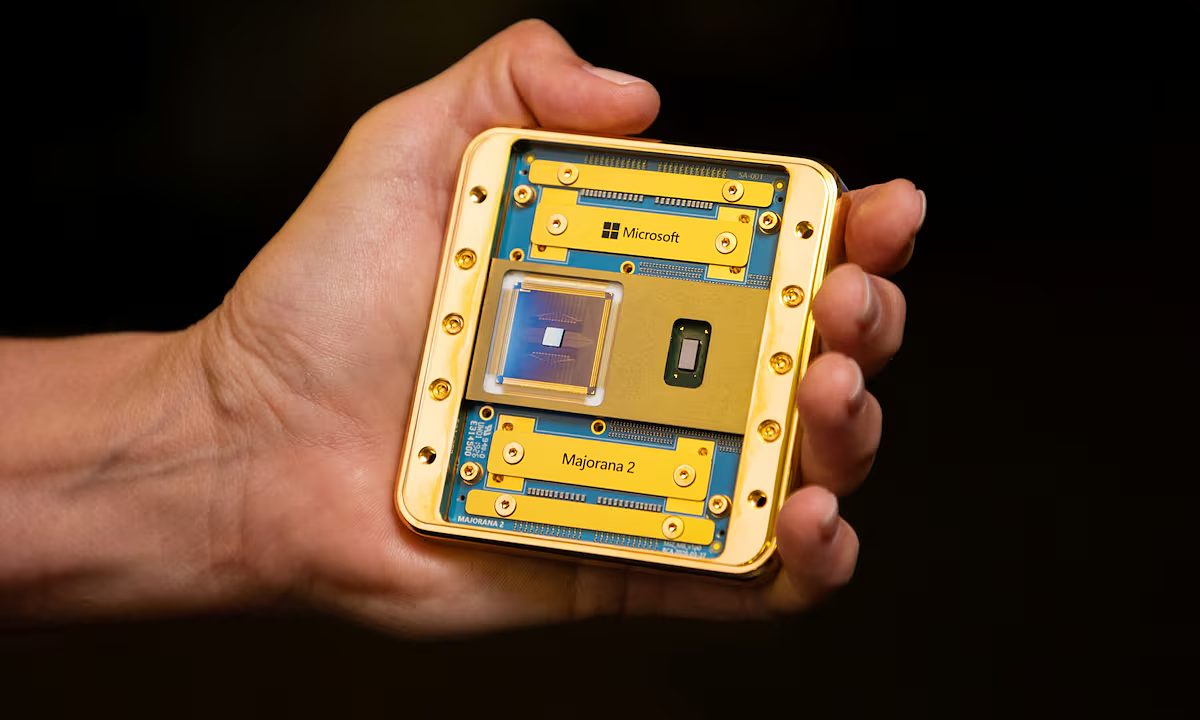
Microsoft announced the Majorana 2 quantum chip uses a new lead-based material, and claims it is “powered by materials science AI tools”.
Launching the Microsoft Build 2026 event in San Francisco (USA) this week, Majorana 2’s biggest change compared to its predecessor Majorana 1 last year lies in the materials. While quantum chips from Google, IBM and other companies use superconducting wires made from aluminum, the new chip is made from lead, a metal that has a larger atomic size due to the greater number of electron shells.
To create Majorana 2, Microsoft improved the material structure of Majorana 1 by replacing the aluminum superconductor with lead, and updated the semiconductor active region when combining two materials Indium Arsenide and Indium Arsenide Antimonide. The change helps increase performance, protect against noise and environmental errors – factors that affect performance and are considered “bottlenecks” on any quantum chip.
“Majorana 2 contains qubits (quantum bits) that are 1,000 times more reliable than qubits in previous processors we have worked on,” Chetan Nayak, Vice President of Microsoft Quantum quantum hardware, wrote in a blog post.
Microsoft’s Majorana 2 quantum computing chip. Image: Microsoft
Quantum computers operate based on the laws of quantum mechanics. According to Microsoft’s definition, a qubit is the basic unit of information in quantum computing. Unlike classical bits that only have a state of 0 or 1, qubits can exist in both states simultaneously thanks to the quantum superposition property, allowing this type of computer to explore many parallel computing directions, bringing exponentially increased processing speed for some tasks, such as solving math problems and simulating quantum systems. Some of the main current quantum computing technology directions include superconductivity, ion traps, photonics and neutral atoms.
According to Nayak, the new material structure helps create highly reliable topological qubits, especially with operations on the microsecond time scale. Unlike traditional qubits that are susceptible to errors with just small vibrations, the special feature on topological qubits is that information is not stored on a single particle, but instead is encoded into the global structure of special particles called anyons, helping the system resist noise and reduce the natural error rate.
“This rapid progress, supported by AI, helps cut the time needed for chip fabrication in half, thereby providing a scalable quantum computer, expected to be available by 2029,” Nayak emphasized.
According to Jason Zander, Executive Vice President of Microsoft, the reason companies do not use lead to make quantum chips lies in the “highly specialized process”. “The breakthrough was that we found a way to use lead with a water-soluble substance on the chip without leaching the lead during the manufacturing process,” Zander told Reuters. “Their existence was not proven until Microsoft observed it.”
The use of AI to support quantum chip research shows the company’s new direction. Earlier this year, the company said it had cooperated with the Pacific Northwest National Laboratory (PNNL) in Richland, Washington (USA) and successfully researched a material that could help produce Li-ion batteries that use 70% less lithium than today. At the Majorana 2 launch, Zander emphasized PNNL’s major contribution to the new chip.
However, critics and physics experts are now reacting negatively when Microsoft does not publicize enough data to verify its claims with Majorana 2, according to TechCrunch. “Microsoft can use as much lead as it wants, but that won’t protect them from the fundamental scientific principle that research results need to be reproducible,” said Henry Legg, a quantum physics instructor at St. Andrews in Scotland, commented.
The American software company later argued that the company could not release all new chip data due to commercial secrets. However, the company confirmed that it has “had confidential discussions” about Majorana 2 with the US Defense Advanced Research Projects Agency (DARPA) – an organization that is evaluating the feasibility of several different types of quantum systems being researched.
Besides Microsoft, many leading technology and semiconductor companies are currently increasing investment in quantum chips to gain advantage in this new generation computing field, such as Google with Sycamore and Willow, Intel with Tunnel Falls, or Amazon Web Services with Ocelot, while Nvidia focuses on building simulation infrastructure and platforms for quantum research. In China, Baidu, Alibaba Cloud and Origin Quantum are also expanding research into quantum computing chips and systems, in the context of the US and China competing in core technology capabilities.
As more and more quantum chip prototypes appear and are touted as breakthroughs, experts believe this technology is about to be applied in real life. Talk to As an insider, Ellie Brown, quantum computing and cloud computing economics analyst for S&P Global Market Intelligence, said that based on the latest research data, most current industry development roadmaps target the deployment of quantum computing systems in the 2028-2032 time frame.
https://legiano-no.eu.com/
https://legiano-no.org/
https://legiano-sk.eu.com/
https://legiano-sk.net/
https://legiano-sk.org/
https://legiano-sk.sk/
https://leovegas-dk.dk/
https://leovegas.biz.dk/
https://leovegas.co.dk/
https://leovegasdk.com/
https://leovegasdk.dk/
https://totalcasinoo.com.de/
https://total-casino-no.co.no/
https://casumo-no.org/
https://betanos.co.no/
https://casinozer.us.com/
https://hugo-casino-no.eu.com/
https://instant-casino-no.eu.com/
https://instantcasino-no.eu.com/
https://instantcasino-no.org/
https://ladbrokes-no.com/
https://ladbrokes-no.org/
https://lightcasino-no.com/
https://lightcasino-no.org/
https://lightcasino.eu.com/