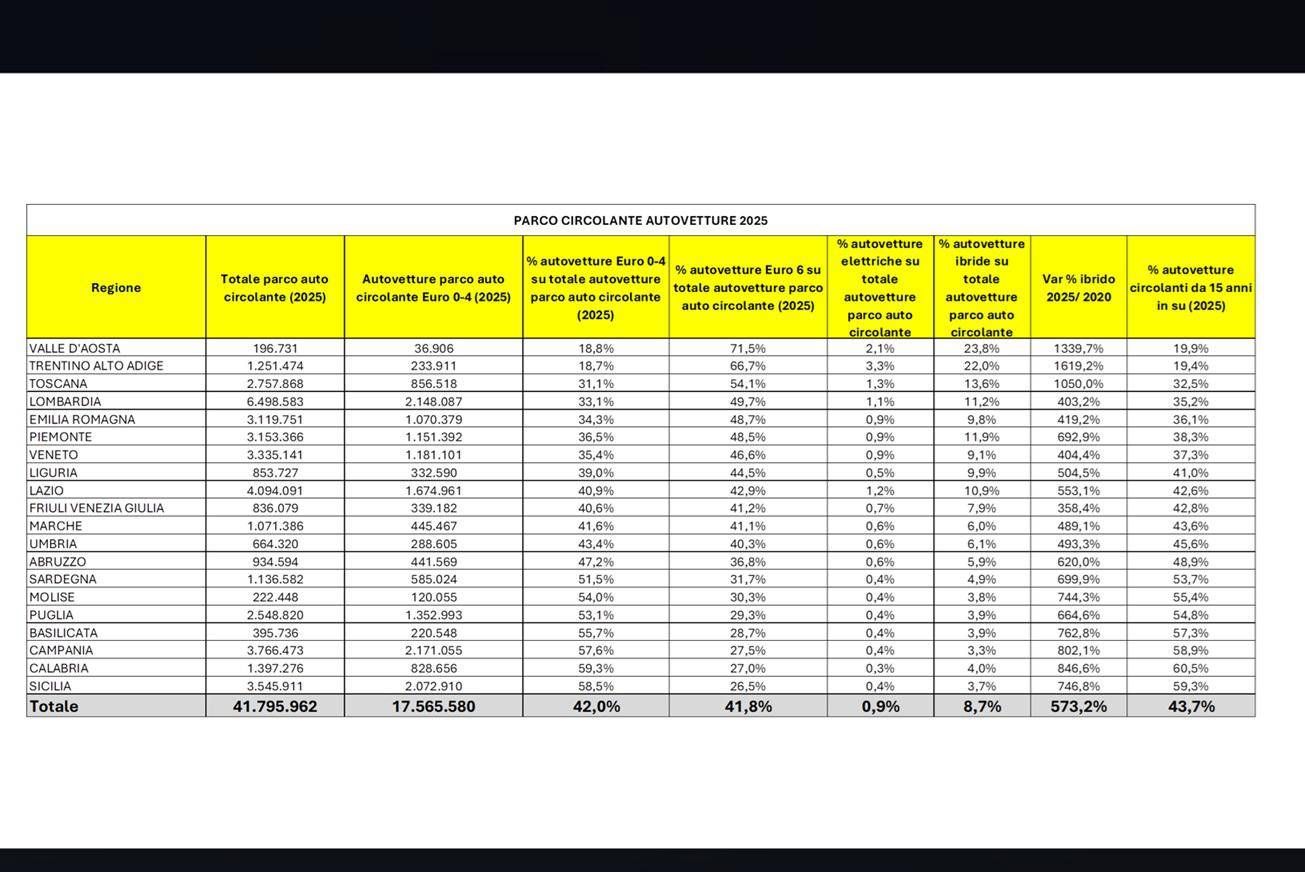
Based on the statistical findings processed by the AutoScout24 Study Center based on ACI data, published in conjunction with the World Environment Day on 3 June 2026, the national car fleet has reached an overall size of approximately 41.7 million units. In the period included between 2020 and 2025, the most relevant macroeconomic indicator is represented by the development of hybrid propulsion vehicles, whose volume of registrations in circulation recorded an increase of 573.2%resulting in a progression of the overall market share from 1.4% to 8.7%, with a net increase of 7.3 percentage points. On the contrary, the diffusion of fully electric vehicles still shows reduced penetration parameters, standing at 0.9% of the national total.
In parallel with the expansion of hybrid engines, there is a progressive transition towards emission classes with lower environmental impact, with Euro 6 approved vehicles which reached 41.8% of the fleet in circulation, compared to 26.2% recorded in the previous five years. Despite this increase, the The process of replacing obsolete vehicles presents structural critical elements due to the age of the vehicles in use. In fact, they are still almost active on the Italian road network 17.57 million vehicles with an emission class equal to or lower than Euro 4, which represents 42% of the entire national fleet; within this category, 4.24 million units belong to the Euro 0 and Euro 1 classes, equivalent to 10.1% of the total. From a chronological point of view, over four out of ten cars, equal to 43.7% of the fleet in circulation for an absolute value exceeding 18.26 million vehicles, have a length of service equal to or greater than 15 years.
The statistical projections developed by crossing the cancellation rates from the public automotive register with the renewal trends indicate that, to obtain a fleet made up exclusively of traditional and hybrid electric or Euro 6 approved vehicles, an estimated period of over 15 years will be necessary. From this mathematical model, Euro 0 vehicles with more than thirty years of age, similar to the category of historic vehicles, and cars called “youngtimer” aged between 20 and 29 years included in the ACI Safeguarding List were excluded.
Sergio Lanfranchi, representative of the AutoScout24 Study Center, examined the economic and regulatory issues: “The incentives available today are not yet sufficient to accelerate the renewal of the car fleet in circulation. It would also be necessary to support more low-emission, Euro 6, hybrid and electric cars, not only new, but also used. In fact, the economic factor remains decisive in the choice to change cars; it is precisely on this front that the game is being played. One aspect to reflect on is certainly the distinction between cars of real historical and collectible interest and simply old cars, often less safe and more polluting, which are used on a daily basis. If the former represent a heritage to be preserved, it is necessary to intervene on the latter by encouraging their replacement with more modern, efficient and sustainable vehicles. In this sense, digital platforms, thanks to a wide range of cars of all price ranges, can also represent a useful tool to significantly contribute to the process of renewing the car fleet in circulation.“.
Source: AutoScout24 Study Center processing based on ACI – Automobile Club d’Italia data
The distribution of regional-scale data reflects a marked territorial gap in the adoption of new technologies. As regards i vehicles powered exclusively by batterythe only administrative areas to exceed the 2% threshold are Trentino-Alto Adige with 3.3% and Valle d’Aosta with 2.1%. Valle d’Aosta also holds the record for diffusion of hybrid cars with 23.8%, followed by Trentino-Alto Adige at 22% and Tuscany at 13.6%, while the minimum percentages are recorded in Molise with 3.8%, in Sicily with 3.7% and in Campania with 3.3%. A similar polarization is observed in the analysis of most polluting emission classes, between Euro 0 and Euro 4whose maximum concentration on the total regional vehicles is found in Calabria with 59.3%, in Sicily with 58.5% and in Campania with 57.6%. On the contrary, the largest share of Euro 6 cars it is concentrated in Valle d’Aosta with 71.5% and in Trentino-Alto Adige with 66.7%, followed by Tuscany at 54.1% and Lombardy at 49.7%, confirming a national ecological transition that proceeds at different geographical speeds.