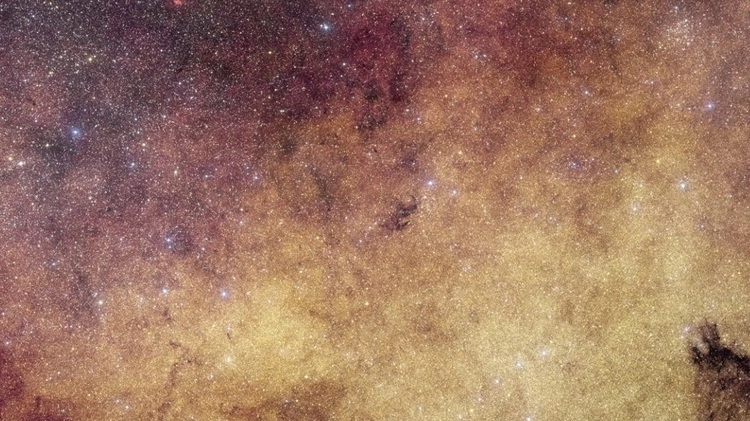
The photo of more than 60 million stars at the center of the Milky Way by the Euclid telescope operated by the European Space Agency (ESA) marks a new era in planetary exploration.
Theo Guardianastronomers used ESA’s Euclid space telescope to take the largest and most detailed image ever of the center of the Milky Way. Euclid took the photo for a total of 26 hours in March 2025, nine times pointing the camera lens toward the central area called the galactic bulge.
“Designed to observe distant galaxies, the telescope’s visible light camera is sensitive enough to distinguish individual stars in that super cramped area without being obscured,” ESA shared with the photo on June 24. This massive image promises to open a new era in extrasolar planet discovery with the number of exoplanets possibly increasing from about 6,000 to more than 100,000.
The $1.1 billion Euclid Telescope is launched in 2023 to create the most accurate 3D map of the universe and unravel the mysteries surrounding dark matter and dark energy. According to the most popular model, only 5% of the universe is made up of ordinary matter, about 70% is dark energy (the force driving the expansion of the universe) and the remaining 25% is dark matter (the invisible glue that binds galaxies). However, with images of the galactic bulge, Euclid can aid in observing microlensing events.
The Milky Way’s galactic bulge taken from ESA’s Euclid telescope. Image: ESA
One method of detecting exoplanets is to observe the host star as it moves in front of another, more distant star. Through a process called microlensing, the closer star’s gravity bends light from the farther star, making it appear brighter. As a planet orbits the star closer, its additional gravitational pull can cause brightness to spike. According to Space, scientists used this method very effectively with the James Webb Space Telescope (JWST) to study some of the earliest galaxies. However, light bending from background sources can also be used to detect faint objects such as planets.
Theo Live ScienceNASA prepares to launch the Nancy Grace Roman space telescope, named after NASA’s first head of astronomy. The machine will launch into space on SpaceX’s Falcon Heavy rocket from NASA’s Kennedy Space Center in Florida as early as August 30. Researchers hope the new observatory can detect about 1,500 exoplanets using the microlensing method.
Data from Euclid’s images could provide observational targets for Roman telescopes, helping astronomers measure the speed at which stars move and confirm the existence of the planet and its mass. By comparing observational data, they were able to find an exoplanet moving across the host star’s surface, eliminating the possibility that the two stars orbit each other in a binary system and produce similar signals.