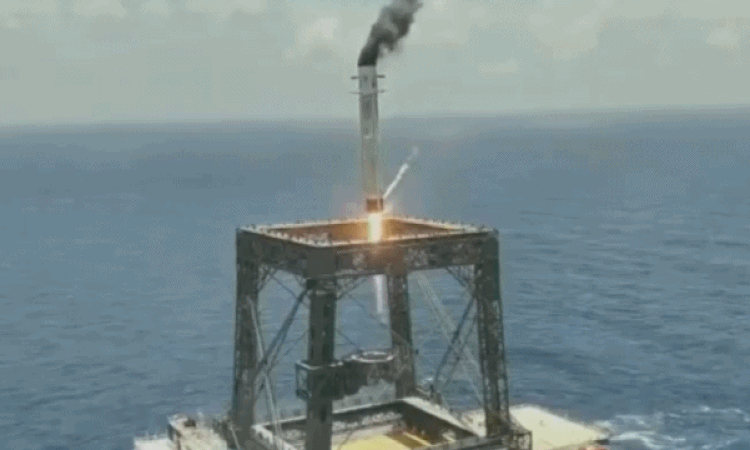
After launching into space, the first stage of the Long March 10B rocket landed again and was successfully recovered by the net system.
On July 10, the Long March 10B rocket took off from the Wenchang Satellite Launch Center, Hainan Island, on its first test flight. About six minutes after separation from the second stage, the first rocket stage made a controlled vertical descent. This part was then picked up by Navigator, a vehicle equipped with a specialized net rig, at sea, more than 300 km from the launch site.
“Very true to the center of the grid. The precise control ability is excellent,” commented Chen Mingbo, Chairman of China Aerospace Science and Technology Corporation (CASC).
The event marked the first time China successfully recovered a rocket booster during a flight to orbit, becoming the second country after the United States to do so. According to Global Timesthis is also the first time in the world that a rocket stage has been recovered using a net system.
The first stage of the Long March 10B rocket landed at sea. Video: CGTN
The Long March 10B is a liquid-fueled two-stage rocket supervised by the China Institute of Launch Vehicle Technology (CALT) under CASC. This reusable rocket is 70 m high, 5 m wide, has a launch mass of about 760 tons and can carry 16 tons of cargo into low Earth orbit.
While reusable rockets often land with deployable landing legs, such as SpaceX’s Falcon 9, the Truong Chinh 10B uses four hooks located next to the mesh fins in the body. During landing, they will hook onto the Navigator’s steel cables.
Navigator is China’s first specialized net missile capture vehicle, 144 m long, 50 m wide and weighs 25,000 tons when fully equipped. Thanks to the dynamic positioning system, this vehicle can maintain its position in turbulent conditions, acting as a reliable mobile landing platform on vast seas.
According to Sun Zhenlian, a technical expert at CALT, when the first stage of the Long March 10B rocket reached the space above the recovery platform, it continued to decelerate. The missile stage’s positioning and guidance system continuously collects real-time velocity and position data, transmitting information to the control system to adjust direction and speed accordingly. At the same time, Navigator also monitors the status of the missile stage to control the capture cable.
Sun calls this process a “two-way meeting” with high precision. The entire process takes place in a short time, is affected by wind and waves at sea, and requires close coordination between the rocket body, cables and hook mechanism. “This is like dropping a pen from the 100th floor into the pen holder while still controlling the speed and direction,” Hao Jinjie, an engineer working at CASC, told CGTN.
The instantaneous load also poses a huge challenge to the hook mechanism, requiring it to withstand the complex forces of contact with the net, slipping or pulling. “The hook mechanism is like a powerful hand, holding the rocket stage tightly,” Sun described.
Next, the Navigator must secure the rocket stage. “Due to environmental factors such as waves and sea breezes, the rocket stage can wobble inside the trellis. The recovery system stabilizes it in two steps. First, auxiliary cables hold the rocket stage tightly in multiple directions. Then, the locking platform automatically moves underneath, clamps and locks,” Sun explained. The process is like tightening a seatbelt around a rocket stage, making it stable even at sea, he added.
The first stage of the Long March 10B booster rocket is held in place by a net system at sea on July 10. Image: Xinhua
According to Chen Muye, technical expert at CALT, the net recovery system has many advantages, including simplifying the rocket structure because it does not need to be equipped with landing legs. This further reduces overall mass, increasing cargo capacity and performance for the missile. The net can also be adjusted flexibly, so the ability to tolerate deviations when landing is quite good. In addition, the system can be designed in modular form to serve many different sized missiles.
Experts will refurbish the recovered thruster stage to reuse it for the next flight, expected to take place later this year. “If the number of reuses is high enough, costs can be reduced by 20-30%. With further improvements, the reduction can reach 50-60%,” Hao commented..
Kan Lei, a rocket technology expert at CALT, said that the success of the Long March 10B launch and recovery mission marked an important step forward in China’s space industry. In the future, reusable technology is expected to significantly reduce commercial launch costs, while improving China’s competitiveness in the world market.
braineast43 » AirVent
brainmap69 » SunDayNews
Public profile – sidetop75 – Architects & Designers in UK – Archeter.co.uk
User alleychair22 – piglix.com
galbraiththerkelsen974659 – PukiWiki
waxoption42's profile – Read the Docs Community
User wooldesk02 – Kitchenanswershub Q&A
sidegoat88 » 🔫Кримінальний огляд 👮
drinkstem84 » Petites annonces en Tunisie – Achat, vente, location sur notre blog
Kahn Westh's Profile page
combweight85 » GamesGrom – Игровой Портал. Все для игр
combtop22 » Uznove.Uz – Universial Portal
Korisnik gramweight75 – Iskustva.net
alleypolish64 » Windows 11 скачать торрент – оригинальные образы и сборки
Public profile – quiltmap86 – DLX Free Classifieds in Pakistan
Moon McCarty's Profile Page
Kullanıcı: combgrowth85 – Matematik Kafası
Viešas profilis – melodypump23 – Meistrai ir specialistai
کاربر combsave91 – پرسش و پاسخ اداری و استخدامی
streamwire49 » Актуальные новости в мире смотреть онлайн
Public profile – timerdonald27 – Pethome
المستخدم alleytoad12 – إسأل المسافر
ronaldflag15 » 1
User scarftimer08 – Physicsgurus Q&A
YouTube