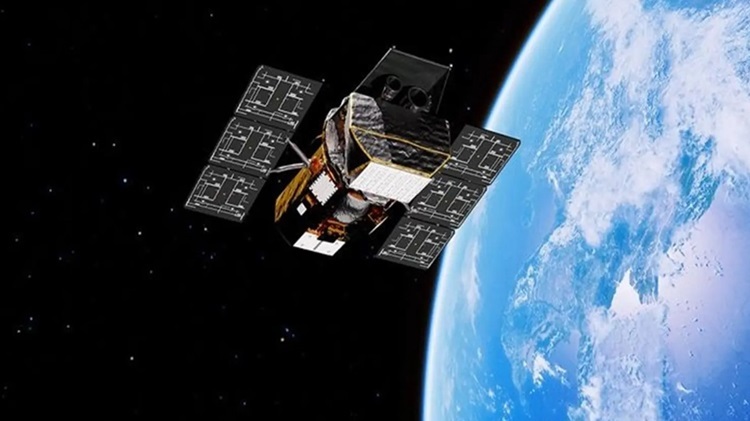
Katalyst Space’s LINK spacecraft spun out of control in space before approaching the Swift telescope to conduct a rescue mission.
Theo Interesting Engineeringthe LINK autonomous spacecraft developed by Katalyst Space had direction control problems due to damage to the propulsion system and flywheel, complicating the rescue mission of NASA’s Neil Gehrels Swift Observatory. The ship began spinning last weekend after losing direction control. Preliminary inspection results showed that two of the three jet flywheels were not working, and the ship’s cold air propulsion system was also malfunctioning.
LINK maintained power and communication with the Katalyst Space team, with other major systems operating as expected. Currently, engineers are trying to stop the spacecraft from rotating using electric thrusters in the next few days. Once LINK is in stable flight, the company will reassess the ship’s condition and update the guidance, navigation and control systems to accommodate the new configuration. Katalyst Space will work with NASA to determine whether the plan to reach and secure the Swift Observatory can continue.
This problem occurred after a directional control problem during the initial commissioning phase of the LINK train. At the time, Katalyst Space reported an issue with one of the spacecraft’s three jet flywheels, but said it had stabilized orientation control and restored reliable communications through flight software patches and operational updates.
Simulate the Link ship flying in space. Image: NASA
The LINK ship’s propulsion structure includes three xenon-powered electric thrusters, which were fired during the commissioning phase. According to Ars Technica, electric propulsion is one of the most important elements of the rescue mission, allowing the Link ship to rendezvous with the Swift satellite at an altitude of about 322 km above Earth. When Link connects with Swift using a trio of robotic arms, the electric thrusters will be reactivated to raise Swift’s orbit and save the observatory from destruction. Before the latest incident occurred, Katalyst Space announced that the LINK spacecraft had completed half of the test operation phase and was preparing to enter the flight phase near the Swift observatory.
The LINK launched on July 3 on Northrop Grumman’s Pegasus XL rocket, deployed from the company’s Stargazer aircraft over the waters of the South Pacific. The spacecraft established communications after launch and began its commissioning phase, which included testing the electrical, electronics, propulsion, sensor and navigation systems. The spacecraft is designed to move close to Swift, survey the 21-year-old observatory and hold tight before gradually raising its orbit over several months. The mission aims to address the observatory’s rapidly lowering orbit due to increased atmospheric drag and solar activity.
NASA contracted with Katalyst Space in September 2025 to design, build, test and launch the LINK spacecraft, completing the rendezvous, hold and orbit raising mission in less than a year. This is a challenging task because the Swift observatory does not have a propulsion system capable of maintaining orbit indefinitely. When a spacecraft moves through low Earth orbit, even the thin atmosphere creates drag, causing its altitude to gradually decrease. Recent solar activity has also increased atmospheric drag around Earth, accelerating Swift’s fall. According to Fox, Swift needs to be raised into orbit as soon as possible to continue observing the biggest explosions in the universe, including gamma-ray flashes and supernovae.