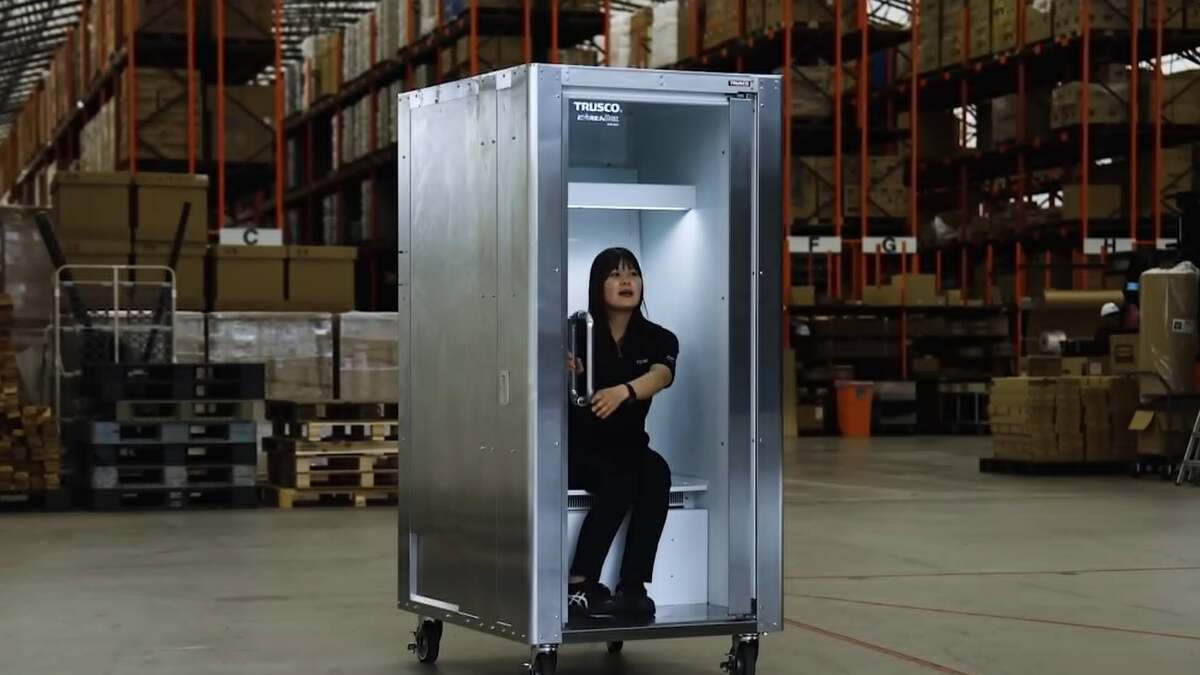
Industrial equipment company Trusco Nakayama produces refrigerators as large as phone booths, helping to cool the human body in minutes.
Share above AFPTrusco Nakayama said it has sold more than 300 Do Hiemon Box refrigerators since April for 1.5 million yen ($9,400). According to China Yamamoto, the company’s sales representative, customers are usually construction sites, factories, warehouses, and may expand to golf courses and baseball fields in the future.
Because Hiemon Box works with a regular power outlet, it is easy to move on wheels and does not consume much electricity. To avoid overuse, the device automatically turns off after 20 minutes.
Theo Japan Timesthe refrigerator maintains a temperature of 15 degrees Celsius and blows air at 5 degrees Celsius when someone sits on the bench inside, helping to quickly reduce the feeling of heat exhaustion or heat stroke. “The goal is not to provide a place to rest, but mainly to help prevent heat-related health problems from becoming more serious,” explains Fumiaki Matsubara, Trusco’s product manager.
According to Yutaka Kono, an expert at equipment company Konoe, investing in heat protection measures is becoming essential to maintain the current workforce and attract new talent. Traditional air conditioning and local coolers can help reduce heat, but Kono’s company has many open areas for trucks and heavy equipment to operate.
“I was really surprised by the new idea: putting people in a refrigerator. The fact that the human body is instantly cooled down to a safe temperature when entering the refrigerator sounds very appealing,” Kono told AFP.
Taichi Konishi, a 24-year-old worker, uses Do Hiemon Box three times a day. “I was only inside for about two minutes, but that was enough for the sweat to dry,” he shared.
Do Hiemon Box refrigerator for people. Image: Trusco Nakayama
Scientists believe that human-caused climate change is increasing the frequency and intensity of extreme heat waves. In 2025, Japan will experience the hottest summer in history. This year, the country’s meteorological agency started using a new word, like “kokushobi” or “cruel hot day”, when temperatures reach 40 degrees Celsius, calling on the public to respond to extreme heat like a natural disaster.
From early to mid-August, Tokyo alone recorded nearly 120 heat-related deaths. Across Japan, nearly 63,000 people needed emergency medical care this summer.
Since last year, Japanese businesses have faced stricter legal requirements to support workers working in the sun. For example, construction sites must provide workers with appropriate clothing such as jackets with built-in fans, air-conditioned rest rooms, and shelters. A new initiative this year allows Tokyo civil servants to wear shorts to work – a breakthrough in a country where formal office attire remains popular.
In a survey conducted by Japanese research company Teikoku Databank in July, 50% of businesses said that severe heat disrupted operations, and nearly 88% shared that they had increased measures to support workers.