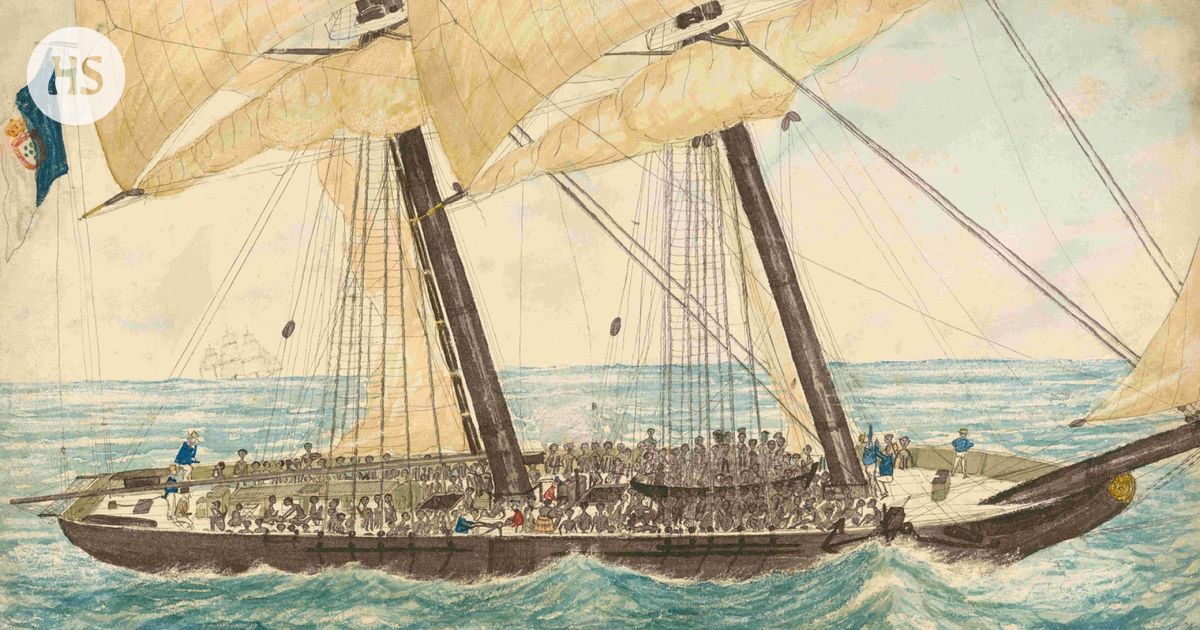
How can a person be completely erased from history?
The question cannot be avoided in a cemetery where African slaves are buried. Practically nothing is known about the deceased: no name, no date of birth or death, and no where they came from.
Often nothing is known about the cemeteries themselves, but they are found by accident when clearing the land. However, they are found all the time.
For example, the former president of the United States of Andrew Jackson on the ground – about 300 meters from the main building – the graves of 28 slaves were found a couple of years ago.
Could you science is giving these people back some of their history?
The answer is yes you can. This summer, a convincing proof of this was obtained when an international team of researchers published research about the origins of Africans who were kidnapped as slaves.
The study investigated whether their origin can be determined by examining the isotopes of the teeth and comparing them to the isotope map of Africa.
“Many were taken from far inland and forced to walk to the coast.”
“Before our research, there were practically two methods for finding out the origin of slaves,” says the person who led the research in an email Vicky Oelze from the University of California, Santa Cruz campus.
The first resort was the log books of the slave ships, but they didn’t get very far. Their data started from the slave trading ports, and they mainly recorded the number of people who boarded the ships, not their origin.
“However, we do know that many were taken far inland and forced to walk to the coast before being sold to European traders,” says Oelze.
Second the method is dna comparison, which has been used to some extent in investigations of the origin of slaves.
However, as an indicator of origin, it is also incomplete. Even if a person’s DNA could be linked to an ethnic group, it does not tell where he was born and lived.
The strontium isotopes used by Oelze’s group are much better suited for determining the origin.
Strontium enters the body with water and food. In the body, it binds to bones and teeth, where it remains forever.
Strontium isotopes are different forms of strontium atoms that reflect the soil and geological history of an area. Each region has a distinctive “isotope fingerprint” that cannot be found anywhere else.
The excavations have revealed that as many as a third of those buried were under 12 years old.
Fresh in the study, strontium isotopes were measured in tooth enamel.
Because tooth enamel is formed in childhood and does not change after that, a reliable isotopic fingerprint of the geographic location of childhood remains in the tooth enamel.
Oelze and colleagues’ research was carried out on the island of St. Helena, which has played a special role in the transatlantic slave trade. The island, located in the South Atlantic, functioned between 1840 and 1870 as a settlement for slaves freed by the British navy.
The slaves came from Portuguese, illegal slave-trading ships that had been stopped at sea by the British navy.
An estimated 27,000 slaves were brought to St. Helena over thirty years, many of whom died on the island.
In 2007, a cemetery was found in the area, where it is estimated that 8,000–10,000 slaves freed by the British were buried. Archaeological excavations have revealed that as many as a third of those buried were under 12 years old.
Oelze and colleagues obtained a mica sample from 152 deceased and compared it to the strontium isotope map of Africa, also done by Oelze’s group.
Before the study, Oelze and colleagues had analyzed samples from across sub-Saharan Africa to obtain references against which the isotopic samples were compared.
“Our results clearly showed where in Africa the St. Helena specimens were captured,” says Oelze.
Most of the deceased came from what is now Angola, but there were also people from Congo and Gabon.
Although the majority were from the coast, as expected, many clearly had their roots inland, the most distant even thousands of kilometers away from the territory of present-day Zimbabwe.
According to Oelze, this may indicate that the coast was already so depleted in the 19th century that the slave traders had to search for slaves further and further inland.
According to Oelze, working in St. Helena has been extremely rewarding and important to the local community.
“Now we can answer people’s questions about more than ‘from somewhere in Africa’.”
“Dead African slaves were thrown there like any other waste.”
St. Helenalla buried slaves have been treated with respect, but the same cannot be said at Oelze’s other research site in Lagos, Portugal.
In the area called Valle de Gafaria, a cemetery was found in connection with the construction of the parking garage, which had already been established in the 15th century.
In more detailed investigations, the deceased turned out to be African. It is the earliest cemetery of African slaves in Europe, right from the beginning of the slave trade.
Although the slave trade is often spoken of as a transatlantic phenomenon, in the 15th and 16th centuries many slaves were brought to Spain and Portugal.
People kidnapped as slaves spent long sea journeys in very difficult conditions. The drawing depicts slaves on the French slave ship Séraphique at the end of the 18th century.
Cemetery investigation revealed the shocking treatment of slaves. According to Oelze, Valle de Gafaria shouldn’t even be called a cemetery, as it was practically a city dump.
“Dead African slaves were thrown there like any other waste,” says Oelze.
Valle de Gafaria has become a hotbed of controversy between activists and city authorities, as local organizations of African descent have been completely left out of investigations.
According to Oelze, the Portuguese researchers have not communicated or shared information with the people most affected by the issue.
The tense situation has not been eased by the fact that the city gave permission to build a miniature golf course on top of the cemetery, although researchers believe there are still many graves in the area.
Oelze’s hope is that, through his research, the forgotten people of Valle de Gafaria will also get a part of their history back.