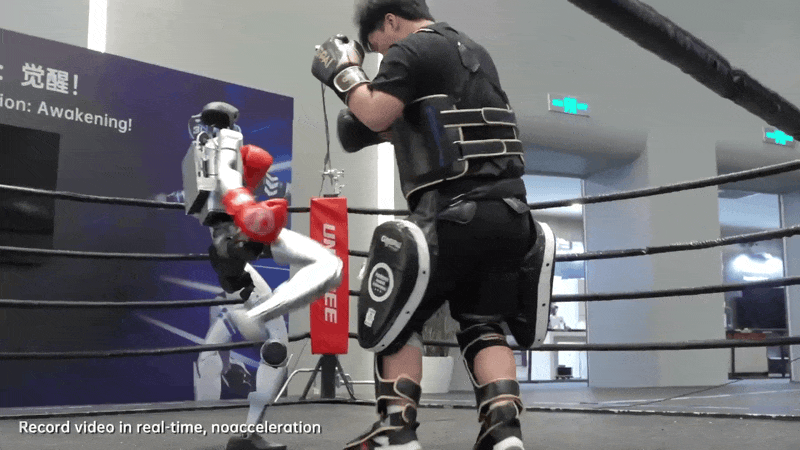
Unitree Robotics’ UnifoLM-X2-1.0 uses real-world data from the surrounding environment to learn how to fight instead of through a computer or remote control.
Instead of converting commands or gestures from virtual reality glasses or controllers into movements, the UnifoLM-X2-1.0 uses a “perception system that turns predictions into action,” according to Unitree. In particular, when operating, the robot’s camera and sensor system continuously processes the environment, predicting how the scene and the opponent’s actions may change, then uses those predictions to plan the next movement.
In the demonstration video, the Unitree G1 running UnifoLM-X2-1.0 reacted to an approaching human opponent by adjusting its posture, moving its legs, and dodging attacks. The robot also performs punches and kicks aimed at the opponent.
Unitree G1 runs UnifoLM-X2-1.0 to perform competitive matches. Video: Unitree/YouTube
The company says the new technology addresses a major challenge in deploying humanoid robots: reducing the latency between perception, decision making and physical action. UnifoLM-X2-1.0 is designed to help solve the bottleneck of robots acting in the real world, by allowing them to plan rapid movements, make tactical decisions, and execute closed loops in highly dynamic interactions.
“UnifoLM-X2-1.0 breaks the bottleneck of existing robot platform models, as it can make instant plans and execute fast interactions in real time. The process helps them fight completely automatically,” Unitree described when posting a video on YouTube.
Previous humanoid robot combat demonstrations have relied on remote control or some other form of human intervention. According to Interesting Engineeringthe new model shows that Unitree is moving to a more advanced automated system. However, upon analyzing the video, the site realized the UnifoLM-X2-1.0 may not fully work on the robot itself. The console log shows commands like OBS/replan and env.step that show sensor information being sent to a separate computer running the AI model, which then sends movement instructions back to G1.
“That said, reducing the system’s dependence on an external computer remains a challenge for humanoid robots,” Interesting Engineering comment.
According to research by BofA Global Research, Chinese manufacturers account for about 95% of all humanoid robots shipped globally in 2025.