Researchers have identified the process of delamination of the Earth’s crust beneath Italy as driving much of the seismic activity along the Apennine Mountains that run across the peninsula.
Theo Live Sciencea research team led by geoscientist Stefano Tavani at the University of Florence discovered that the Earth’s crust under Italy is separating and sinking into the mantle. This is the cause of many seismic activities in the Apennine Mountains stretching 1,200 km along the Italian peninsula. This area also helps scientists better understand the final stages of subduction (which occurs when a denser, heavier plate of oceanic crust slides under an adjacent continental plate).
The Mediterranean region is located between Africa, Asia and Europe, and includes many tectonic plates and mountain ranges, making the region’s geology extremely complex. The southern African Plate is pushing northward, compressing the Earth’s crust, forcing the ancient Tethys ocean to sink into the mantle beneath the Apennines in about 50 million years.
Theo Science Alertthis process creates thrust along the Apennine Mountains. As the African plate sank beneath the Eurasian plate, the boundary of the subduction zone moved toward the African plate, causing the Eurasian crust to stretch and thin, creating two large basins: an older basin in the Mediterranean Sea west of Corsica and Sardinia, and a newer basin in the Tyrrhenian Sea of the Mediterranean off the western coast of the Italian peninsula.
To understand the unusual tectonic activity behind the formation of the Apennine Basin and Range, Tavani and his colleagues integrated data from GPS and satellite measurements into a tectonic model of plate motion. They found that the crust under the Apennines is separating and sinking into the mantle in a process called delamination. It is this delamination process that causes most of the seismic activity in the Apennines, not subduction.
Similar to a zipper, the delamination process does not occur over the entire mountain range but is concentrated in a “hinge zone” with the front part dipping under Italy towards the Adriatic foreland plate of the Adria microplate, a basin running parallel along the eastern flank of the Apennines. Popular Mechanics said the researchers reached their conclusions by analyzing decades of earthquake and GPS data as well as looking at the Mohorovičić discontinuity (Moho for short), the geological boundary between the Earth’s crust and the mantle below. According to them, a 500 km stretch of the Moho on both the Tyrrhenian and Adriatic sides overlaps, forming a “delamination front”. Research data show that the crust behind the hinge zone moves at a rate of about 4 mm/year while compression occurs at a rate of 2 mm/year in front of the hinge zone.
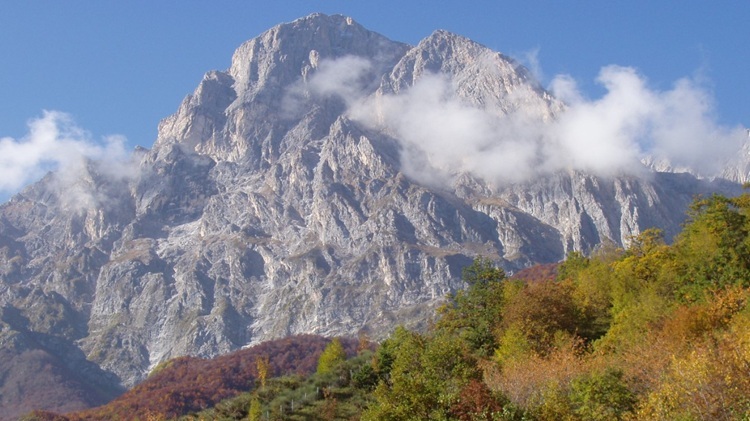
Apennines Mountains in Italy. Image: Wikipedia
Tavani’s team emphasizes that the delamination process did not begin suddenly but likely occurred at least in the late Mesozoic, about 10 million years ago. In research published on September 7 in the journal Communications Earth & Environment, the research team predicted that in a few million years, the Earth’s crust under Italy will completely separate and the two plates will merge. According to them, other places around the world are going through a similar process, such as the Hellenic Trench in southern Greece.