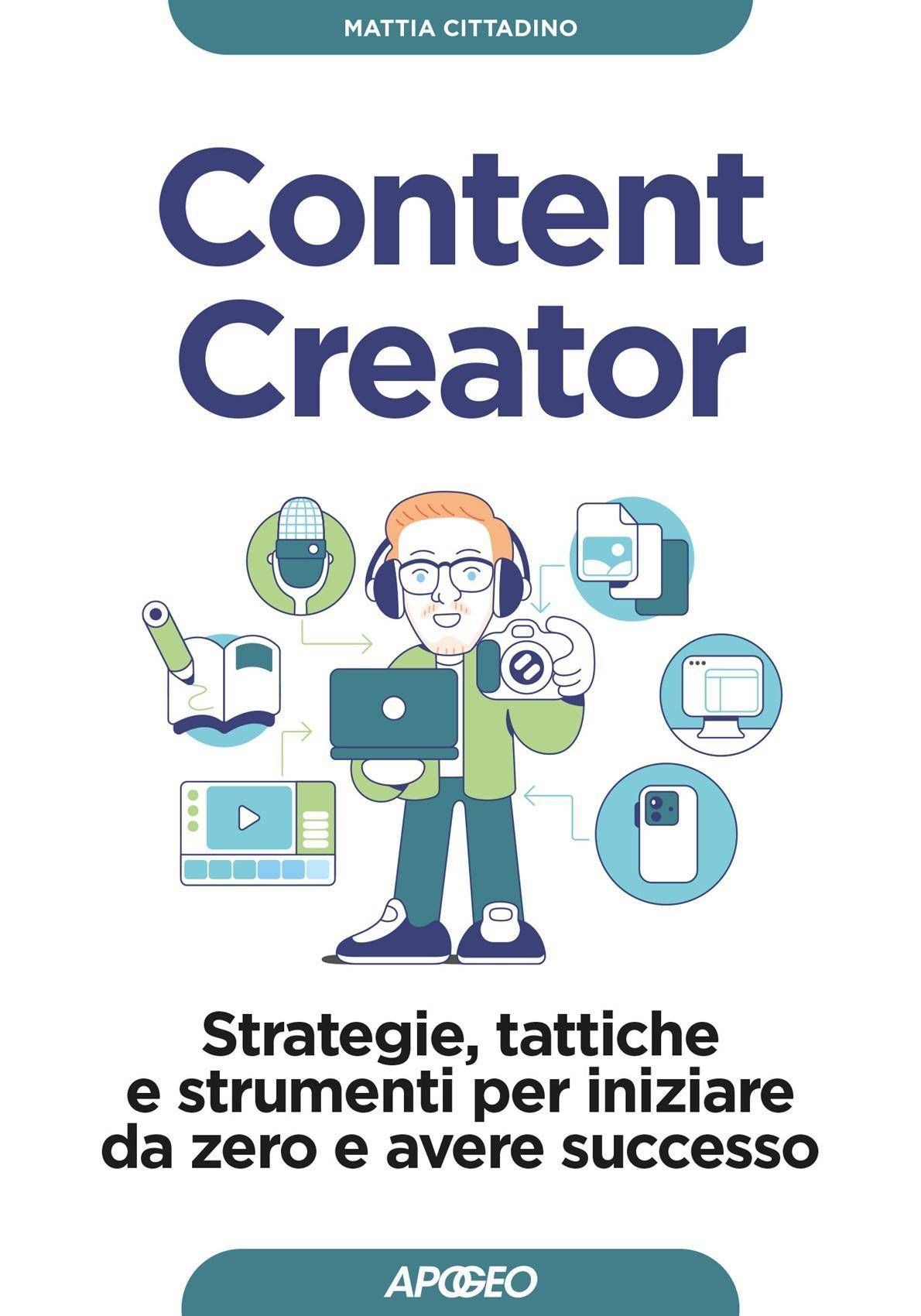
In the landscape of contemporary digital communications, the transition from amateur to professional creator requires much more than impromptu inspiration or the compulsive pursuit of current trends. The essay Content Creator by Mattia Cittadino, published by Apogeo, addresses this step in scale with a programmatic and highly operational approach, designed to guide those who intend to transform content production into a sustainable and long-lasting working model.
The path outlined by the author starts from a fundamental introspective analysis: the definition of the Coordinates of the content. Even before choosing the video camera or the social channel, Cittadino offers a real analytical mirror to establish elements such as who you are and what you do, the distinctive traits of your personality, your “personal Why” (i.e. the profound reason that drives the action), the narrative pillars, but also the factors to avoid and the reference archetypes. This initial mapping turns out to be the true antidote to market saturation: the niche, claims the author, is not a closed enclosure, but a starting point to be defined through its own uniqueness.
In choosing channels, the manual invites us to overcome the dogma of omnipresence to adopt a decision-making matrix based on direct and pragmatic questions. Questions like “What format could you enthusiastically create multiple times a week for a year?” serve to measure the creator’s performance in the long term. The architecture of the channels is thus divided into quick-use “discovery” platforms (Instagram, TikTok, YouTube Shorts) and “slow” and proprietary platforms (such as Substack, YouTube long form or the newsletter), ideal for building a deep relationship with the public and a database independent of the arbitrary decisions of the algorithms.
A particularly enlightening contribution concerns the management of workflow and technology, summarized in the principle “Less is more, anche per i tool“. Citizen fights the illusion that accumulating complex software improves the quality of the output. Technical complexity, on the contrary, risks paralyzing the activity: “Often the secret is not to add, but to select carefully. More effective content is not more complex content, but one that starts from a truly relevant concept“. From simple writing on Google Docs or Google Keep, to the strategic management of tools like Notion or Canva, the technological infrastructure must serve to reduce operational friction, leaving room for the care of the story.
Artificial Intelligence also finds a very specific place in the text: tools such as ChatGPT, Gemini or Claude are framed as assistants for brainstorming, reviewing scripts or re-adapting formats, without ever replacing “the ‘living’ part of the content, tone, vision, narrative choices, which remains the responsibility of those who create it“.
What makes Content Creator a less conventional manual is above all its focus on what happens away from the social media showcase. In fact, the book does not limit itself to describing techniques, platforms and visibility, but tries to question the profession in its most personal and concrete dimension. Simple questions only in appearance, such as “Your current job is overwhelming you?”, open a reflection on individual motivations, expectations and fragilities, before leaving room for the more pragmatic aspects of the profession: organisation, relationships with companies, contact management and tax framework.
What emerges is the portrait of a profession that is much less immediate than it might appear behind a screen: creative, of course, but also made of discipline, awareness, relationships and entrepreneurial choices. And it is precisely in this balance between public exposure and invisible work that Content Creator finds one of its most interesting elements.