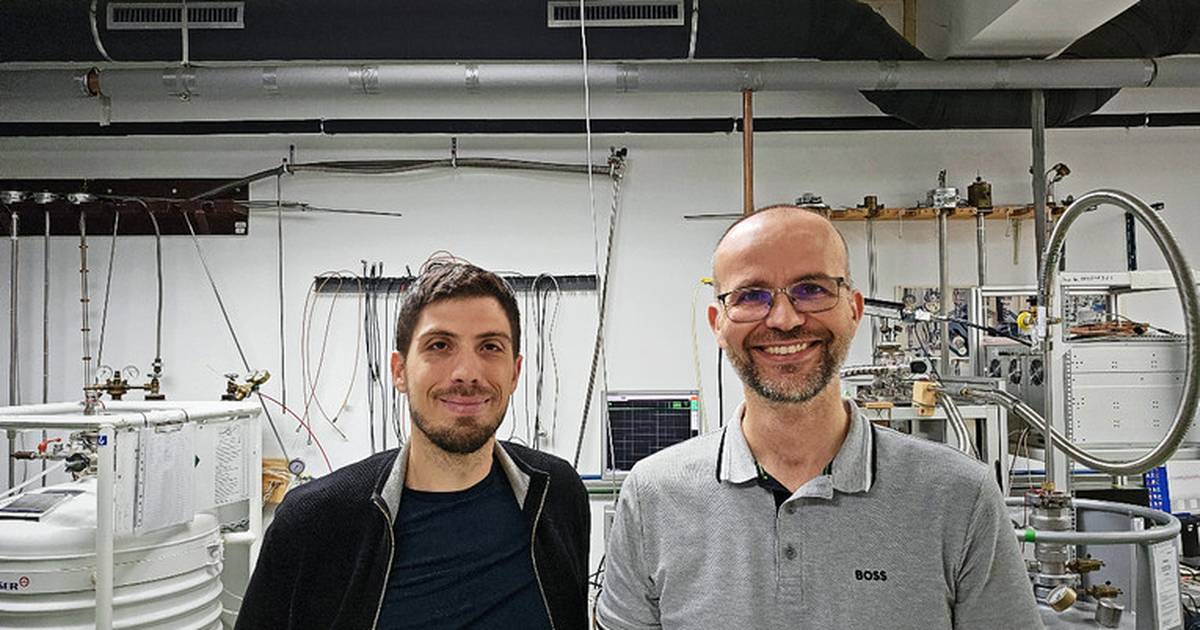
Physičari Ivan Jakovac i Mihael Grbić from the Faculty of Science and Mathematics of the University of Zagreb led an international team that experimentally confirmed theoretical predictions about two quantum phases in a magnetic material, PMF announced.
The results of the research were published in the journal Physical Review Lettersand the paper was published on the cover of its 13th edition and was recommended by the editor.
Scientists have studied an insulating compound composed of chains of very small magnets, the so-called Haldane chains, named after Duncan Haldane, who first theoretically predicted them in 1983. When the chain is exposed to a strong magnetic field and very low temperatures, its properties change – the so-called quantum criticality. The chains begin to behave like one-dimensional conductors in which magnetic quasi-particles move without resistance. During additional cooling, the system changes to an even more unusual state – the Bose-Einstein condensate, the fifth aggregate state.
– What we had for decades only as a theoretical prediction, we have now managed to confirm directly experimentally. When the temperature and magnetic field change, the material behaves exactly as the theory predicted – said Jakovac.
Theoretical predictions about the appearance of a magnetic Bose-Einstein condensate in such systems were made as early as 1990, while the properties of another important quantum state, known as the Tomonaga-Luttinger liquid, were predicted at the beginning of the 2000s. Experimental confirmation was demanding, and in the meantime, more than 20 similar materials were synthesized that did not have all the properties necessary for reliable observation of these states.
– With the help of quantum physics, we can use different calculations to predict many states of matter, but the real test of these predictions occurs when we vary some of the parameters and monitor how that calculation evolves, and whether it is in accordance with the experiment. In our case, we varied the magnetic field in a wide range from 0 to 34 T and showed that in the entire area the system behaves in accordance with the laws of quantum physics – said Grbi.
The turning point was brought by a compound called BoNO, which is completely organic and does not contain metals. The material was synthesized by Professor Y. Hosokoshi from Osaka Metropolitan University in Japan.
The researchers used nuclear magnetic resonance to study the material’s behavior and determine the boundaries between the two quantum phases. Part of the measurements were carried out in Zagreb, and the rest of the experiments were carried out in research centers in Grenoble, France, and Dresden, Germany.
The research belongs to the field of highly correlated systems, in which changes in temperature, magnetic field or other external conditions can significantly affect the properties of materials. According to PMF, organic magnetic compounds like BoNO open up additional possibilities for the study of quantum states of matter, including coherent states that are also investigated in the context of quantum computing.