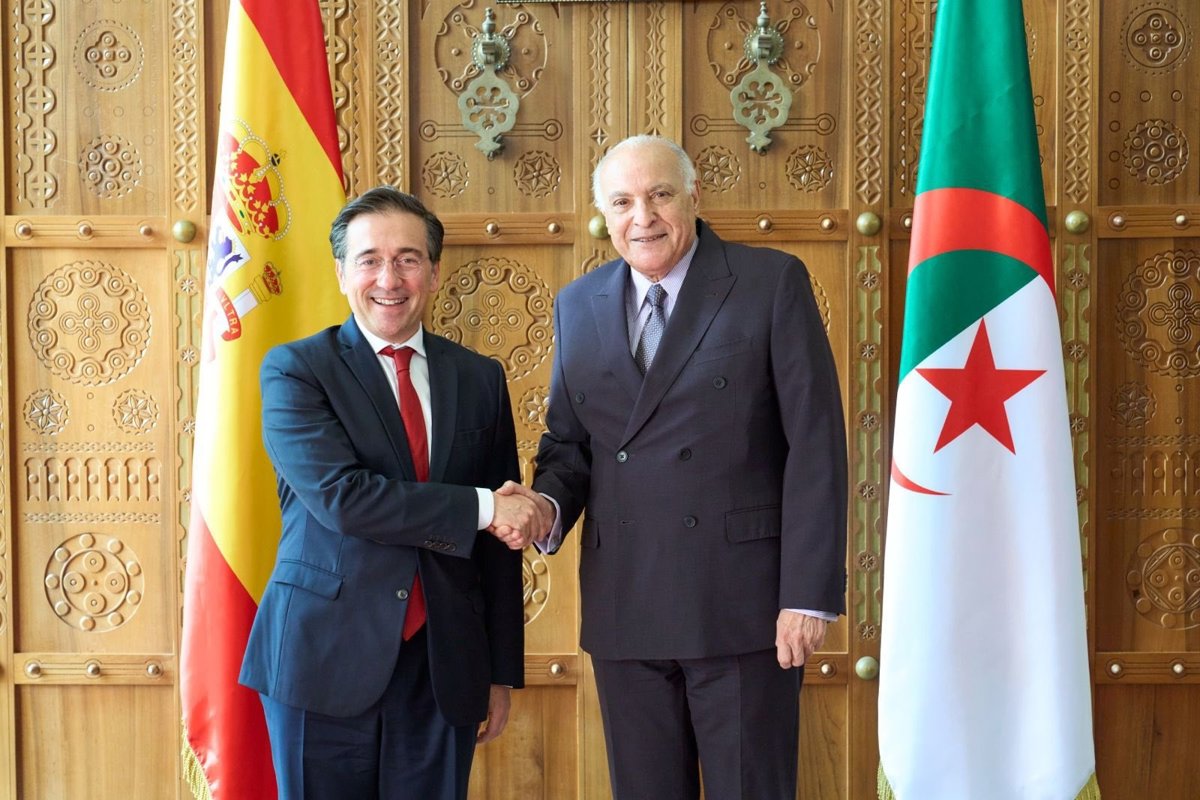
The Minister of Foreign Affairs, European Union and Cooperation, José Manuel Albares, has considered the bilateral crisis that caused support for the Moroccan autonomy plan for Western Sahara in March 2022 to be over, announcing from Algiers that the bilateral relationship is entering a “new stage” and that the two countries are already working on holding a summit chaired by Pedro Sánchez and Abdelmayid Tebune, the first since 2018.
“This visit that I have made today represents the beginning of a new stage, a new stage in our excellent and extraordinary bilateral relationship,” he assured in statements to the press after meeting with his Algerian counterpart, Ahmed Attaf, and being received by President Tebune.
In these contacts, they have agreed to “relaunch visits, trips and meetings at all levels” and start working on holding a High Level Meeting (RAN), “which will be held on this occasion in Spain, given that the last one was held here in Algeria.”
The head of diplomacy has clarified that “it is still very premature” to talk about dates because we have to “cross the agendas of both presidents and find the moment”, but work will begin on it now.
The minister has not spared his praise for Algeria, “a neighboring country”, he said, with which Spain shares a “Mediterranean neighborhood” but which “above all is a strategic partner and a friend of Spain”, in addition to being “a reliable, constant supplier, under any circumstances” of gas.
“Our relations, which are already at an extraordinary level, are being strengthened and deepened,” insisted the minister, who with his words wanted to overcome a diplomatic crisis that the two countries began to leave behind at the end of 2023 with the return of their ambassador to Madrid and had a new milestone with the end of bilateral trade restrictions in November 2024.
In this sense, he clarified that in his meeting with Tebune, the Algerian president conveyed to him “the full validity of the Treaty of Friendship, Good Neighborhood and Cooperation between our two countries”, after the president ordered its suspension in June 2022, upon confirming that Spain was not going to back down in its support for the Moroccan autonomy plan for the Sahara, and without until now having been informed that said suspension was no longer in force.
WITHOUT DEEPING INTO THE QUESTION OF THE SAHARA
On the other hand, with regard to Western Sahara, an issue that was precisely the trigger for the diplomatic crisis, since Algeria had not been informed of the Spanish decision to support the Moroccan autonomy plan, the minister said that the topic has been “raised on a couple of occasions” by his interlocutors “to talk a little about the situation in which the process in this regard is located.”
“We have not gone deeper,” added the minister, who did not want to assess the negotiations that the United States is sponsoring between Morocco and the Polisario Front, with the participation of Algeria and Mauritania as well, following the latest UN resolution in which the parties were urged to engage in talks “based on” the autonomy plan.
“These are negotiations between the parties and therefore it is up to them to decide,” he simply stated, reiterating once again Spain’s “total support” for the personal envoy of the UN Secretary General for Western Sahara, Staffan de Mistura, who has also participated in the aforementioned talks, one of whose rounds was held precisely in February in Madrid.
In another vein, the minister has indicated that he has also spoken with his interlocutors about immigration, both about the fight against irregular immigration, in which “joint work is already bearing fruit.” Thus, he highlighted the 49% drop in arrivals from Algeria in 2025, although he added that the route heading to the Balearic Islands “still needs more work and greater reinforcement.”
https://hubabooba.com
https://hubabooba.com/data-policy/
https://hubabooba.com/pictures/
https://hubabooba.com/profile/
https://hubabooba.com/questions/
https://hubabooba.com/recordings/
https://hubabooba.com/write-us/
https://kim2t.com
https://kim2t.com/bio/
https://kim2t.com/contact-us/
https://kim2t.com/gallery/
https://kim2t.com/media/
https://kim2t.com/privacy/
https://kim2t.com/questions/
https://lucylia.online
https://lucylia.online/about/
https://lucylia.online/faq/
https://lucylia.online/photos/
https://lucylia.online/recordings/
https://m1ssariana.com
https://m1ssariana.com/about/
https://m1ssariana.com/contact/
https://m1ssariana.com/media/
https://m1ssariana.com/pictures/
https://m1ssariana.com/questions/