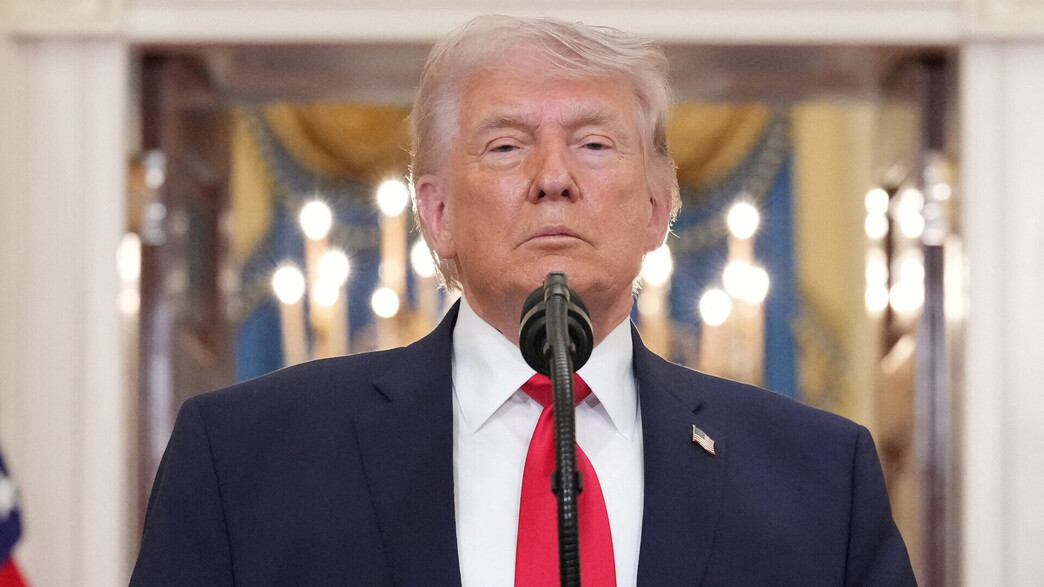
The US president declared progress and promised an end within “two or three weeks” • The Wall Street Journal defined it as an attempt to market the campaign, and the New York Times emphasized the lack of a clear exit path • The Washington Post, Guardian and CNN also pointed to conflicting messages and inconsistencies • In the background: a spike in oil prices, declines in the markets and growing domestic criticism
U.S. President Donald Trump made a special statement tonight (between Wednesday and Thursday, Israel time) to the American people. In the statement, which was broadcast at the height of peak viewing time in the U.S., he said that “I am proud to say that the goals are getting closer to being achieved” – but in the same breath explained that the campaign will continue “for another two or three weeks.” The statement, which lasted 20 minutes and was preceded by a report that Trump might declare an end to the war, received the most extensive media coverage overseas – it seems.
The Wall Street Journal, one of the world’s leading newspapers that is aligned with the more conservative side of the political map, called the statement an attempt by the American president to sell the war to the people. “The president tried to reassure the Americans who expressed doubt that the war with Iran was intended to serve the national interest,” it said. The statement was called “his most direct presentation to the country since the war began a month ago.”
In a statement, Trump promised a quick drop in prices, but the Wall Street Journal cited an expert estimate that it would take weeks or months for oil and gas prices to drop to pre-war prices. They also expressed doubt about Trump’s war strategy – while the president boasted of attacking 12,000 targets, the newspaper also chose to note Iranian successes in the war: tightening the grip on the Strait of Hormuz and nuclear ambitions – which have not yet been abandoned in Tehran. The lack of Iran’s surrender was also noted, the fact that Tehran has not yet accepted Trump’s demands.
The New York Times, which presents a very critical line against Trump and against the war in Iran, promoted an article on the home page that included “5 insights” from the statement:
- A promise of a quick end – without an exit path: The newspaper states that Trump refrained from defining a clear path for exiting the war, and while in his words he ranges from support for negotiations to promises of major escalation, the latest intelligence assessments indicate that Iran is not ready for concessions at this stage.
- In the report, they referred to the fact that Trump called the war “an investment”, and asked the Americans who are worried about the costs of the campaign to “maintain proportions”.
- The pursuit of the uranium – the president is inclined to give up on sending ground forces to locate the enriched material in the Isfahan area, and that the US will rely on satellite surveillance if Iran tries to retrieve the material from the ruins and if it tries to do so, an attack will be carried out.
- Closing the Strait of Hormuz – Trump repeated his demand from the countries that import oil through the Persian Gulf that they be the ones to take care of the problem, a demand that was called a “controversial step”.
The commander of the Iranian navy points to the Strait of Hormuz, archive | Photo: Reuters - The Venezuelan model – the president once again boasted of the success of the operation to capture the dictator Nicolas Maduro as a model for what he is trying to achieve in Iran, but “the reality on the ground is different”, as the Times defined it: while there were no US forces killed in Venezuela, the war in Iran has already claimed the lives of 13 American soldiers and left hundreds wounded, while the Iranian regime is still functioning.
The Washington Post also dealt with the extensive statement, describing Trump’s attempt to calm criticism – but presented sharp criticism of “internal contradictions and inconsistencies” in the operation’s goals.
On the one hand, Trump claimed that Iran had already been “completely destroyed” and that all the objectives had been achieved, but on the other hand he declared that the operations would continue and even increase. Also, while Trump has now claimed that “regime change” was not the goal, he has previously boasted of eliminating Iran’s leaders and encouraged the Iranian people to work for the overthrow of the regime.
Another reaction to the statement we mentioned in the post was the declines in the stock market: markets in Asia and Europe recorded sharp declines and oil prices soared. Domestic criticism of Trump, that the war contradicts the “America First” (MAGA) policy, and public opinion polls that indicated that two-thirds of Americans oppose the war were also noted.
In the British Guardian, one of the leading media outlets in the world, they wrote that Trump “declared victory”. Here, too, the increases in gas and oil prices in the world were emphasized – and that he avoided a concrete description of the measures. Trump’s lack of clarity regarding the strategic goals in the war was also emphasized, and the fact that in the past he stated that he must prevent Iran from obtaining nuclear weapons – this time he claimed that he “doesn’t care” about the uranium stockpile.
Another aspect that was emphasized is the rising tensions with Europe, with an emphasis on the US’s allies. The fact that he confirmed that he is considering withdrawing from the NATO alliance, which was established as one of the West’s lessons from World War II, was described as a challenge to the existing world order.
CNN, one of the leading media outlets in the US and the world, wrote in the headline: “Trump presented his best argument for war – but fails to ease concerns about the end of the war.” They noted that Trump failed to describe a clear exit strategy or to describe the final goal of the war. Trump’s arguments were presented as trying to project power, but are now less convincing after weeks of “contradictory and changing messages” from the White House.
CNN also raised doubts about the credibility and factual basis of the president’s claims, who did not present evidence that would allow the American public to judge for themselves the necessity of the military moves he took. For example, the president’s statement about the “change of the regime” after the elimination of the leadership is a big question mark, because according to CNN – Iran is now under the control of even more extreme elements.
The president’s promises about an imminent reduction in fuel prices and that the stock market will soar were defined as “wishful thinking” and not as the product of a coherent economic strategy, especially in light of the fact that the majority of the American public believes that his policies worsen the economic situation.
Trump’s statement did not manage to rescue him from the historic political depression into which he has fallen, CNN claims, where they highlighted the problematic figure that the president is dealing with, who receives a support rate of only 35% from Americans who, according to them, show deep skepticism towards the way the war is being conducted. It was also written that Trump’s style of messaging on social media and his angry rhetoric contributed to the erosion of public trust in him, and the current speech did nothing to alleviate global anxiety or offer a real solution to the energy and strategic crises created by the war.
http://support.roombird.ru/index.php?qa=user&qa_1=turniptongue52
https://ed.coop/forums/users/smashcurler50/
http://adrestyt.ru/user/sliceguide72/
https://ryu-ga-index.com:443/index.php?sparksherndon260880
https://matkafasi.com/user/lovecurler90
https://archeter.co.uk/user/profile/510585
https://onlinevetjobs.com/author/shapegolf20/
http://karayaz.ru/user/luteblade09/
https://wikimapia.org/external_link?url=https://danish-nutra.com/
https://www.24propertyinspain.com/user/profile/1407385
https://stackoverflow.qastan.be/?qa=user/luteswim57
https://atomcraft.ru/user/woodgolf42/
https://servodriven.com/forums/users/dahliahelium22/
https://molchanovonews.ru/user/dreamball21/
https://sub.elfejewelry.com:443/index.php?mcneilltyler019485
https://sibze.ru/index.php?subaction=userinfo&user=chickformat43
https://dreevoo.com/profile.php?pid=1391278
http://tropicana.maxlv.ru/user/lovekendo02/
https://pikidi.com/seller/profile/cerealtwist37
http://semdinlitesisat.eskisehirgocukduzeltme.com/user/lizardlimit15/
https://uznove.uz/user/pandaharp83/
https://lostdogs.co.za/user/profile/woodgolf40
http://mindwellnessforum.com/user/lungebroker22
https://moiafazenda.ru/user/stophelium04/
http://ask.mallaky.com/?qa=user/dahliagauge05