Many Americans feel confused by Mr. Trump’s campaign to attack Iran, but others still have faith in the President’s strategy.
Krystal Zimmerman, 40 years old, a US veteran who fought in Iraq, is worried about the country’s latest military campaign in the Middle East. Although she once supported attacking Iran’s nuclear facilities, she feared that as the conflict turned from bombings to a precarious ceasefire, President Donald Trump had unintentionally fallen into an endless war with Tehran.
“It wastes resources, money, and makes us look like bullies,” Zimmerman said after just finishing a therapy session at a Department of Veterans Affairs clinic in Colorado Springs, where she is being treated for depression and insomnia that have persisted since her time in the war in Baghdad.
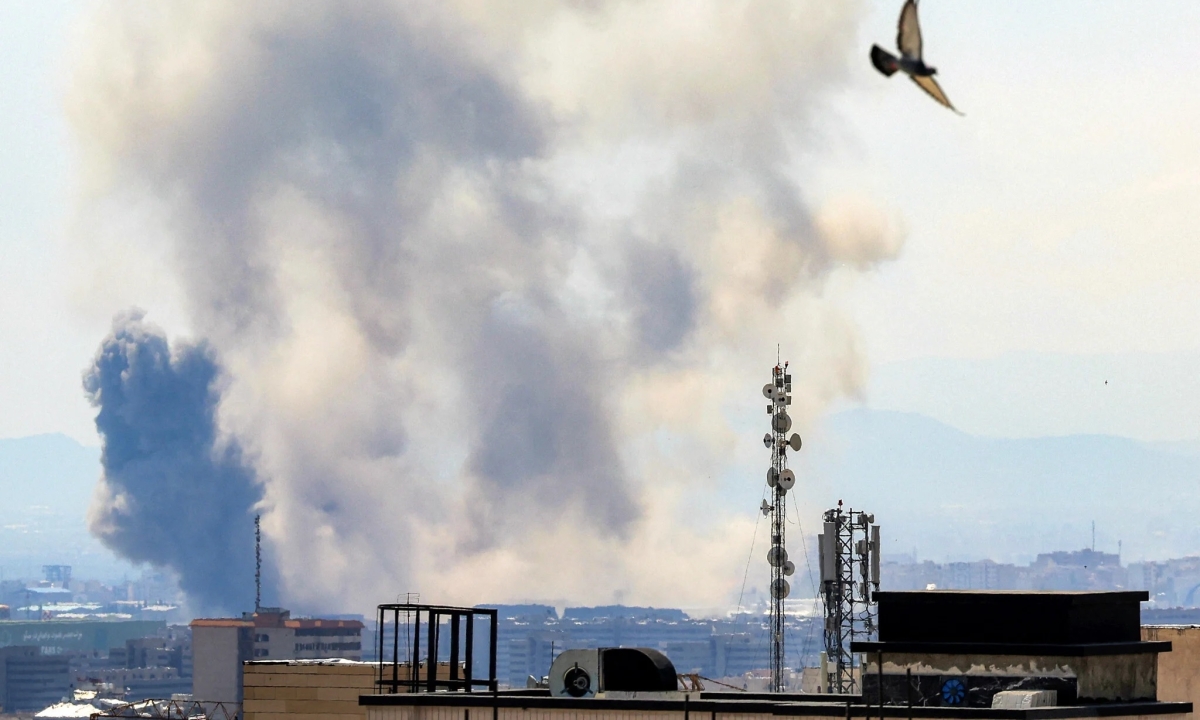
Smoke rose in the capital Tehran, Iran, after US-Israeli raids on April 7. Image: AFP
Many Americans are expressing anger, disappointment, and even confusion as the conflict with Iran has entered its 7th week. Last weekend, peace negotiations between the US and Iran went nowhere and President Trump began to return to tough statements, and ordered a blockade of Hormuz in response to Iran closing the strait.
Public opinion polls of NYTimes in early March showed that 59% of Americans polled opposed war against Iran, a far cry from the strong public support for the intervention campaigns in Iraq and Afghanistan in the early 2000s or the Gulf War in the 1990s.
Some people say they feel surprised by an attack campaign that President Trump has not fully prepared for the people and has not been clearly explained until now.
“I don’t think Mr. Trump is making a wise decision,” Emmelia Lorenzen, 19, said while drinking coffee in Fayetteville, North Carolina.
But those were only silent protests, taking place in conversations at cafes or veterans’ halls and only leading to small protests in some places.
“I find it hard to believe there aren’t many people on the streets, but really, now it’s hard to be surprised or shocked by anything the President does,” Mike Keefe, 64, said while standing with a sparse group of protesters in Portland, Oregon.
American voters’ views on the war in Iran differ by party. According to a survey conducted by the Pew Research Center before the recent ceasefire, the majority of Democratic voters oppose this war, while the majority of Republican voters support the President.
But in a sign of potential trouble for Trump and the Republican Party ahead of the midterm elections later this year, Pew’s survey found that independents tend to favor the narrowly divided Republican party, with 52% approving of the President’s handling of the war and 45% disapproving.
According to poll by CNN At the end of March, there were also some signs of rifts within the Republican Party over the war. Republican voters who are not “MAGA members” tend to support the war less strongly than groups belonging to this movement.
Poll results show that younger Republicans are also less likely to support President Trump’s decision to take military action than those over 45 years old.
Overall, those who self-identify as independent voters are overwhelmingly opposed. This is an important group that can determine the electoral outcome in US battleground states.
Even Republican voters who supported the war don’t necessarily think things are going smoothly. According to Pew’s survey, only about 50% of them think the pressure campaign on Iran is progressing well.
Anxiety
In a series of recent interviews, voters in cities with US military bases such as Colorado Springs, San Antonio or Fayetteville expressed concern that Mr. Trump, who once ran with a message opposing “stupid wars” abroad, is pushing the US into a second Iraq or Afghanistan.
A month and a half have passed, many people said they still do not clearly understand what the President’s goal in Iran is or why he and Israel attacked at this time. Everything happened too fast and erratically, they said.
Previous presidents such as George W. Bush or George HW Bush spent many weeks, even months, to convince domestic public opinion about attacking Afghanistan, Iraq and the campaign to repel Iraqi troops from Kuwait in 1991. Multinational alliances, whether voluntary or not, were also established. Debates also emerged throughout the meeting rooms of the US Congress.
But Mr. Trump announced the launch of a campaign against Iran without notifying Congress in advance, without consulting allies, and without taking any action to convince American public opinion.
And the constantly changing series of statements that Mr. Trump made in phone calls with reporters or late-night posts on Truth Social only added to the public confusion.
Nearly two-thirds of voters and 71% of those with no party affiliation believe Trump did not provide a clear explanation before the war began, according to a Quinnipiac University poll in early March.
On the contrary, polls show that the majority of the public feels that former President Bush made convincing arguments before the war in Iraq broke out.
Lorenzen, who voted for Mr. Trump, was particularly concerned by the threat of destroying Iran’s entire civilization if it did not reopen the Strait of Hormuz, a danger that was averted at the last minute when the US and Iran agreed to a two-week ceasefire.
President Donald Trump at the White House on April 13. Image: AP
“One of Mr. Trump’s biggest campaign drivers was his declaration that he would not pursue war,” Lorenzen said. “And yet as soon as he made the announcement, he pushed the country into war so quickly. I really don’t understand.”
The consequences of the wars in Iraq and Afghanistan have contributed to American voters’ views on the current conflict in Iran. In interviews, they repeated false claims about weapons of mass destruction that were used to explain the 2003 invasion of Iraq and the chaotic withdrawal from Afghanistan and wondered whether history was repeating itself.
Queta Rodriguez, 55 years old, a Marine veteran who was stationed at Quantico base, Virginia, said she still remembers the feeling of extreme sadness and the overwhelming solidarity of the American people after the terrorist attacks of September 11, 2001 shocked the country. She did not agree with former President Bush’s reasoning for attacking Iraq, but felt he at least tried to call on people to unite.
Now, Rodriguez, who lives in San Antonio, said she is very disappointed with President Trump for pushing the country into war in an area where many soldiers have died. She felt dissatisfied because parliament did not restrain the President and was heartbroken to see that many people seemed to be indifferent to the incident.
Faith
However, other veterans and their relatives, a group that tends to support Republicans, said they still support President Trump and the war. They believe that Iran has sponsored armed forces that have spread crisis throughout the Middle East and has helped kill hundreds of American soldiers.
Mr. Trump’s critics say the attacks on Iran were arbitrary, but his supporters believe this should have been done a long time ago.
“Iran is a threat that needs to be dealt with,” veteran Gary Freese, 58 years old, who fought in Iraq, said, adding that President Trump showed “how brave” he was when he ordered an attack on Iran.
Support for Mr. Trump’s campaign in Iran is also strong in areas such as rural western Iowa, where he has won each of the last three presidential elections by large margins.
Kelly Garrett, 51, is one of many farmers who support the attack on Iran, even though they don’t fully understand the reasons. Many Republican voters still have absolute trust in the President.
Rural areas, already reeling from Mr. Trump’s tariffs and tightened immigration policies, are now suffering another economic blow when the closure of the Strait of Hormuz causes fertilizer and diesel prices to skyrocket just as farmers are preparing for new crops.
However, many Republican farmers in Iowa blame profit-seeking corporations instead of President Trump for these rising prices.
Wayne Brincks, 72, a retired farmer, thinks the short-term price is worth it if it prevents Iran from developing nuclear weapons.
“I think the President believes that now is the time to act, otherwise there will be no more opportunities. We have to do something,” he said.
Soldiers of the 82nd Airborne Division prepare for parachute exercises at Fort Bragg, North Carolina, in 2022. Photo: US Army
But even in a place as strongly Republican as Iowa, doubts and worries are starting to surface. Mark Nelson, 35, a Republican farmer and Woodbury County councilman who voted for Mr. Trump, said the campaign to attack Iran undermined the President’s “America first” message.
Such criticism is also appearing more and more among influential people in the pro-Trump movement, such as conservative activists Tucker Carlson, Alex Jones and Megyn Kelly, who have called for strong support for the President.
“The amount of money and resources poured into this war is overwhelming,” Nelson said. He questioned how much Israel influenced the President’s decision to go to war. “I don’t think we are facing any direct threat.”
https://baldwinrecords.org/criminal-records
https://baldwinrecords.org/divorce-records
https://baldwinrecords.org/inmate-search
https://baldwinrecords.org/property-records
https://baldwinrecords.org/warrant-search
https://barryrecords.org/
https://barryrecords.org/arrest-records
https://barryrecords.org/court-records
https://barryrecords.org/criminal-records
https://barryrecords.org/divorce-records
https://barryrecords.org/inmate-search
https://barryrecords.org/property-records
https://barryrecords.org/warrant-search
https://beaufortrecords.org/
https://beaufortrecords.org/arrest-records
https://beaufortrecords.org/court-records
https://beaufortrecords.org/criminal-records
https://beaufortrecords.org/divorce-records
https://beaufortrecords.org/inmate-search
https://beaufortrecords.org/property-records
https://beaufortrecords.org/warrant-search
https://bedfordrecords.org/
https://bedfordrecords.org/arrest-records
https://bedfordrecords.org/court-records
https://bedfordrecords.org/criminal-records