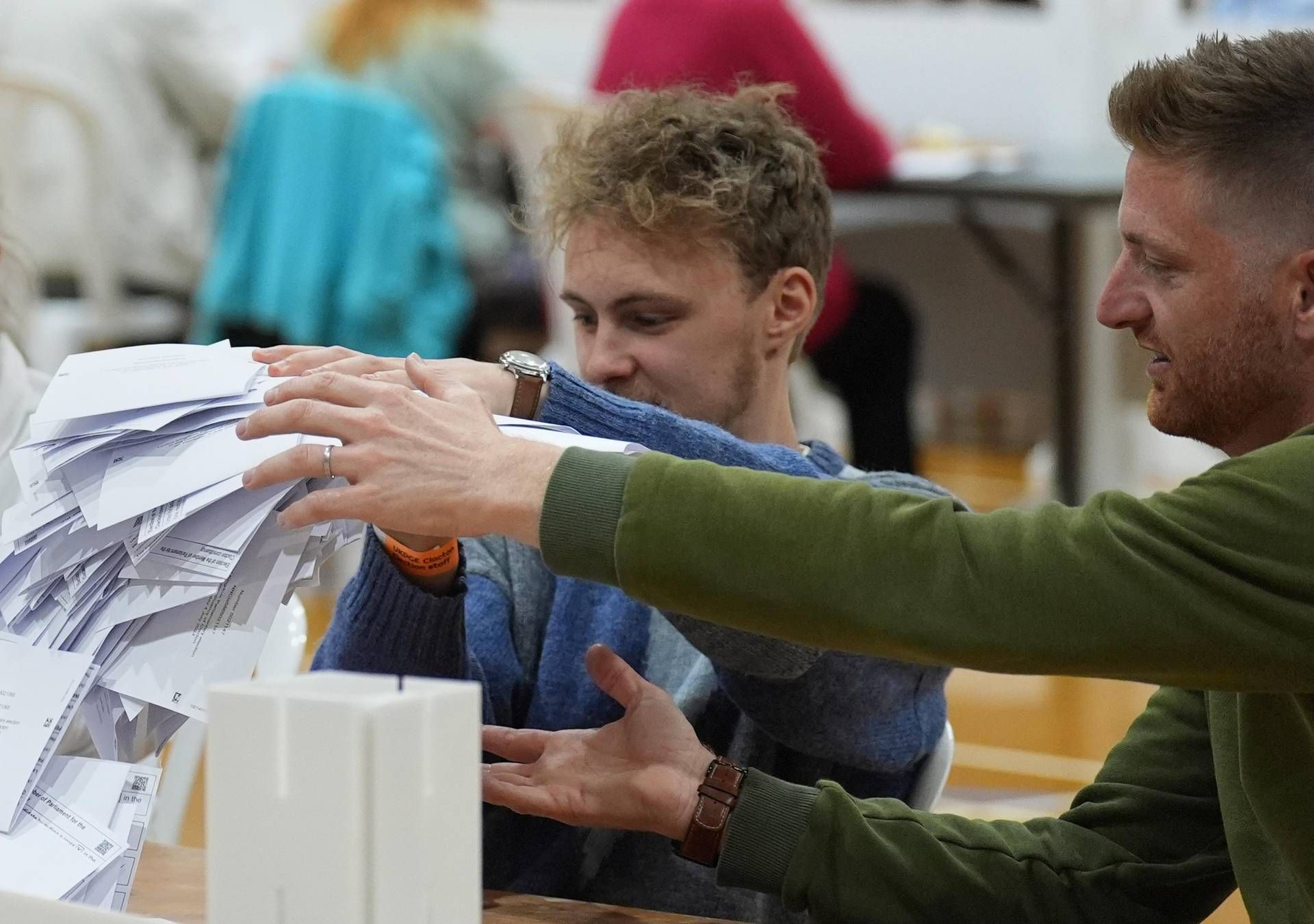
United Kingdom will face on Thursday 7 May its most significant electoral test since the 2024 general election. They will be over 20 million citizens called to vote in a round that will reshape not only the local panorama, but also the delicate balance of the country’s nations. In Scotland all 129 members of Parliament will be re-elected, while in Wales there will be 96 seats up for grabs. However, the heart of the challenge beats in England, where over 5,000 seats in 136 local authorities will have to be renewed.
Testing ground for the current government
It will be a test for the current government, led by Keir Starmer’s Labor Party, but also for its historic opponents, Kemi Badenoch’s Conservatives. Both, according to the most recent polls, around 18%, caught in the grip of Reform UK, the right-wing coalition led by Nigel Farage which stands at 24%, and the Green Party, the left-wing group whose leader is Zack Polanski now rising strongly at 17%, followed by Ed Davey’s Lib Dems at 13%.
“It is now clear that people are preparing to vote against the two parties that have dominated the British political scene since 1945. A dominance, characterized by the Conservatives and Labour, which is increasingly creaking and within a few days we will have tangible proof of their failure”, Tony Travers, professor, analyst and director of the LSE – London School of Economics and Political Science, tells Adnkronos, commenting on the current political scenario of the country in view of the imminent electoral round.
Although these are technically local elections, the national political weight is predominant. According to Travers, in fact, the local vote has become a tool of protest against the current leadership: “There is no doubt that the polls suggest that people are using it as a mid-term opportunity to show their exasperation with the Labor government, but also with the Conservative opposition.”
The director of the LSE underlines how everyday issues are taking a backseat to the figure of the prime minister: “Although the general disappointment concerns safety on the roads, the cleanliness of the streets, the cost of living, inflation and all the things that people see outside their front door, what citizens are most interested in now is whether or not the Labor Party, as national government, and Keir Starmer, as prime minister, remain in office until the natural expiry of the mandate, expected for the summer of 2029”.
The current political situation
The Labor Party arrives at this meeting in an extremely fragile position. The last year has seen consensus collapse due to heavy internal shadows and international turbulence. In the foreground is the Mendelson affair, linked to the ‘Epstein Files’: Starmer has denied any direct involvement, but the rumors of those who claim he had been warned of the possible implications continue to wear down his credibility. Added to this is unprecedented international isolation. After the recognition of the Palestinian state in September 2025, relations with Washington deteriorated, worsening further after the British refusal to support the Trump administration in the recent conflict against Iran, other than simply authorizing the US to use some British bases for possible attacks in the war in the Middle East.
These weaknesses have opened enormous gaps for the smaller forces, putting into crisis the two-party system that has held for eighty years. On one side Reform UK attacks from the right, on the other the Greens press from the left. Travers notes that this phenomenon is not fleeting: “There is a feeling that the two old parties have failed in the eyes of public opinion. This fragmentation is transforming the UK into a multi-party democracy similar to those in the rest of Europe, although the national electoral system is not structured to manage it.”
The grip Labor finds itself in is particularly tight as its opponents move on opposite tracks. The analyst explains that it is almost impossible for Starmer to find a summary: “When they face off against Reform, it’s about immigration: high levels of illegal flows that Nigel Farage’s coalition promises to drastically reduce. When they face off against the Greens, it’s more about international relations: it’s about Britain’s relationship with the United States and Israel in the Middle East or human rights issues. In this scenario, Starmer finds himself managing a political identity crisis that could be fatal.”
In conclusion, according to Travers, “Labor is fighting not just on two fronts, but against two parties with diametrically opposed views. Trying to come up with a vision that wins over both groups of voters is impossible. Thursday’s vote will tell whether the British system will be able to withstand the impact or whether we are facing the definitive decline of the traditional duopoly”. (by Alessandro Allocca)