The crash of two US EA-18G aircraft in Idaho state may have originated from blind spots during maneuvers or pilot errors.
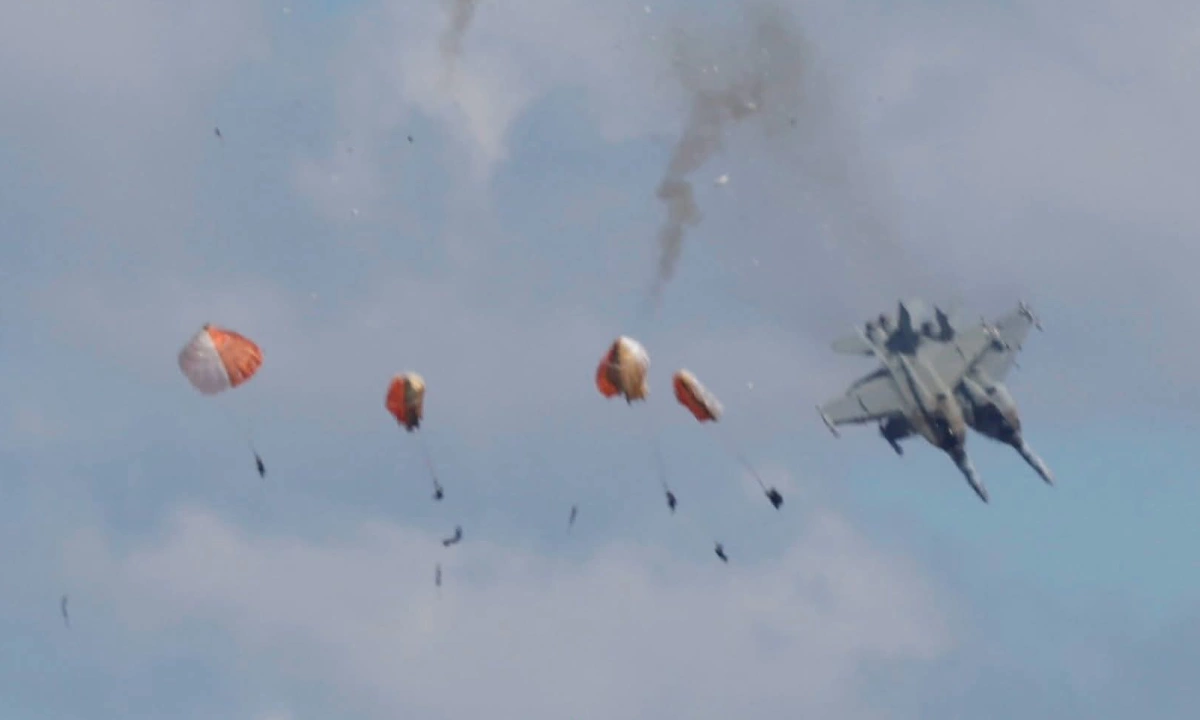
While performing at Mountain Home Air Force Base in Idaho on May 17, two EA-18G Growler fighters of the US Navy’s 129th Electronic Attack Squadron collided and stuck together, spun out of control and began to freely fall. All four pilots ejected safely and were not in danger of their lives.
US naval officials are conducting an investigation and have not announced the preliminary cause of the incident. The US National Weather Service said that at the time of the incident, the area had good visibility and wind gusts were about 47 km/h.
Pilots parachuted after two American EA-18G fighters collided in the air on May 17. Image: X/KC135BOOMER
Howard Altman, editor of the American military website War Zonecommented that the accident may have originated when the two aircraft maneuvered and lost sight of each other, causing the first EA-18G to enter the blind spot under the nose of the second aircraft.
Video of the scene shows the second EA-18G descending and shortening the distance while the other plane is pulling higher. Both crews did not seem to detect imminent danger and did not take any evasive maneuvers until the collision occurred.
This is the cause that has led to disasters at several other air shows, including the B-17G bomber colliding with the P-63F fighter in Texas in 2022, killing all 6 people on the two planes.
“Simulation analysis shows that the pilots had limited ability to observe and avoid, due to the flight path and vision being obscured by parts on the aircraft,” the US National Transportation Safety Board (NTSB) said in its report after the accident at that time.
American P-63 fighter collided with B-17 bomber in Texas in 2022. Video: X/Faytuks
Dr. Carl Morris, a former expert who worked at the Traffic Data Bureau of the US Department of Transportation, published a report on mid-air collisions in 2025, saying that the crew is at risk of not detecting that the plane is about to crash into them in some situations such as increasing and descending altitude, or flying at the same altitude with a diagonal angle.
Aviation safety expert Jeff Guzzetti said the cause was pilot error. “It seems like it’s not a technical problem. Flying close together to form a formation is very difficult and requires precision to avoid incidents like the above,” he said.
John Cox, CEO of aviation safety consulting company Safety Operating Systems, noted that performing at air shows requires a high level of skill, and any mistake can lead to disaster. “Demonstration flying is very difficult and allows for very few mistakes. I’m very happy that everyone is safe,” he said.
Collision situations when ascending, descending and leveling. Graphics: Research Gate
According to expert Guzzetti, it is surprising that both Growler flight crews escaped safely, because mid-air collisions often come with the risk of the crew losing consciousness or dying as soon as the plane crashes, as well as not being able to eject seats due to damage to the plane.
“It was impressive to see that scene. It seemed that the two fighters crashed into each other in a very special way, leaving them intact and stuck together. That most likely saved their lives,” Guzzetti said.
This is the first time Mountain Home base has held a performance event since 2018, when a paraglider died while performing here. In September 2003, an F-16 fighter had a problem while performing an acrobatic maneuver on this base. The pilot took the plane out of a crowded area and launched an emergency chair just one second before the plane hit the ground.
American EA-18G fighter collided while performing at Mountain Home base, Idaho, USA on May 17. Video: Idaho News
There are about 200 airshows taking place in the US each year, and organizers have been working to improve safety over the years.
John Cudahy, president and CEO of the International Council of Air Shows, said that in the past, an average of about two people died each year at US air shows. This number has dropped to an average of nearly one case per year over the past decade.
https://arlingtonlandscapingservices.com/gardening/brush-removal
https://arlingtonlandscapingservices.com/gardening/flower-bed-maintenance
https://arlingtonlandscapingservices.com/gardening/flower-planting
https://arlingtonlandscapingservices.com/gardening/hedging
https://arlingtonlandscapingservices.com/gardening/mulching
https://arlingtonlandscapingservices.com/gardening/plant-removal
https://arlingtonlandscapingservices.com/gardening/pruning
https://arlingtonlandscapingservices.com/gardening/weeding
https://arlingtonlandscapingservices.com/lawn-care
https://arlingtonlandscapingservices.com/lawn-care/artificial-grass-installation
https://arlingtonlandscapingservices.com/lawn-care/dethatching-lawn
https://arlingtonlandscapingservices.com/lawn-care/fertilizing-lawn
https://arlingtonlandscapingservices.com/lawn-care/hydroseeding
https://arlingtonlandscapingservices.com/lawn-care/lawn-aeration
https://arlingtonlandscapingservices.com/lawn-care/lawn-edging
https://arlingtonlandscapingservices.com/lawn-care/lawn-grubs-control
https://arlingtonlandscapingservices.com/lawn-care/lawn-installation
https://arlingtonlandscapingservices.com/lawn-care/lawn-leveling
https://arlingtonlandscapingservices.com/lawn-care/lawn-mowing
https://arlingtonlandscapingservices.com/lawn-care/lawn-renovation
https://arlingtonlandscapingservices.com/lawn-care/lawn-seeding
https://arlingtonlandscapingservices.com/lawn-care/sod-installation
https://arlingtonlandscapingservices.com/lawn-care/weed-control
https://arlingtonlandscapingservices.com/yard-clean-up
https://arlingtonlandscapingservices.com/yard-clean-up/green-waste-disposal