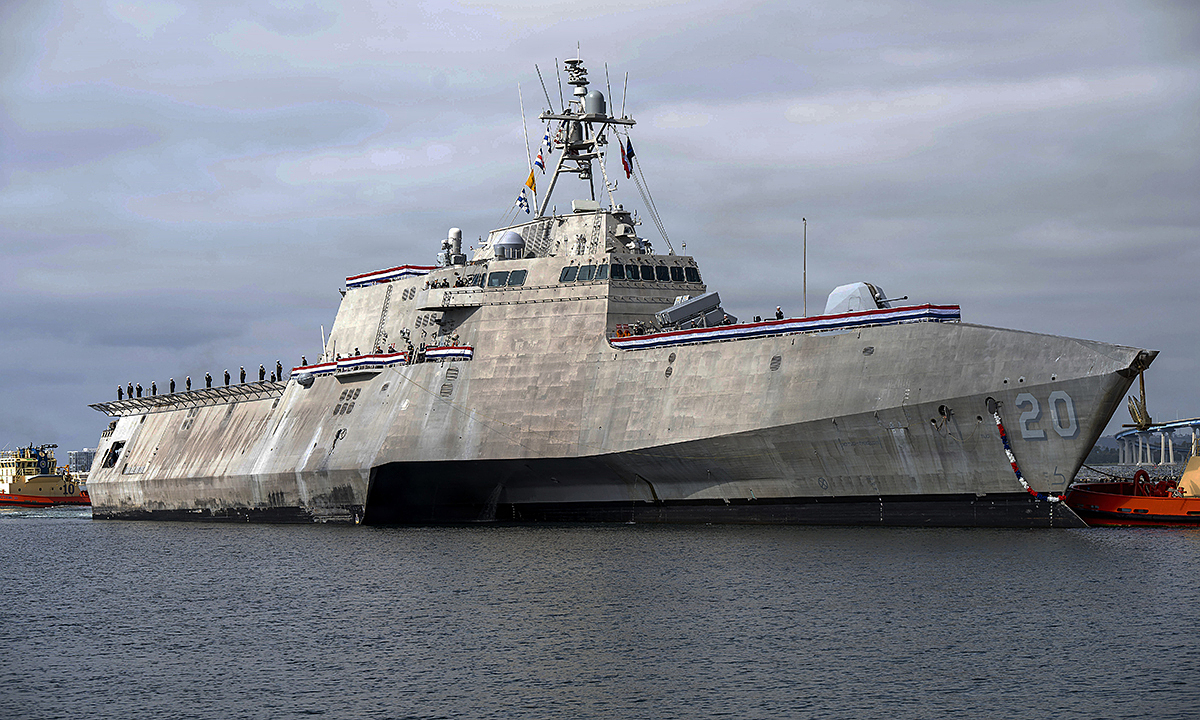
The US littoral combat ship force, which has been criticized for many errors and waste, faces an uncertain future after commissioning its last ship.
The US Navy in mid-month held a commissioning ceremony for the USS Cleveland, the last ship in the contract to order 35 littoral combat ships (LCS). Acting Secretary of the US Navy Hung Cao used the phrase “steel, strength, power” when mentioning this event on social networks.
However, not everyone shares the same opinion, many people question the future of the LCS project after USS Cleveland is commissioned. In the comments section under Mr. Hung Cao’s post, a series of accounts criticized warships of this type for being “easy to hit” and called them “failed tests”.
Theo CNNthe LCS program is estimated to have cost $60 billion. ProPublicaa famous American investigative newspaper, estimates that the final cost could be up to 100 billion USD. “This is one of the worst waste cases of the US military, which is associated with a history of purchasing too expensive and ineffective weapons,” the newspaper said.
The USS Cleveland during the launching ceremony in April 2023. Video: Youtube/Wiscomau5
The LCS program began in 2004, when US naval officials searched for a warship model that could operate in coastal areas, where large ships such as destroyers and cruisers were vulnerable. At this time, the US Navy also eliminated many large warships and wanted to replace them with small ships that could be built quickly and at a cheaper price.
In March 2004, the US Navy made a big gamble when it asked Lockheed Martin Corporation and Australian company Austal to build 4 LCS ships each year, with the goal of owning 49 out of 56 LCS ships by 2019 with a total cost of less than 30 billion USD.
LCS was initially assessed to have a modern, cheap, flexible and optimal design for the task of patrolling shallow waters near the shore and busy maritime traffic such as in the Middle East. They are expected to become the backbone of the world’s strongest navy by 2025.
The US Navy said it wanted to test something different with the LCS, expecting the ship class to be able to quickly change configuration for different tasks such as mine clearance, submarine hunting or maritime combat.
However, the US Navy chose two designs for the LCS, including the Freedom-class single-hull steel ship and the Independence-class aluminum-hull three-hull ship. According to military experts, this decision has further complicated logistics and supply chain issues.
Equipped on Independence and Freedom class coastal combat ships. Graphics: US Navy
LCS ships do not use traditional propeller and rudder designs, but are equipped with pump-jet propulsion systems, allowing them to operate in shallow waters, avoiding the risk of entanglement in electrical wires or cables. The US Navy evaluates the LCS ship to be high speed, agile and possess the ability to deal with fleets of small boats and ships, while also being flexible enough to clear mines.
However, a series of problems began to arise as soon as the project was implemented. The first ship, named USS Freedom, cost up to 400 million USD when launched in 2006, an increase of 180 million USD compared to the original estimate.
Due to hasty design, this class of ships also continuously had errors with the structure and mechanical systems. USS Freedom and USS Independence had maintenance problems in 2010 and 2011, having to stay in port for many months. USS Fort Worth suffered an engine failure in Singapore due to an operating error in January 2016, causing the 4-year-old warship to stop operating for 8 months.
USS Freedom’s engine failed again during an exercise with the Pacific Fleet in 2016 and took two years to repair. Many incidents over the next year also caused the US Navy to decide to stop all large-scale deployments with LCS, and reallocate the program’s budget to other places.
After 14 years of operating the first LCS ship, the US Navy is increasingly disappointed with this class of warship because it does not meet combat needs. The plan to order 56 ships was also reduced to only 35 ships.
In early 2022, the US Navy proposed to scrap 9 Freedom-class ships with a total value of 4.5 billion USD. The US Congress blocked the plan, on the grounds that the US military needed warships and protected the billions of dollars in budget allocated to the program. This forced the US Navy to make the most of the ships that the officials in charge wanted to get rid of a few years earlier.
To date, 7 LCS have been removed from service, of which the USS Sioux City has only been in operation for 5 years.
The USS Santa Barbara tested launching the UAV LUCAS in the Arabian Gulf in December 2025. Video: US Navy
In the shipbuilding plan for 2026, the US Navy evaluates the LCS as “an essential warship of the low-level fleet, capable of complicating the enemy’s decisions”. LCS ships can fight mines, as well as effectively fight against seas thanks to NSM anti-ship missiles.
“The strategy with LCS is to switch from buying new to maintaining and modernizing so that these ships always ensure combat capability and reliability throughout their operating life,” the US Navy said.
However, military experts doubt this. Emma Salisbury, an expert at the Foreign Policy Research Institute (FPRI) based in the US, believes that it is necessary to consider the usefulness of LCS in combat, because these ships have never actually fought.
She pointed out that there is no evidence that the three LCS ships stationed in the Middle East do a good job of mine clearance. In April, the US announced that it was establishing conditions for this operation in the Strait of Hormuz, but only deployed two destroyers instead of LCS ships.
Carl Schuster, former executive director at the Joint Intelligence Center of the US Pacific Command, commented that the LCS does not have strong enough air defense capabilities to perform tasks in conflict areas. He also expressed skepticism about the US Navy’s announcement in 2025 to upgrade the defense system on LCS ships to deal with unmanned aerial vehicles (UAVs).
The USS Cincinnati at San Diego naval base, California, USA on March 4. Image: US Navy
“They easily become targets of cruise missiles, UAVs or other air assets. They are almost powerless in combat scenarios, even anti-piracy patrols are dangerous for LCS,” Schuster said.
Salisbury and Schuster both believe that the LCS is only a temporary solution for the US Navy, likely to have to give way to the class of defense ships codenamed FF(X) announced in December 2025.
FF(X) was developed on the basis of the Legend class patrol ship of the US Coast Guard. They are expected to have a displacement of 4,750 tons, a maximum speed of 52 km/h, a range of 22,000 km, and be equipped with a 57 mm Mk.110 naval gun, a 30 mm Mk.38 gun, a SeaRAM air defense complex with 21 RIM-116 missiles, 16 NSM anti-ship missiles or 48 AGM-114 Hellfire missiles.
Former Colonel Schuster believes that there is no longer a bright or long-term future for the LCS fleet. “They will be retained until the new corvette comes into operation in the next 3-4 years. The US Navy will then quietly eliminate the LCS ships, one or two at a time,” he commented.
https://medium.com/@strateh76/10-top-alternatives-to-agencyanalytics-9e5530a3f95d
https://ivan474800.substack.com/p/10-premier-alternatives-to-agencyanalytics