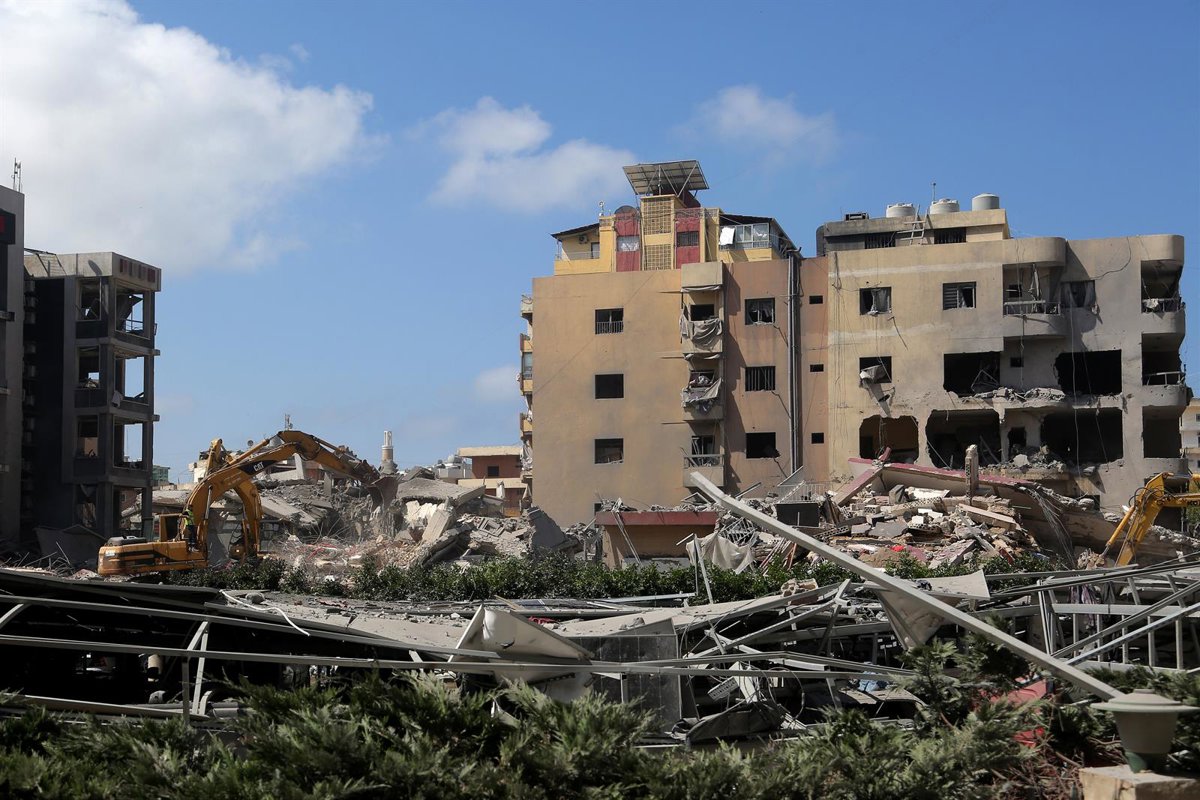
At least seven people, including a paramedic, died this Wednesday due to new bombings carried out by the Israeli Army against southern Lebanon, amid the intensification of Israeli bombings and after the president of the United States, Donald Trump, announced on Monday an agreement according to which Israeli troops would not be sent to the capital, Beirut.
According to information collected by the Lebanese state news agency, NNA, at least four people, all of them Syrian nationals, have been killed in an attack carried out by a drone in the Al Hush area. Furthermore, another attack on the road between Al Hush and Al Maamura has killed two Palestinians.
Added to the fatalities is a paramedic from the Al Risala Ambulance Association, hit in a bombing carried out by a drone in the city of Nabatiye. The man has been identified as Alí Salman Nader, a resident of this same town.
On the other hand, a bombing has hit a vehicle that was traveling on a road in the surroundings of Jaldé, a city located just south of Beirut, without at the moment there being information about possible victims and without Israel having commented on these new attacks.
In this context, the Arabic spokesman for the Israeli Army, Avichai Adrai, issued evacuation orders early in the day for the towns of Arzi, Mzaret Kozriyé, Al Raz and Al Zariyé, in the midst of the displacement of tens of thousands of people due to Israel’s attacks.
“Given the violations of the ceasefire agreement by the terrorist group Hezbollah and its attacks against the Israeli internal front, the Army is forced to act against it with force, especially in its areas,” he said in a message published on social networks.
“For their safety, they must evacuate their homes immediately and move north of the Zahrani River,” warned Adrai, who stressed that “anyone who is close to Hezbollah elements, their facilities and their combat assets puts their lives in danger.”
For its part, the World Health Organization (WHO) has condemned the attacks carried out by Israel against medical centers in Lebanon as part of its offensive against the country, including the death of four people in bombings on Tuesday against the surroundings of a hospital in the city of Tire (southern).
The director general of the WHO, Tedros Adhanom Ghebreyesus, has lamented that “attacks on health in Lebanon continue to take lives and deprive the population of access to healthcare”, before adding that the attacks against the surroundings of the Yabel Amel Hospital in Tire left 39 health workers injured, in addition to “serious” damage to the emergency department and an intensive care unit.
“The WHO is verifying the figures and the full extent of the impact,” he said in a message on social networks, in which he recalled that “Hiram Hospital suffered damage on May 22 and May 31, which caused injuries to 37 health workers.” “Despite this damage, these hospitals continue to face a growing flow of patients from mass casualty events,” he warned.
In this sense, he stressed that the WHO has been able to verify 191 attacks against the Lebanese health system since March 2, with 128 deaths and 371 injuries among health personnel and patients. For this reason, it has reiterated its call for the protection of these facilities, staff and patients, “in line with International Humanitarian Law.”
Trump revealed on Monday that he had had a “very productive” conversation with Israeli Prime Minister Benjamin Netanyahu, who pledged not to send troops to Beirut, before highlighting that he has also maintained contacts with members of the Lebanese Shiite militia party, Hezbollah, who “have agreed to stop shooting.” “Israel will not attack them and they will not attack Israel,” he added.
The last large-scale hostilities broke out on March 2, when Hezbollah launched projectiles against Israel in response to the assassination of Iran’s supreme leader, Ayatollah Ali Khamenei, in the offensive launched on February 28 by Israel and the United States against the Asian country.
The parties had agreed to a ceasefire in November 2024 after thirteen months of fighting following the attacks of October 7, 2023, although since then Israel continued to launch frequent bombings against the country and maintained the presence of the military in several points arguing that it was acting against Hezbollah, amid complaints from Beirut and the group about these actions.
https://arkansasstatesolar.org/cost/
https://arkansasstatesolar.org/financing/
https://arkansasstatesolar.org/installation/
https://arkansasstatesolar.org/laws/
https://arkansasstatesolar.org/residential/
https://arkansasstatesolar.org/solarbasics/
https://indianastatesolar.org/
https://indianastatesolar.org/community/
https://indianastatesolar.org/cost/
https://indianastatesolar.org/financing/
https://indianastatesolar.org/installation/
https://indianastatesolar.org/laws/
https://indianastatesolar.org/residential/
https://indianastatesolar.org/solarbasics/
https://kansassolar.org/
https://kansassolar.org/community/
https://kansassolar.org/cost/
https://kansassolar.org/financing/
https://kansassolar.org/installation/
https://kansassolar.org/laws/
https://kansassolar.org/residential/
https://kansassolar.org/solarbasics/
https://kentuckysolar.org/
https://kentuckysolar.org/community/