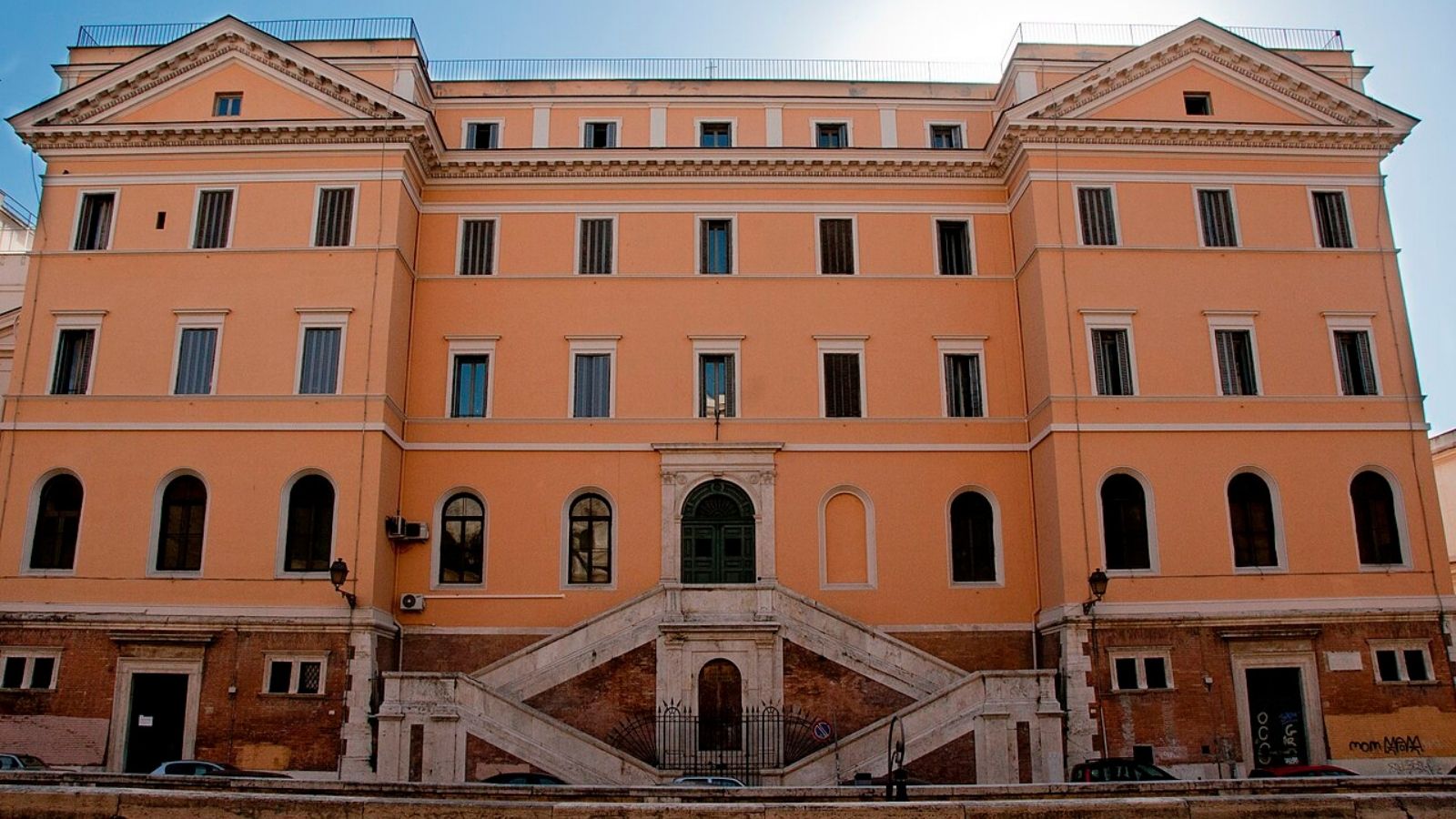
A recent discovery has turned a high school in Rome into a new point of interest for researchers into the history of the Roman Empire. Underneath the gymnasium of the Liceo Scientifico Cavour school, in the central region of the Italian capital, archaeologists found a luxury residence built around 1,800 years ago, with frescoes, mosaics and ornaments preserved.
The excavation began in January 2026, after reports made by students about the existence of underground environments reached the Special Superintendency of Rome through History and Latin teacher Claudia Marino.
Archaeologists confirmed that the spaces belonged to an ancient domusas the houses of the richest families in Ancient Rome were known.
The curious thing is that, for years, students at that school told stories about the existence of hidden rooms beneath the gymnasium where they practiced sports. But the legend was real.
The property preserves colorful murals, mosaics, stucco reliefs and other elements that help archaeologists understand how part of the elite of Ancient Rome lived.
How and where did the discovery of the 1,800-year-old luxury home happen?
The first signs emerged long before the excavations. According to Live Science magazine, Several students explored, on their own, underground tunnels under the school building and found ancient corridors and rooms.
The situation changed when Claudia Marino was informed about the clandestine explorations. She reported the site to the body responsible for the city’s archaeological heritage. The discovery, however, was only announced in May this year, by Professor Filippo Coarelli, an archaeologist at the University of Perugia, in Italy.
Liceo Scientifico Cavour is located in one of the most historic areas of Rome, close to the Colosseum and the Roman Forum. Before operating as a school, the building housed a Catholic missionary congregation.
When this construction was built at the end of the 19th century, archaeologists had already found part of an ancient domus. Even so, much of the construction remained buried for more than a century.
The region has enormous historical importance. Historians believe that famous politicians from Ancient Rome maintained residences in this neighborhood during the period of the Roman Empire.
Archaeologists concluded that the house was built in the mid-2nd century AD. To date, only a portion of the residence has been excavated, as the structure remains below the school building and probably extends into areas that have not yet been explored. For now, the archaeological site has been named Domus Liceo Cavour.
What does the residence found beneath the Roman school gymnasium look like?
Below the gymnasium floor were preserved several rooms from the old residence. Archaeologists found virtually intact walls, narrow corridors and decorated rooms, protected for centuries by layers of earth and rubble.
According to Coarelli, one of those responsible for the excavations, the work was particularly complex due to the small spaces, no natural lighting and little air circulation. Before removing the sediments, it was necessary to reinforce part of the structure to avoid the risk of collapse.
The residence preserves several typical elements of the mansions of the Roman elite from the 2nd century. Among the main findings are:
- murals with human figures and floral motifs;
- stucco decorations on vaulted ceilings;
- ornamental friezes and geometric designs;
- a black mosaic made up of large irregular stones, a style considered sophisticated for the time;
- ceramic fragments, such as amphorae and containers used in everyday life.
The researchers also identified much more recent graffiti, made between the 1920s and 1950s by students, visitors and others who had access to the underground environments before they were once again forgotten.
Who were, in fact, the residents of the residence?
The researchers They have not yet reached a conclusion about who lived in the residence. According to Live Science, an inscription found during excavations carried out in the 19th century suggests that the residence may have belonged to a member of the Umbrius family, a group about which there is little historical information.
However, archaeologists believe they originated in south-central Italy, near Pompeii, and moved to the region.
The portal Wanted in Rome reports that stratigraphic analyzes identified former owners. The first of these would be L. Fabius Gallus, a Roman senator from the 2nd century AD. He served as suffect consul (equivalent to a vice president) in the year 131 and is mainly known for being cited on archaeological objects such as seals on lead pipes, as he is said to have been the owner of a private water supply system in Rome.
The analyzes also later identified a woman named Umbria Albina as the owner of the property. She would have been a Roman aristocrat. Umbria’s name was also found on water pipes. Archaeologists are still studying the remains to determine more precisely who occupied the residence over the centuries.
Whether from Umbria or Gallus, the house found was considered noble for the time. This happens because, in Ancient Rome, decoration was one of the main indicators of wealth. The preserved frescoes, stucco details and mosaic found show that the owners invested in sophisticated finishes, typical of the residences of the richest families of the Roman Empire.
The so-called “Pompeian red”, a shade widely used in Roman mural painting, still appears alive on part of the walls, even after almost two thousand years. For archaeologists, the preservation of the environments offers a rare opportunity to observe construction techniques, decorative patterns and aspects of the daily life of the Roman elite.
Rome still hides ancient buildings beneath the modern city
Rome is considered one of the most archaeologically complex cities in the world. Over more than two thousand years of continuous occupation, new constructions were built over old buildings, creating successive historical layers beneath streets, squares and modern properties.
That’s why, excavations for infrastructure works often reveal temples, houses, roads, aqueducts and other remains of the Roman past.
In the case of Liceo Cavour, the site will also be the result of studies, but the excavations have not yet been completed. The researchers believe that the residence remains under other areas of the school and could be investigated in the future.
The school management and the Special Superintendency of Rome are considering opening the archaeological site for public visitation. Among the possibilities discussed is the participation of the students themselves as guides, introducing visitors to the history of the residence discovered beneath the gymnasium where they study.
San Antonio, TX Professional Lawn Installation Services | SanAntonioLandscaping.us
San Antonio, TX Professional Lawn Leveling Services | SanAntonioLandscaping.us
San Antonio, TX Professional Lawn Mowing Services | SanAntonioLandscaping.us
San Antonio, TX Professional Lawn Renovation Services | SanAntonioLandscaping.us
San Antonio, TX Professional Lawn Seeding Services | SanAntonioLandscaping.us
San Antonio, TX Professional Sod Installation Services | SanAntonioLandscaping.us
San Antonio, TX Professional Weed Control Services | SanAntonioLandscaping.us
San Antonio, TX Professional Yard Clean Up Services | SanAntonioLandscaping.us
San Antonio, TX Professional Green Waste Disposal Services | SanAntonioLandscaping.us
San Antonio, TX Professional Gutter Cleaning Services | SanAntonioLandscaping.us
San Antonio, TX Professional Junk Removal Services | SanAntonioLandscaping.us
San Antonio, TX Professional Leaf Removal Services | SanAntonioLandscaping.us
San Antonio, TX Professional Tree Removal Services | SanAntonioLandscaping.us
Austin, TX Landscaping Services | AustinLandscaping.us
Austin, TX Professional Gardening Services | AustinLandscaping.us
Austin, TX Professional Brush Removal Services | AustinLandscaping.us
Austin, TX Professional Flower Bed Maintenance Services | AustinLandscaping.us
Austin, TX Professional Flower Planting Services | AustinLandscaping.us
Austin, TX Professional Hedging Services | AustinLandscaping.us
Austin, TX Professional Mulching Services | AustinLandscaping.us
Austin, TX Professional Plant Removal Services | AustinLandscaping.us
Austin, TX Professional Pruning Services | AustinLandscaping.us
Austin, TX Professional Weeding Services | AustinLandscaping.us
Austin, TX Professional Lawn Care Services | AustinLandscaping.us
Austin, TX Professional Artificial Grass Installation Services | AustinLandscaping.us