Right before leaving Washington for Türkiye to attend the NATO conference, President Trump received information about Iran that made him angry.
Secretary of State Marco Rubio and Secretary of Defense Pete Hegseth went to the Oval Office at the White House on the evening of July 6 and reported to President Donald Trump that Iran had attacked commercial ships moving through the Strait of Hormuz along the southern route close to the coast of Oman. Three ships were attacked just hours apart, including a Qatari gas tanker.
Mr. Trump was angry and asked his advisers whether they really believed Iran was still serious in its efforts to negotiate to reach a final agreement. WSJ said sources from unnamed White House officials.
After talking with aides, the US President came to the conclusion that the answer is “no”. The attack became “the final straw”, as the US and Iran had continuously accumulated disagreements around the interpretation of the Strait of Hormuz clause in the memorandum signed last month.
Right before departing for Ankara, Türkiye to attend the NATO summit, Mr. Trump approved a series of tough moves, such as resuming air strikes and revoking the temporary exemption from sanctions on Iranian oil. President Trump warned that the target could be expanded to include civil infrastructure, including desalination plants that provide domestic water.
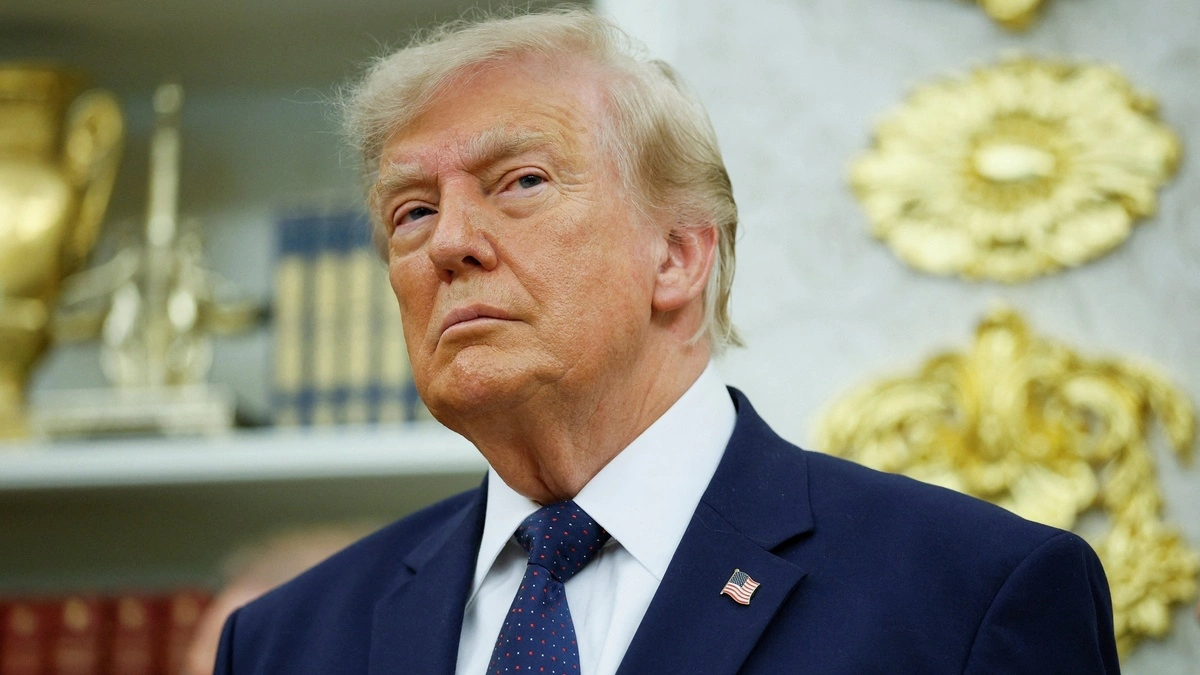
US President Donald Trump in the Oval Office, White House, July 6. Image: Reuters
Disagreements pent up
The memorandum of understanding that the US and Iran signed in mid-June includes 14 points, of which article 5 states that Iran commits to creating conditions for commercial ships to travel safely and free of charge through the Persian Gulf – Oman Sea route within 60 days. Iran will coordinate with Oman and countries along the Persian Gulf to build a mechanism to manage and provide maritime services in the Strait of Hormuz in the future, on the basis of international law.
However, because the document does not specifically state the implementation method, related parties have their own interpretation of each provision. Iran believes that it plays a key role in coordinating the movements of ships through Hormuz. Meanwhile, the US sees Article 5 as the key to restoring freedom of movement in the Strait.
Gulf countries depend significantly on the Strait of Hormuz for oil exports. Therefore, for Iran, Hormuz is also a strategic tool, directly tied to national security that Tehran cannot be allowed to lose, whether at the negotiating table or in conflict.
Therefore, Iran is increasingly indignant when the US coordinates with Oman and the International Maritime Organization (IMO) to establish a new route completely within Oman’s territorial waters and encourages commercial ships to choose this option instead of using the northern route through Iran’s territorial waters.
The rift began to show on June 25, when the cargo ship Ever Lovely was attacked while moving along the coast of Oman. The US accused Iran of being the culprit, airstrikes on many Iranian coastal targets on June 26 in retaliation. Iran responded by attacking US military positions in the area. This tit-for-tat cycle continued for two days and then there was a lull.
Cruise routes pass through the Strait of Hormuz. Graphics: Guardian
Data from Kpler, a company specializing in tracking shipping activities, shows that ship traffic through Hormuz last week reached about 30% of the level of more than 100 vehicles per day before the war. This number is divided equally between the two sea routes adjacent to Iran and Oman.
The US is also promoting a separate peace agreement between Lebanon and Israel, with the long-unrealized goal of disarming Hezbollah, an armed group allied with Iran. Meanwhile, negotiations on financial support for Iran are not making much progress.
This makes hard-liners in Iran, especially the Islamic Revolutionary Guard Corps (IRGC), believe that the memorandum signed with the US is a failure that causes them to lose their greatest leverage.
“The US is taking advantage of the negotiations to gain time, gradually removing Iran’s control of the Strait of Hormuz,” Ehsan Hosseini, editor-in-chief of the conservative economic news site Khat-e Energy of Iran, said on his personal YouTube channel last week. “We risk losing our most important pressure tool.”
‘The last drop of water’
In that context, even while organizing a week-long funeral for the late Supreme Leader Ali Khamenei, the IRGC could have acted, instead of sitting back and watching its strategic leverage gradually disappear.
The memorandum continued to crack on July 5, when cargo ships moving through the southern sea route received warnings from Iran via radio.
“This route is not safe, you are in danger,” Wall Street Journal Refer back to the message content. “Our missiles and drones are ready to target you.” Not long after, three commercial ships were attacked, in which a Qatari gas tanker suffered a fire in its engine compartment, forcing the crew to evacuate.
“The attacks took place right at the time of Mr. Ali Khamenei’s funeral, showing that Iran wants to show a victorious attitude,” said Suzanne Maloney, an expert at the Brookings Institute, adding that Iran wants to send a message that it is determined to establish new control over Hormuz.
Iran is also not too concerned if the US re-imposes oil sanctions that have just been lifted after decades.
“Revenue is not as important as control,” Majid Shakeri, an economist and adviser to Iranian Parliament Speaker Mohammad Bagher Ghalibaf, said on state television. “Either we hold the strait, or everyone will be willing to die for it.”
An Iranian diplomat on July 8 accused the US of violating the peace agreement by establishing a new route through Hormuz without communicating with this country. Therefore, Tehran has reason to target this route.
The developments angered President Trump. The US leader has previously repeatedly stated that the peace memorandum signed with Iran in mid-June is proof that his maximum pressure strategy has brought results.
Another reason seems to be the timing factor. President Trump said on July 8 that he gave Iran “a week off” during the negotiation process to organize the funeral for the late supreme leader, but Tehran “did not play nice when it started launching missiles at ships.”
Vice President JD Vance also sent a tough message in a speech in Milwaukee on July 9.
“The problem is very simple. If they shoot at boats, we will give them a suitable blow,” Mr. Vance said.
Ships are anchored in the Strait of Hormuz off the coast of Bandar Abbas, Iran, June 17. Image: AP
Joel Rayburn, an expert at the Hudson Institute, said that Iran appears to be betting that President Trump, tired of conflict and just four months away from midterm elections, will not want to risk restarting a war that is unpopular with voters.
“They are at risk of misjudging President Trump, which they have repeatedly done,” Mr. Hudson said. “This time they went too far.”
Future conflict
Ben Soodavar, a war research expert at King’s College London, UK, said that two scenarios could happen in the future.
First, the US can continue to expand air strikes against targets in Iran, and at the same time use military power to maintain freedom of navigation through the Strait of Hormuz.
“This is an extremely difficult task, because Iran does not need to defeat the US Navy to paralyze the Strait of Hormuz. It only needs to make the maritime route dangerous enough so that ships do not dare to pass through. Prolonged US airstrikes can reduce but it is difficult to completely eliminate Iran’s ability,” Mr. Soodavar told reporters. The Conversation.
The second scenario is that Mr. Trump limits the scale of air strikes and uses military measures as leverage to bring Iran back to the negotiating table, towards a new ceasefire agreement.
“This option also faces obstacles. If it is not possible to ensure freedom of navigation through Hormuz, it will be very difficult for President Trump to reach a better agreement than the one he just abandoned, especially when faced with an Iran that still maintains a tough stance, more confident because it still stands firm after suffering heavy attacks,” according to Mr. Soodavar.
casinoriverrock on We Don’t Have Time
casinoriverrock – Battlelog / Battlefield 4
8548467 Casinoriver Rock
casinotreasur
casinotreasury
Youtube Icon
casinotreasury | Profile
casino treasury – Member Profile – The 016 – Worcester, Mass.
_dhgr0gesw's profile – Giloo Documentary
Casino Villento
Casinovillento
casinovillent « Giveaway of the Day Forums
casinovillento Official Homepage | PubHTML5
Profil de casinowolinak
ALS Forums
014980
casinowolinak
Casinowolinak
Cannabis.net
@countryclubcasino's Profile – websim.com
Project 1999 – View Profile: countryclubcasino
GTA 5 Mods av thestargoldcasino – GTA5-Mods.com
countryclubcasino's profil
Profile of "u_1285806164" – Members – Allods Online Forum
BeatSaver.com