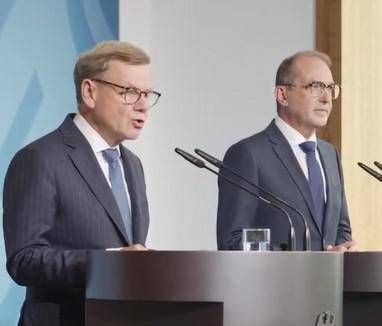
“I really don’t like the term hybrid warfare.” Wolfgang Ischinger, president of the Munich Security Conference and former German ambassador to Washington and London, comments during a meeting with the press in Rome, responding to a question from Adnkronos, on the case of the explosive drones at Leipzig-Halle airport, in the aftermath of the German government’s decision to formally attribute responsibility to Russia.
“When we talk about hybrid warfare, I fear that public opinion, apart from those who follow these issues closely, have no idea what we are talking about. They know what a hybrid vehicle is, half electric and half petrol. But what is hybrid warfare? It’s not easy to explain.”
Better, according to the MSC president, to use more precise words. “We have to call things by their name. If it’s an act of war, we should call it an act of war. If it’s state terrorism, we should call it state terrorism. If it’s sabotage in the traditional sense, let’s call it sabotage.”
The Leipzig case dates back to August 4, when a drone equipped with approximately 600 grams of explosives was found in the security area of the airport, near a Ukrainian Antonov cargo ship. The device did not explode due to the failure of the trigger system. In the following days the investigation expanded to other devices: on 14 August a drone was found in a field in Kabelsketal, close to the airport, together with traces of what investigators believe to be Rdx, an explosive for military use.
Ischinger had commented on this in recent weeks. If Moscow’s responsibility had been proven, he explained to Welt TV, Germany would have had to conclude that “Russia is carrying out acts of war against us”. With that small drone, he warned, “a terrible tragedy could have occurred”. The former diplomat, who leads the Munich Security Conference and who was in Rome today to lead the round table dedicated to European defense, had asked for clearer rules on who in Germany has the power to identify, monitor and neutralize hostile drones.
The turning point came yesterday. The German government attributed the operation to Russian state actors based on police investigations and intelligence information. The configuration of the drones, explosives and triggering techniques would present characteristics already found in other operations attributed to Moscow and in the conflict in Ukraine.
Berlin then summoned the Russian ambassador and announced a series of diplomatic and security measures. These include the closure of the Russian Consulate General in Bonn from 18 September and the termination of the agreement relating to the Russian House in Berlin. The government also intends to promote new European sanctions against people involved in sabotage operations, strengthen controls and increase pressure on the so-called Russian shadow fleet.
Moscow has rejected the accusations, calling them unfounded and speaking of a new escalation in relations with Berlin.
Ischinger’s opinion on the response decided by Berlin is positive. “We must increase the price Moscow pays for its war.” The decisions announced yesterday “did not go too far” and at the same time were not too weak: “I consider them appropriate.” The message must be that “we will not let this happen again”.
The issue, however, cannot be addressed only on a national scale. “The real challenge is not for Germany to react to what happened in Leipzig. Next week it could happen in Italy, Norway or another NATO country.”
Hence the request for a common response, possibly also with Washington. “We should have a coordinated approach”, so that, if a similar episode occurs in Europe, “our American ally agrees to react and does not ignore it just because it didn’t happen in the United States”. The objective is to make Moscow understand that operations of this type “will have an increasingly higher cost”.
Even traditional sanctions alone do not seem sufficient. “They work,” but “they apparently do not deter Russia from carrying out these so-called hybrid acts.” We therefore need other tools capable of imposing political, financial or other costs without producing uncontrolled escalation.
Among the areas indicated by Ischinger is the Russian shadow fleet, active in the Baltic, the North Sea and the Mediterranean, on which European countries could exercise more stringent controls on compliance with environmental, insurance and navigation regulations.
“We need to exercise more deterrence, and deterrence is the opposite of escalation.”