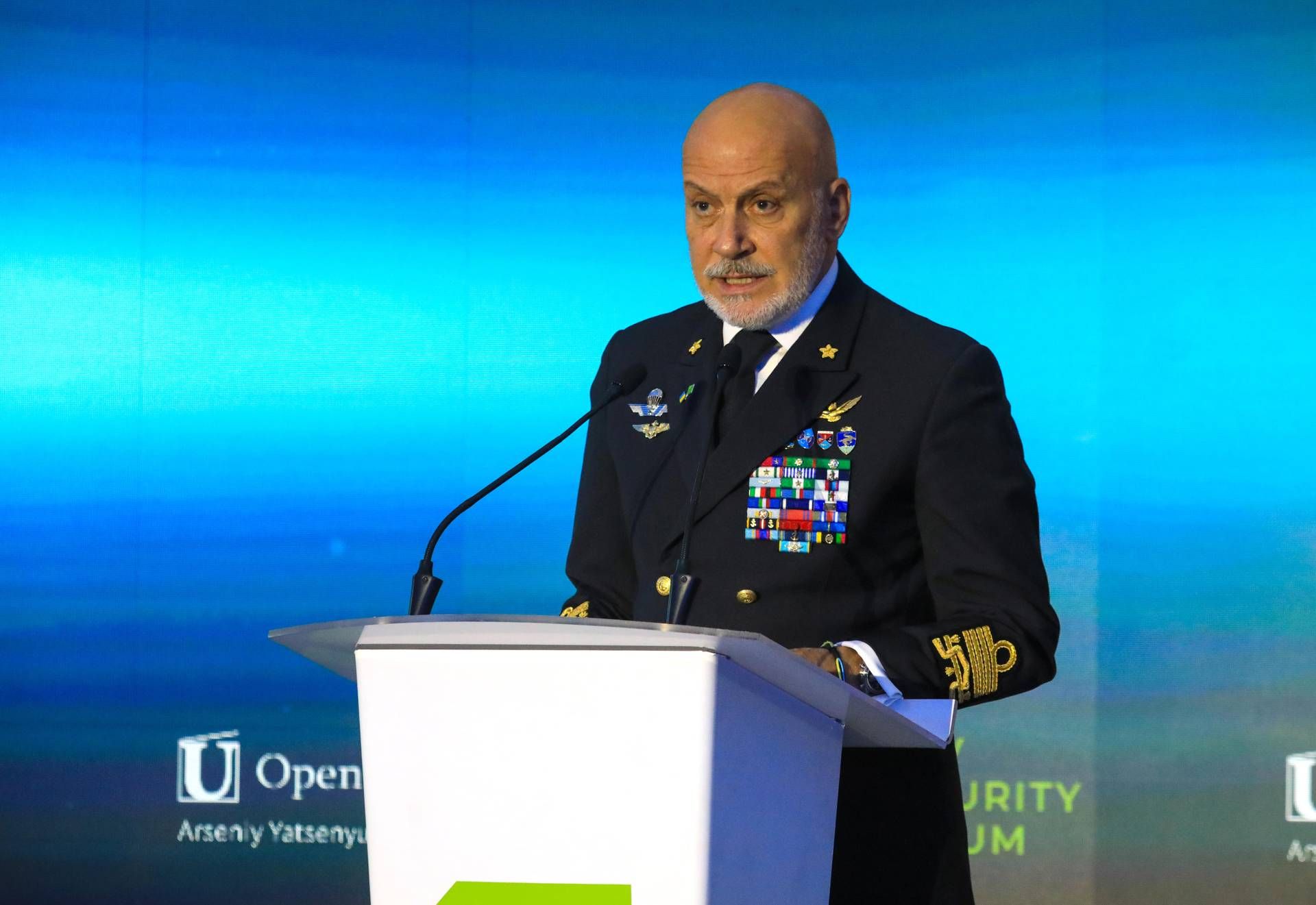
“We continue to witness serious positions taken in denying the danger or even the existence of threats and, consequently, in opposing the now mandatory need to invest in our security. I leave it to our citizens to discern how much these positions are the result of honest analysis of clear facts, or of exploitation of various kinds, often political”. Admiral Giuseppe Cavo Dragone, president of the NATO Military Committee, said this to Adnkronos, commenting on the story of the explosive drone in Leipzig and Germany’s (and Europe’s) accusations against Russia.
Germany has announced that Russia is responsible for the hybrid attack in Leipzig on August 4. How big is the threat of Russian hybrid warfare growing? Colleferro also comes to mind, where there was recently an explosion which was initially hypothesized as Russian sabotage. You have been saying for some time that “we are not at war, but we are no longer in a state of full peace”. Is that balance more fragile today?
“The threat is also evolving on a qualitative level. The case of Leipzig, for example, does not appear to be an extemporaneous or improvised action. We are talking about military-grade material brought a few meters from an airplane, inside an airport of an Allied country. It is a clear leap in quality, and must be read in sequence with the drones on the eastern flank, the fires in plants producing for Ukraine, the GPS interference, the cyber attacks. Investigations are underway on Colleferro and the Minister Crosetto was clear. But the fact that the question arises every time a deposit is missed in Europe says a lot about the climate we live in. I confirm my formula, but the gray area has narrowed. But this makes the balance more fragile: in hybrid threats, ambiguity is the main weapon, but when the episodes multiply and become more evident, that same ambiguity becomes less and less credible the danger or even the existence of threats and, consequently, in opposing the now mandatory need to invest in our security. I leave it to our citizens to discern how much these positions are the result of honest analysis of clear facts, or of exploitation of various kinds, often political”.
What are the NATO, European and national defenses against these episodes? From a strictly military point of view, if that drone had exploded killing civilians or soldiers on German territory, would the Military Committee have suggested an immediate switch to open response? We talk about a new normal, but what is the breaking point?
“The front line is generally national: police, intelligence, infrastructure protection, as happened in Germany. NATO works in parallel at the allied level: shared intelligence and attribution, so that an episode in Leipzig is read together with one in Bulgaria or the Baltic; anti-hybrid support teams on request; and the most visible part, such as Eastern Sentry, Baltic Sentry, integrated air and anti-drone defense, resilience of critical infrastructures. I don’t go into hypothetical scenarios, especially when they concern possible victims, because the final decision is not up to the Military Committee. Our task is to ensure that, whatever the Council decides, the Council always decides on the basis of defined options and tools. From a military point of view, the summary is simple: a failed attack remains an attack.
Meanwhile, Berlin responded: do you believe that purely diplomatic and economic deterrence is still sufficient against Russia? Von der Leyen and Rutte have said that they will not tolerate attacks: what response will this firmness translate into?
“The German response was rapid and proportionate. But deterrence is credible only when it combines all available tools – political, economic, informational and military – in an overall way. The point is to make Russia understand that it cannot operate below the threshold while counting on impunity. On a military level, this means strengthening the allied presence at the points where Moscow seeks to exert pressure and maintain readiness in every domain. The political leaders will then define what concrete measures this firmness will translate into. But the most effective response, Russia’s already knows: if Leipzig’s goal was to weaken support for Ukraine and divide the Allies, the effect was exactly the opposite.”
These days you are in Canada for the Conference of the Chiefs of Defense of the Indo-Pacific nations. On Thursday, in Brussels, Elbridge Colby took stock of the review of the American military presence in Europe: how are the balances with the USA changing and how important are these appointments?
“Undersecretary Colby’s move to the Atlantic Council was an important step because it clarified the method: consultation with the Allies, a defined timetable, no decisions taken a priori. The balance changes, but not in the sense of America leaving Europe. Instead we are moving towards an Alliance in which Europe and Canada assume primary responsibility, while American capabilities remain essential for collective deterrence and defence. This is NATO 3.0, a Europe with stronger Canada in a stronger Alliance strong. And the numbers from Ankara say that it is not a slogan. And I confirm it from here (Victoria, ed.), where Canada demonstrates it from another angle, that of an Atlantic Ally and a Pacific nation. This reminds us that what happens in the Indo-Pacific directly affects our security.