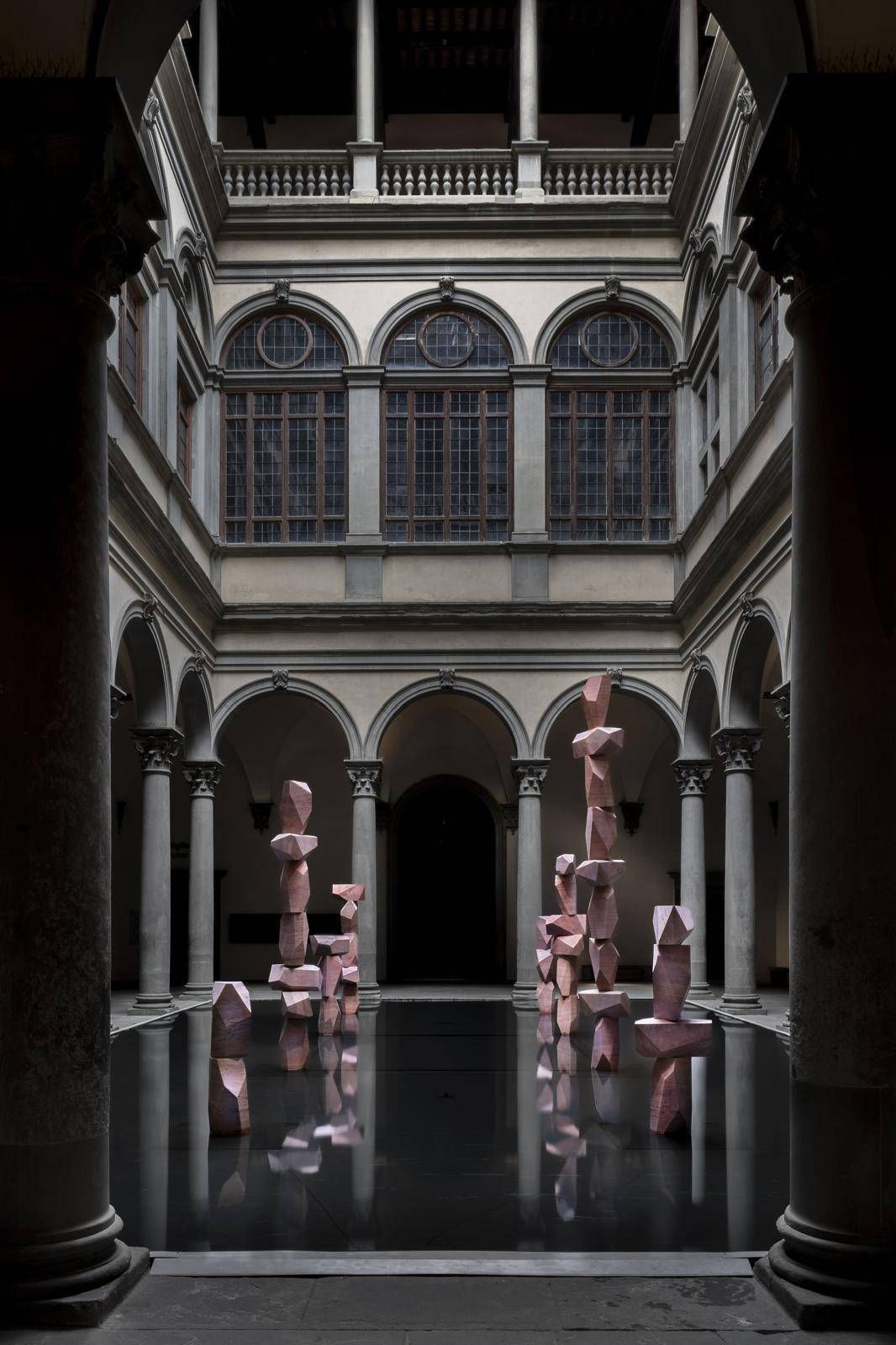
In the heart of Florence, among the elegant geometries of the Renaissance, the Courtyard of Palazzo Strozzi stops for a moment from being just architecture and becomes a landscape suspended on the edge of the future: a large pool of water reflects the sky, the historic facades and the passage of visitors, while eight imposing pink travertine columns emerge as still living ruins of a civilization that imagines itself adapting to an underwater world. This is the powerful and restless vision of “There Are Other Fish In The Sea”, the new installation by the Danish collective Superflex, which occupies the courtyard of Palazzo Strozzi until 2 August 2026.
The project is promoted by the Palazzo Strozzi Foundation and the Hillary Merkus Recordati Foundation, in collaboration with Kunsthal Spritten and is part of the Palazzo Strozzi Future Art program. It is curated by the general director of the Foundation, Arturo Galansino.
The installation was born from a hypothesis that is as visionary as it is concrete: the progressive rise of the seas could, in the coming decades, radically transform the relationship between human beings and architecture. In this scenario, buildings would no longer be just spaces inhabited by humans, but structures shared with other forms of life. The columns designed by Superflex are in fact not simple sculptures, but ecological devices: their irregular and modular surfaces are designed to encourage the settlement of marine life, transforming the courtyard into a potential ecosystem. The water that surrounds them is not just a scenographic element, but an integral part of an environment in which reflections and matter merge, multiplying the perception of space.
At the basis of the project is the idea of an “interspecies architecture”, developed by the collective through its Interspecies Architectural Manifesto. A perspective that overturns human centrality and proposes a design capable of including the needs, forms of life and times of different species. The courtyard of Palazzo Strozzi, symbol of the Renaissance and of the centrality of man as the measure of the world, thus becomes the ideal place to undermine this vision, opening a space for reflection on how to build – or imagine – more shared future environments.
The project also takes on a strong symbolic value on the sixtieth anniversary of the Florence flood of 1966, an event that profoundly marked the city and its relationship with water. From that memory comes a question addressed to the present: how to live in a world in which water is no longer just a limit, but a constant presence?
“The work invites us to imagine new forms of coexistence between species, in line with the vision of Palazzo Strozzi as a place of dialogue between past and future,” declared Arturo Galansino, underlining the role of the museum as a space for comparison between historical legacy and contemporary imagination.
The institutional dimension also reinforces the message of the work. “Supporting this project means promoting a shared reflection on models of coexistence in which the human dimension is part of a broader ecosystem,” said Andy Bianchedi.
The initiative also includes the publication of a catalog published by Marsilio Arte, which will be presented on 19 June at Palazzo Strozzi, demonstrating a project that is not limited to the installation, but extends as a broader cultural reflection.
https://www.openpr.com/news/4416430/from-london-to-the-world-the-evolution-of-the-tracksuit-culture
https://www.smartmoneymatch.com/Zoidii
https://explore.jobs.netflix.net/careers/search?query=Avici%20Referral%20Code%20%22V7EJDE%22%20Get%20up%20to%2020%25%20Discount%20at%20Checkout&domain=netflix.com&sort_by=relevance
https://hashnode.com/@forsaljningschefen
https://hashnode.com/@rallyvite
http://https-www-dixoninjuryfirm-com.hub.biz/
https://e27.co/startups/rallyvite/
https://gravatar.com/aeoengine
https://gravatar.com/medicalstorepe
https://addyp.com/listing/wilayah%20persekutuan/Kuala%20Lumpur/seo-services/cleverly-my
https://en.tagdirectory.net/5792/website/Omar+Al+Khatib+-+Freelance+full-stack+web+developer
https://maphub.net/medical-store
https://gettr.com/user/thedixoninjuryfirm
https://www.owler.com/company/sarmsarmy
https://gettr.com/user/afinalmessage
https://en.tagdirectory.net/5810/website/Emergence+Human+Capital+-+HR+-+Reward+Consultancy
https://www.pexels.com/@forsaljningschefen-2156769956/
https://medicalstorepe.gumroad.com/l/medical-store-pe
https://www.owler.com/company/aeoengine
https://app.innmind.com/viewStartup/HGesHadXNiEFBa2Nw
https://www.promoteproject.com/startup/189040/zoidii
https://app.innmind.com/viewStartup/QZhhLDbXxAQdrh4gn
https://alternativeto.net/software/cleverly-my/about/
https://disqus.com/by/der_hauptling/about/
https://app.innmind.com/viewStartup/eDZXSuBFKhDyhagfy