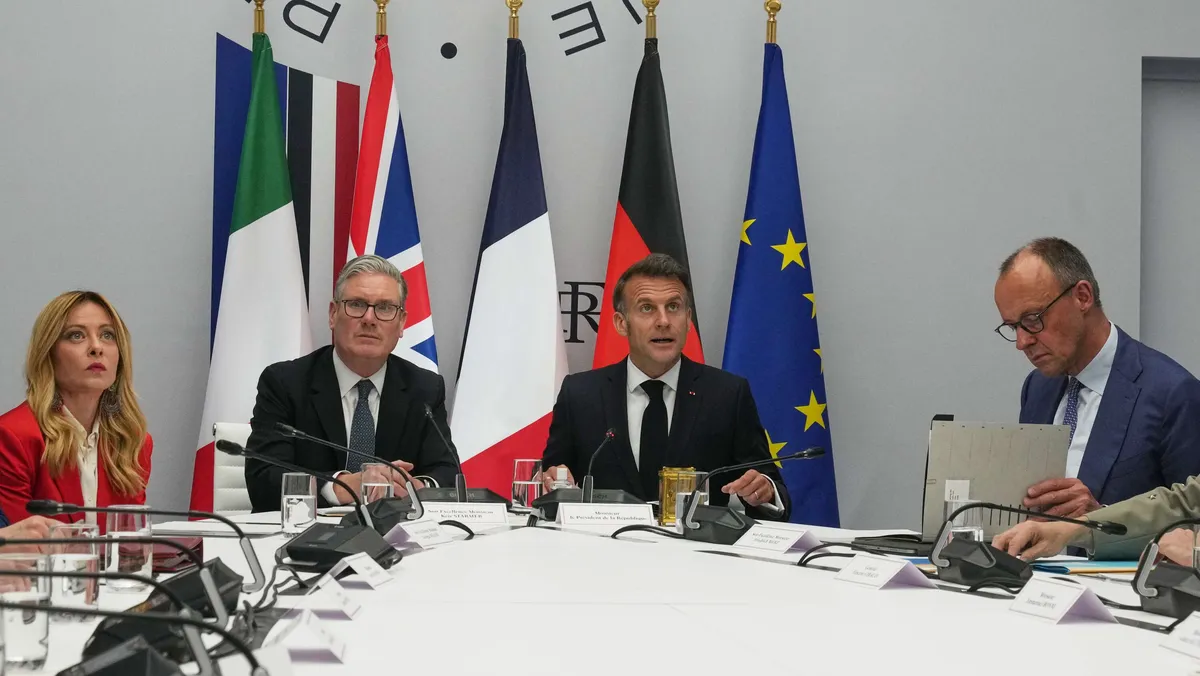
The Iran war and the closing of the Strait of Hormuz as a result is building a new coalition of “willing countries” in Europe right now. It is a German, French, Italian and British project.
The new coalition of the willing is very similar to the coalition formed last year to support Ukraine. Both are headed by the French president Emmanuel Macron and British Prime Minister Keir Starmer. However, one thing is different in the coalition of the Strait of Hormuz: Italy, the third largest EU country, is in it. In the Ukraine coalition, Italy is only an observer.
European director and researcher at Eurasia Group, which analyzes political risks Mujtaba Rahman considers this significant and even historic.
“The most significant fact is the almost unanimous view of the leaders of the four major Western European countries – France, Britain, Germany and Italy,” he writes in his commentary.
According to the definition given by Keir Starmer at a press conference on Friday, it is a maritime security restoration operation that will be carried out “as soon as conditions permit”. The alliance’s military planners will meet in London next week to discuss the issue.
According to Emmanuel Macron, it is a “non-partisan mission, completely separate from the warring parties, to escort and secure merchant ships passing through the Persian Gulf”.
In addition to Germany, France, Italy and Great Britain, the coalition includes about 50 other countries, including Finland.
“Finland is ready to work on a solution that brings stability to the region and respects international law”, the President of the Republic Alexander Stubb wrote in the message service X.
Disagreement over the role of the United States
There is still disagreement within the coalition about the role of the United States. Chancellor of Germany Friedrich Merz would also like to see the United States participate, Macron, on the other hand, outlined that only countries that are not parties to the conflict will participate in the operation.
Naval researcher at the British Royal United Services Institute think tank Sidharth Kaushal estimates that in practice the coalition could manage mine clearance and create a maritime threat warning system in the Strait of Hormuz area. On the other hand, according to him, escorting merchant ships is more difficult.
“For something like that, you need a huge number of ships, which no one has,” he states in his comment.
At the same time as the new “coalition of the willing” was announced at the press conference, the United States and Iran announced that the Strait of Hormuz was open to merchant ships. Iranian Foreign Minister Abbas Araghchin according to which the passage of merchant ships will remain “fully open” during the ten-day ceasefire declared in Lebanon.
Three possible scenarios
Experts emphasize that traffic in the strait has not returned to normal, but the situation is still very uncertain.
“In practice, ships now move cautiously and often only along pre-arranged routes. Safety is not self-evident, but requires constant coordination and risk assessment. Shipping companies are hesitant, insurance costs remain high, and some ships are waiting for the situation to be clarified before setting off. This tells you one thing. Trust has not been restored,” Doctor of Military Sciences, Member of Parliament for the Coalition Jarno Limnell write Speech on his blog.
He emphasizes that the most important question is not whether the strait is open today.
“The important thing is who controls the possibility of closing it tomorrow. At the moment, the opening is based on political will, not a permanent solution. Therefore, the situation is structurally unstable.”
Limnell writes of three scenarios that are now possible.
The first is controlled but fragile normalization. Traffic increases gradually and the market calms down, but uncertainty remains a permanent part of the operating environment.
Another scenario is a prolonged gray phase. The Strait of Hormuz is nominally open, but in practice the passage is slow, expensive and prone to interference. According to Limnell, this is currently the most likely course of development.
The third scenario is a new escalation.
“If the ceasefire breaks down or the regional confrontation intensifies, traffic in the strait could be disrupted again quickly. In that case, the effects would be immediate and wide-ranging on the entire world economy.”
https://www.udrpsearch.com/user/toiletpowder55
http://jobs.emiogp.com/author/germanmeal07/
http://xn--l1ae1d.xn--b1agalyeon.xn--80adxhks/user/metalhelp64/
https://www.demilked.com/author/lyrictoy13/
https://www.bandsworksconcerts.info:443/index.php?lyricflat32
https://etuitionking.net/forums/users/bracedate82/
https://gratisafhalen.be/author/limitkitty83/
http://qa.doujiju.com/index.php?qa=user&qa_1=germanharp93
https://www.ludikarus.com/author/moatshark74/
http://jobboard.piasd.org/author/tauruscrown96/
https://school-of-safety-russia.ru/user/quietmeal26/
https://365d24h60m.com/forums/users/puppyrate61/
http://karayaz.ru/user/screensushi50/
https://ryu-ga-index.com:443/index.php?sylvestmcgraw195127
https://de.kzen.dev/index.php/user/formthread69
http://adrestyt.ru/user/taurusear29/
http://okprint.kz/user/quietflame61/
https://atomcraft.ru/user/screenturkey67/
https://molchanovonews.ru/user/screenkitty33/
https://egamersbox.com/cool/index.php?page=user&action=pub_profile&id=408248
http://tropicana.maxlv.ru/user/quietburma05/
https://sibze.ru/index.php?subaction=userinfo&user=tauruskitty21
https://archeter.co.uk/user/profile/539903
https://sub.elfejewelry.com:443/index.php?shaffercovington848752
http://madk-auto.ru/user/vanturkey51/