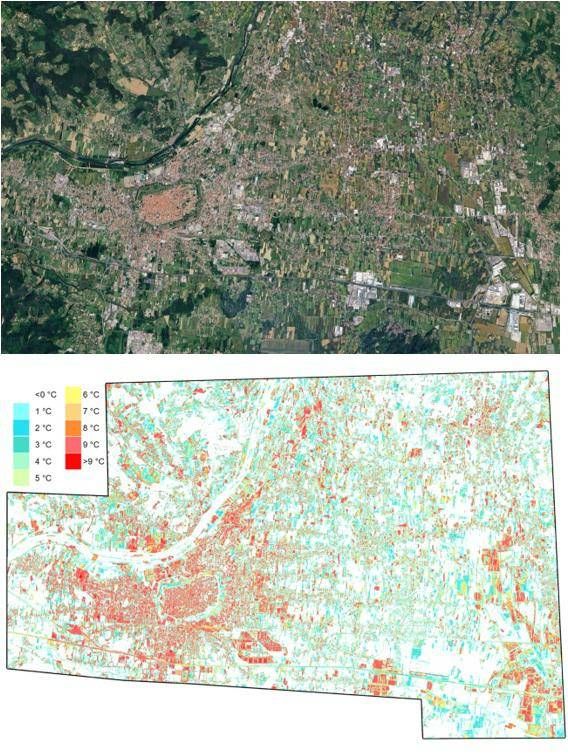
The integration of solar photovoltaics in urbanized environments represents a pillar of the energy transition, but its effects on the local microclimate are not uniform. Research by the Institute for Bioeconomy of the National Research Council (Cnr-Ibe), published in the journal Sustainable Cities and Society, has shown that the effectiveness of panels in mitigating urban heat depends strictly on the underlying material. The study made use of acquired data via hyperspectral and thermal sensors during a scientific flight over the city of Lucca, analyzing the albedo (the solar reflectance capacity) and the thermal emission of the different surfaces.
Urban heat island intensity map calculated as the difference between the temperature of each point and the average temperature of natural areas, derived from high-resolution aerial thermal image
The results indicate that installing photovoltaic panels on asphalt parking lots or dark metal roofs, typically low-albedo surfaces that accumulate a lot of heat, can reduce local surface temperatures by 5 to 10°C during the summer season. In these scenarios, a “win-win” effect is generated: production of clean energy and cooling of the surrounding environment.
On the contrary, the installation of solar infrastructures on natural surfaces, such as lawns or bodies of water, alters the processes of evapotranspiration and the natural thermal capacity of the soil. In these cases, the study recorded an increase in surface temperature of up to 17°C, turning a sustainable technology into a potential driver of local warming.
Understanding these mechanisms is crucial to achieve the targets set by the National Integrated Plan for Energy and Climate (PNIEC). In 2025, Italy has reached an installed power of 43.5 GW, with the aim of reaching 79 GW by 2030 to cover 63% of national electricity demand with renewable sources.
“Urban policies will have to favor the installation of panels on low albedo surfaces such as bituminous roofing and asphalt, and avoid installation on light surfaces“, explains Beniamino Gioli, coordinator of the Cnr-Ibe team. Although the energy produced contributes to global cooling by reducing greenhouse gas emissions, Gioli warns that “the alterations in albedo and surface temperature can also be a cooling at a local level but also a warming with undesirable local effects“.
The use of high-resolution remote sensing technologies proves to be an indispensable tool for the governance of modern cities. These sensors allow us to precisely estimate how much solar radiation is absorbed or reflected back into space, guiding planners towards informed choices. The challenge for the “smart cities” of the future will therefore be to balance energy enhancement with the maintenance of a liveable microclimatepreventing the energy transition from unintentionally amplifying the phenomenon of heat islands in the most vulnerable areas.
https://nl-lalabet.nl/account/
https://leoncasino-portugal.com/entrar/
https://leoncasino-portugal.com/app/
https://leoncasino-portugal.com/codigo-promocional/
https://leoncasino-portugal.com/bonus/
https://leoncasino-portugal.com/apoio-ao-cliente/
https://leoncasino-portugal.com/sobre-nos/
https://leoncasino-portugal.com/politica-de-privacidade/
https://leoncasino-portugal.com/termos-e-condicoes/
https://leoncasino-portugal.com/jogo-responsavel/
https://leoncasino-pt.eu/entrar/
https://leoncasino-pt.eu/app/
https://leoncasino-pt.eu/codigo-promocional/
https://leoncasino-pt.eu/bonus/
https://leoncasino-pt.eu/apoio-ao-cliente/
https://leoncasino-pt.eu/sobre-nos/
https://leoncasino-pt.eu/politica-de-privacidade/
https://leoncasino-pt.eu/termos-e-condicoes/
https://leoncasino-pt.eu/jogo-responsavel/
https://leoncasinoonline.pt/entrar/
https://leoncasinoonline.pt/app/
https://leoncasinoonline.pt/codigo-promocional/
https://leoncasinoonline.pt/bonus/
https://leoncasinoonline.pt/apoio-ao-cliente/
https://leoncasinoonline.pt/sobre-nos/