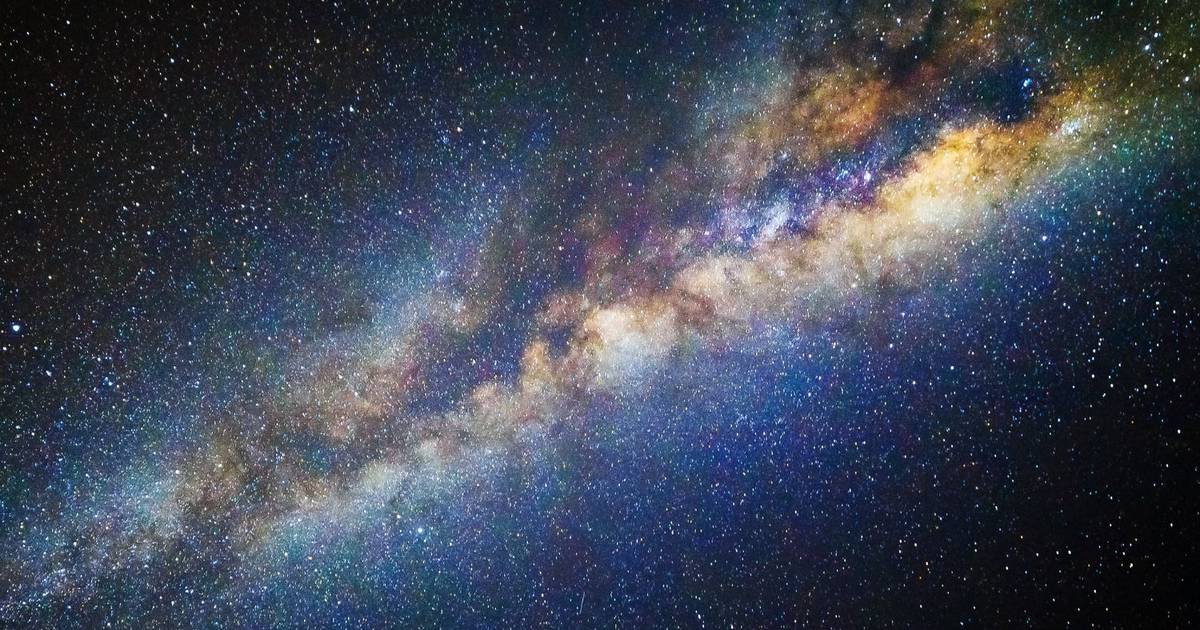
Where exactly is the edge of the Mlije path located? The answer to that question is much more complicated than one might think at first. Our galaxy, namely, does not have a sharp, clearly defined border. Instead, its density gradually decreases and merges with the void of intergalactic space. Scientists therefore use several different markers to define its extent, from a visible stellar disk to a vast, invisible mantle of dark matter, writes Science Alert.
Recent research, however, has revealed a new, precise way of determining the edge – the limit of the area where new stars are still actively being born.
The multiple boundaries of our galaxy
The most visible component of the Milky Way is its stellar disk, a flattened rotating structure that contains most of the stars, gas, and dust. The diameter of this disk is estimated at about 100,000 light years. Around it stretches a stellar halo, a much larger but less sparsely populated sphere of old stars that can stretch up to a million light-years in diameter.
However, the largest component, which defines the gravitational edge of our galaxy, is the dark matter halo. It is believed that this invisible cloud extends up to two million light years from the galactic center. But the new research focused on the more dynamic and active edge – the one where new star formation stops.
The boundary where stars are born
By combining measurements of the ages of more than a hundred thousand giant stars with advanced simulations of galaxy evolution, researchers have discovered a clear edge of active star formation.
The analysis revealed a specific “U”-shaped pattern in the age distribution of stars. As expected, stars are generally younger the farther they are from the galactic center, because galaxies form “from the inside out.”
This trend is valid up to a certain point. The study showed that approximately 40,000 light-years from the center of the Milky Way, the trend reverses and the stars become older again. This point, where the average age of stars is the smallest, marks the outer limit of the active “birthplace” of stars in our galaxy.
- The extent of the Milky Way disk in which stars form has long been an open question in galactic archaeology. By mapping changes in the age of stars across the disk, we now have a clear, quantitative answer – stated the lead author of the study, Dr. Karl Fiteni from the University of Insubria.
The “Migrant Star” Mystery
If the formation of stars suddenly stops at that edge, an obvious question arises: why are there stars outside it? The answer lies in a process called “radial migration”.
Stars are not always found in the place where they were born. Over billions of years, interactions with the gravitational forces of the galaxy’s spiral arms can gradually “push” them outward, much like surfers ride ocean waves.
Most of the stars outside this edge did not form there, but have migrated slowly. Since the process is gradual and random, it takes longer for the stars to reach larger distances.
This explains why the most distant stars are also the oldest. Their nearly circular orbits rule out the possibility that they were ejected by collisions with other galaxies, confirming that their presence is the result of the internal dynamics of the Milky Way.
- The key thing about the stars in the outer disk is that they are in nearly circular orbits, which means they must have formed in the disk. These are not stars that were scattered over great distances due to a collision with another satellite galaxy – explained the co-author of the study, prof. Victor P. Debattista.
This discovery opens a new chapter in understanding the structure and evolution of our galaxy. Although the location of this edge is now known, scientists are still investigating what causes star formation to stop at that distance. Upcoming projects like the 4MOST and WEAVE telescopes will provide even more detailed data that will help solve that puzzle.
https://secure2.websrvcs.com/system/media/play.asp?id=30216&key=5C9709D0-57E6-4DD4-82B5-5D6128964855
https://tagembed.com/zh-CN/blog/instagram-statistic/
https://wsr.u4updates.xyz/47mz/h45wk.html
https://optimisticmommy.com/14-ways-to-get-more-instagram-followers-likes-in-2022/
https://nds.brewology.com/forum/viewtopic.php?p=212031
http://56843.eridan.websrvcs.com/System/Media/Play.asp?id=56843&key=5C9709D0-57E6-4DD4-82B5-5D6128964855
https://1vscarh4fy.wzth678.xyz/jiaodian/
https://kprofiles.com/forums/threads/btss-v-breaks-guinness-world-records-for-fastest-to-gain-both-1-million-and-10-million-followers-on-instagram.26054/
https://christinamcondreay.com/wp/masslinker-com-software-to-publish-your-own-4/
https://pad.degrowth.net/s/QqaenadCR
https://footextravaganza.com/getting-familiar-with-instagram-likes/
https://repository.participatorylab.org/en/user/talleresneumaticosenmarbella
https://convivea.com/forums/index.php?topic=9763.0
https://hedgedoc.digillab.uni-augsburg.de/s/Z99lanPVHf
https://op.pai.wtf/s/UFnibWiWO1
https://e-dinarcoin.com/enjoy-social-media-fame-with-cheaper-instagram-likes/
https://kopivy.com/social-analytics-instruments-are-essential-for-profitable-instagram-advertising-and-marketing/
https://techacute.com/el/%CE%B3%CF%81%CE%AE%CE%B3%CE%BF%CF%81%CE%BF%CF%82-%CE%BF%CE%B4%CE%B7%CE%B3%CF%8C%CF%82-instagram-%CF%80%CF%8E%CF%82-%CE%BD%CE%B1-%CE%BA%CE%AC%CE%BD%CE%B5%CF%84%CE%B5-tag-%CE%BA%CE%AC%CF%80%CE%BF%CE%B9%CE%BF%CE%BD-%CF%83%CF%84%CE%B7%CE%BD-%CE%B9%CF%83%CF%84%CE%BF%CF%81%CE%AF%CE%B1-%CF%84%CE%BF%CF%85-instagram/
https://www.precisiondemonj.com/?attachment_id=29
https://littlebluedeerdesign.com/instagram-algorithm-beating-the-system-to-more-likes-followers/
https://md.mandragot.org/s/bIQIgySZ4O
https://expertoeneventos.com/profile/the-point-jet-ski-en-marbella/
https://english.selu.edu/Ruskin/node_modules/nodemon/README.md
https://bukht.com/what-are-some-useful-schemes-to-buy-instagram-story-views-naturally/
https://heatherboersmaart.com/this-is-not-a-mask/