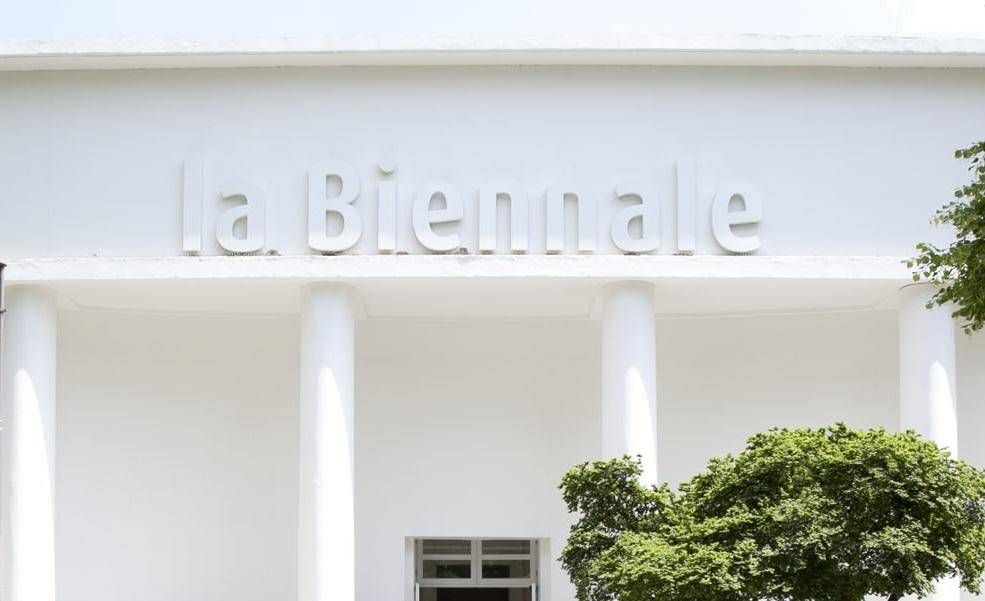
Four days after the vernissage of the 2026 Biennale Arte, the most important Italian cultural event was overwhelmed by an institutional earthquake that is unprecedented in its recent history. The international jury resigned en masse, the opening ceremony on May 9th was cancelled, the awards were postponed to November 22nd, the closing day of the 61st Art Exhibition and for the first time the gold and silver Lions will be awarded by visitors. And in the background, like a fault line that has never really subsided, global geopolitical tensions move.
The breaking point
The breaking point is to be found in the decision taken on 23 April by the five jurors – Solange Oliveira Farkas (president), Zoe Butt, Elvira Dyangani Ose, Marta Kuzma and Giovanna Zapperi – to exclude Israel and the Russian Federation from the award ceremony as they are countries on trial for “crimes against humanity” before the International Criminal Court. A choice initially defined as “autonomous” by the Venice Biennale Foundation, but which immediately triggered political and legal reactions.
The exclusion affects two sensitive issues: on the one hand Israel, in the midst of an international crisis that fuels accusations and counter-accusations; on the other, Russia, already absent from 2022 after the invasion of Ukraine but now ready to reappear in its historic spaces at the Gardens. The answer didn’t take long to arrive. The Israeli artist Belu-Simion Fainaru, called to represent his country in the national pavilion, has sent a formal warning, speaking of “racial discrimination” and “anti-Semitism” and threatening an appeal to the European Court of Human Rights. A move that turned a curatorial decision into a potential international court case. This is where the crisis has made a qualitative leap. The Foundation, through its legal office, has put a decisive element on paper: the jurors could be called upon to personally answer for damages in the event of litigation. It would no longer be just a cultural or political dispute, but a direct patrimonial issue. The risk of having to compensate – out of one’s own pocket – any damages requested by the Israeli artist or by the Foundation itself has radically changed the scenario.
The inspection at Ca’ Giustinian
According to what emerged during the inspection at Ca’ Giustinian on 29 and 30 April, ordered by the Ministry of Culture, as Adnkronos learned, the jurors were informed both of the negative media impact of their decision and of their legal exposure. It is in this context that the decision to resign was made.
Meanwhile, the case had already been under the government’s attention for weeks. The Ministry of Culture led by Alessandro Giuli sent inspectors to Venice to shed light on the relations between the Biennale and some countries, in particular Russia. The inspection – also formally linked to requests for clarification from Brussels regarding compliance with the sanctions imposed on the Russian Federation after the aggression against Ukraine – analyzed documents, procedures and organizational choices. Officially the ministry declared itself uninvolved in the resignation, but the timing is significant: the jury’s farewell came just as the inspectors were leaving Ca’ Giustinian, on the afternoon of Thursday 30 April.
It’s not just the Russian case that’s on the table. Israel and Iran have also come under observation, in a climate of growing international pressure. The European Union has threatened to suspend 2.3 million euros in funding from the ‘Creative Europe’ program for cinema-related projects. Faced with the risk of a legal and financial crisis, the Foundation led by Pietrangelo Buttafuoco made a drastic choice: cancel the jury’s decision and readmit Russia and Israel to the competition. It’s the final spark. From Jerusalem, Foreign Minister Gideon Sa’ar cheered and attacked: “There is no place for politics, boycotts and anti-Semitism in the world of culture.”
An often underestimated element contributes to making the situation of the Biennale Arte even more unstable: the absence of the curator Koyo Kouoh, who passed away a year ago. The exhibition, entitled “In Minor Key”, was born from a specific idea: to escape the “horror spectacle” to restore dignity and listening. A principle that seems to have shattered against geopolitical reality. Without strong leadership and with tensions that have accumulated for months – in particular over the reopening of the Russian pavilion – the Biennale arrives at the inauguration in conditions of extreme vulnerability.
The ‘Visitors’ Lions’
The consequences of the jury’s resignation are immediate and sensational. The inauguration ceremony on May 9th was canceled (moreover, Minister Giuli had already made it known well in advance that it would not take place due to Russian participation). With it, the traditional assignment of the Lions. There was no technical time to appoint a new jury and so the Foundation decided to postpone everything until November 22nd, the last day of the exhibition, explicitly citing “the exceptional nature of the international geopolitical situation”. In the midst of the storm, Buttafuoco relaunched with an unprecedented solution: the visitors will decide the winners. This is how the “Visitor Lions” were born, an experiment that overturns the traditional model based on a jury of experts. A choice that the president defined as “emergency”, comparing it to the measures adopted during the covid pandemic. Behind the move, however, there is also a necessity: to keep the event alive, avoiding a total lack of legitimacy after the resignation of the jury.
The crisis of the 2026 Biennale Arte is not the result of a single mistake, but the cumulative effect of multiple factors: global geopolitical tensions, institutional fragilities, legal risks, political pressures and the absence of strong curatorial direction. The jury’s initial decision – to exclude Russia and Israel – acted as a detonator. But the real explosion came when that choice encountered the minefield of international law, European funding and diplomatic balances. (Of Paolo Martini)
https://updasp.primewayz.com
https://dhakavision.com.bd
https://telestralimited.in
https://bijoybarta24.com
https://pkluck.net
https://agreement.teamtcb.in
https://emedlife.in
https://yooverseasedu.com
https://aahoreiti.secretsofweb.in
https://shoaibproduction.com
https://tamul.co.in
https://blog.rcbhatta.com.np
https://yogavani.info
https://masastudio.in
https://landtenurehub.org
https://fed.org.in
https://mytourism.pk
https://apexsengineering.com
https://strikebigdaddy.in
https://rmcsargodha.edu.pk
https://nirmalacollegeujjain.in
https://indiandecor.in
https://ciadewas.in
https://littlecompany.com
https://blisspharmaceutiks.com.pk