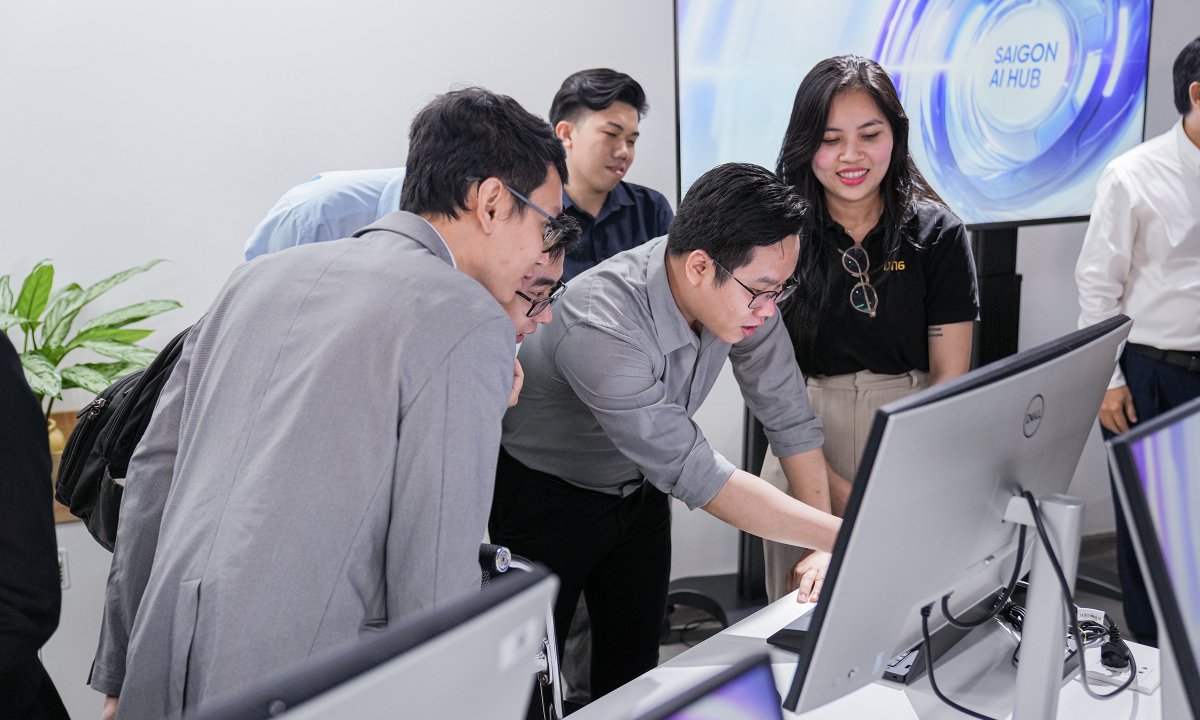
Research teams at Saigon AI Hub have early access to Google’s latest technologies, backed by technical support from DeepMind experts.
In the announcement on May 4, Google Labs and Saigon AI Hub announced becoming a strategic partner, to deploy Google Labs’ first Applied AI Lab in Vietnam.
Google Labs is a place to test Google’s AI ideas, including the AI Futures Fund, an investment initiative to accompany pioneering AI organizations at many stages of development. Saigon AI Hub (SAIH) is the first research organization in the world selected to participate in this program. This is an open AI research space in Ho Chi Minh City co-founded by VNG and Ho Chi Minh City National University late last year.
Representatives of Google Vietnam, VNG, Ho Chi Minh City National University at the location of the first Saigon AI Hub. Image: Ngoc Diem
Accordingly, the Google Labs fund will work directly with research teams at SAIH, providing them with early, exclusive access to Google’s latest technologies, along with direct technical support from Google and Google DeepMind experts. This is to create conditions for the domestic research and innovation ecosystem to access Google’s most advanced AI models, thereby creating AI solutions with high socio-economic value.
According to Mr. Josh Woodward, Vice President in charge of Gemini applications, Google Labs and AI Studio, choosing Saigon AI Hub as the first partner for the Applied AI Lab experimental cooperation model not only provides tools, but also aims to create a favorable environment for Vietnamese researchers to narrow the gap between theoretical research and practical applications.
“We believe that the solutions developed here will not only benefit Vietnam alone, but also provide valuable perspectives for the global AI research community,” said Mr. Josh Woodward.
VNG Chairman Le Hong Minh also assessed that global collaborations such as with Google Labs help SAIH researchers have the opportunity to apply new technology at the same time with the world’s leading AI organizations.
“We realize that the biggest barrier to AI research in Vietnam is not the lack of talent, but the lack of resources and supporting conditions for them to fully develop their abilities,” Mr. Minh said, hoping to expand this model with other partners.
The first ten research groups at Saigon AI Hub focus on practical applied AI fields, such as: developing a large language model (LLM) to minimize “illusion” and an optimal multimodal emotion recognition system for Vietnamese; building an AI agent that searches for videos and a professional soccer analysis model; LLM application supports human-robot interaction in a virtual reality environment and handles regional accent separation in Vietnam; supporting early diagnosis of colorectal cancer and automating the production process of 3D virtual reality content; Develop a Deepfake detection model and identify distracting objects in images.
A research team at Saigon AI Hub. Image: Ngoc Diem
These groups bring together nearly 60 researchers from universities in Ho Chi Minh City. They are selected based on the criteria of practical applicability, research capacity and responsible AI development orientation, with topics spanning many key fields including linguistics, computer vision, human-robot interaction, medical applications and information security.
All teams are committed to publishing research results at leading international conferences and journals (A*/A, Q1/Q2), and completing at least one prototype product with practical applicability.
https://winlionme.webflow.io/
https://www.notebook.ai/documents/2529960
https://magic.ly/WinliOther/Winlion-Secure-Gaming-for-Canada
https://f319.com/members/winliother.1103519/
https://www.letsknowit.com/winli54939
https://sites.google.com/view/winliother/
https://justpaste.me/JlL62
https://te.legra.ph/Winlion-Casino–Play-Anywhere-in-Canada-05-04
https://sport-bet2025.blogspot.com/2026/05/winlion-canada-casino-platform-online.html
https://lawschoolnumbers.com/WinliOther
https://profit.ly/user/WinliOther/blog/66521
https://www.efunda.com/members/people/show_people.cfm?usr=WinliOther
https://energy-models.com/user/winliother
https://supremesearchnet.yooco.org/events/event.733635-winlion___easy_play_canada_casino.html
https://winliother.mystrikingly.com/
https://telescope.ac/winliother/ieeohuo2xkdiqlqnoj0mzn
https://getfoureyes.com/s/8Rf4b/
https://cannabis.net/user/228270
https://imageevent.com/winliother