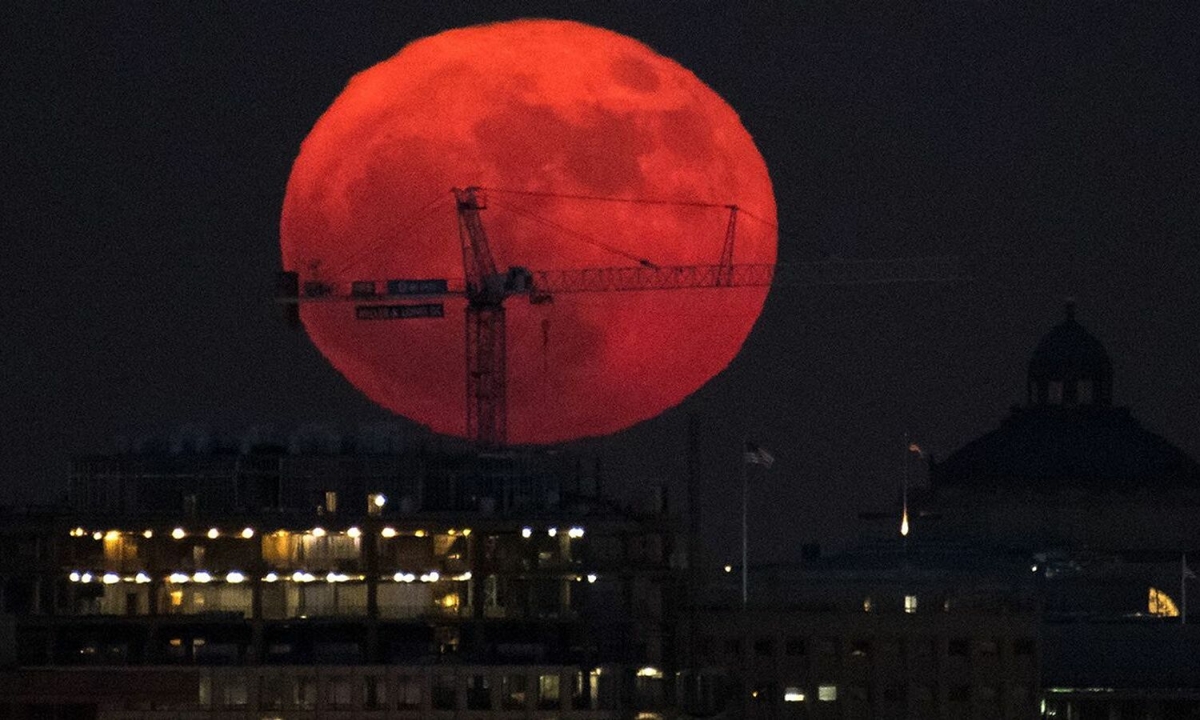
People often see the Moon as very large when it rises or sets, larger than when it is high up, but this sense of size is not correct.
According to NASA, observers can check the size of the Moon in many ways, for example, straightening the index finger and holding it up next to the Moon to see that the fingernail and this celestial body are equally large. They can also look at this celestial body through a paper tube, or bend down and look back between their legs. When observed this way, Earth’s natural satellite will not be as large as imagined. Another way is to photograph the Moon near the horizon and at high altitude. If the camera’s zoom level is kept the same, the photographer will see that the Moon has the same width in both photos.
The fact that the Moon appears larger when it is near the horizon than when it is higher is called the lunar illusion. This mysterious phenomenon has puzzled astronomers for millennia and still has no exact solution.
Super moon (the Moon is closest to the Earth in orbit on a full moon day) in Washington on December 3, 2017. Image: NASA
Theo Live Sciencethe first explanations referred to the amplifying properties of fog or the refraction of light in the atmosphere. Aristotle, a famous Greek scientist in the 4th century BC, said that when people observe the Moon at the horizon, light must pass through a thicker layer of atmosphere, causing this celestial body to expand like looking through a magnifying glass. However, modern photographs refute this hypothesis, showing that refraction causes the Moon to become flattened instead of larger.
Neuroscientist Bart Borghuis at the University of Louisville said the moon illusion is probably “something that happens inside the brain” when building the perception of size.
Other researchers have also offered many explanations for how the brain is fooled. One theory is that when near the horizon, the Moon is placed in contrast to smaller objects such as trees and buildings. However, according to astronomer Susanna Kohler, spokesperson for the American Astronomical Society (AAS), the Moon still looks larger even on a flat surface like the ocean, showing that the illusion is also influenced by many other factors.
The hypothesis that has the most evidence to support it and appears most often in textbooks focuses on a bias in the way humans use distance to perceive size. The process involves two steps, Borghuis said. First, the retina records the size of the object, then the viewer evaluates the size, taking into account the perceived distance from the object to himself.
This principle of visual perception is called Emmert’s Law and can also be applied to the Moon. In research published in the journal Sciencewhen a simulated image of the Moon appears over the horizon, people will perceive it as larger because the terrain makes it appear farther away. Conversely, when images of the Moon are displayed in the absence of terrain, lacking visual distance indicators, the exaggerated illusion often disappears.
Theo IFL Sciencethe same thing happens with the famous Ponzo illusion, in which two identical horizontal lines appear to have different lengths due to the context of the surrounding converging lines. Context causes the brain to perceive the upper horizontal line as farther away, which, according to the brain’s logic, an object that is farther away and has the same apparent size must be larger.
The Ponzo illusion makes two horizontal lines appear to be of different lengths. Image: National World
However, NASA believes that this is still not a perfect explanation. Astronauts in orbit also experienced the lunar illusion even though there was no foreground object to serve as a clue to distance, the agency said. This shows that this phenomenon has more complex causes.
“While there is no complete explanation for why humans see the Moon like that, we can agree that the giant Moon is a beautiful sight, real or virtual. So, before anyone figures out exactly what is going on in the brain, perhaps it is best to just enjoy the illusion of the Moon and the emotional, magical, sometimes ghostly scenes it creates,” NASA wrote.