The advantage of production scale and diverse supply chain makes Chinese exporters no longer too concerned about US policies like last year.
Yu Yangxian – a sales employee in China said she did not pay much attention to President Donald Trump’s visit to Beijing this month, even though most of her company’s electronic lockers and vending machines are sold to the US.
“As long as the US is still trading internationally, they will have to do business with us. China’s supply chain and product quality are very good,” Yu explained. After the US raised import tariffs on other countries last year, Yu’s company chose to pass on some of the costs to customers.
Although import taxes are a concern, Yu said the company has recovered from last year’s turmoil, when there was a time when US import tariffs on Chinese goods reached three digits. However, like many export companies, their number of customers in the US is almost unaffected, and they even have many new partners.
Yu explains that this shows that China’s manufacturing industry is more competitive and resilient. This is thanks to a multi-year autonomy strategy, building an almost complete domestic supply chain in many fields. “No matter what President Trump says, it’s not a big threat to us,” she said.
Yu said the company has expanded into Europe, South America, Southeast Asia and Africa in response to Mr. Trump’s import tariffs and rising raw material prices because of the Iran conflict.
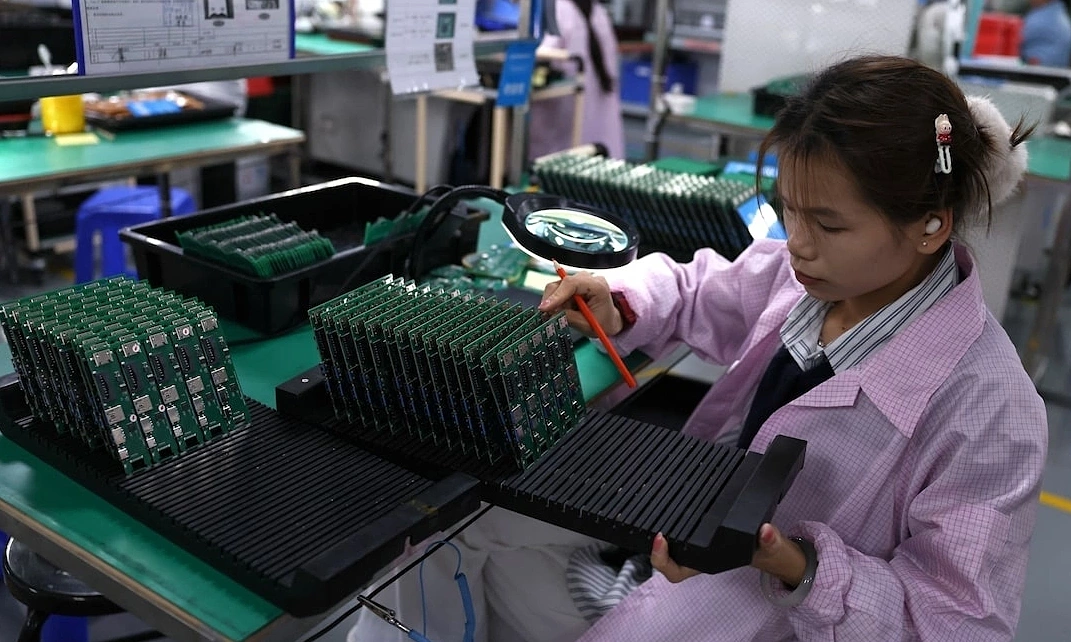
An employee checks a circuit board at an Agilian Technology partner factory in Dongguan. Image: Reuters
This is also Beijing’s strategy. In 2025, China will have a record trade surplus of 1,200 billion USD – equivalent to the size of the Dutch economy – thanks to penetrating new markets at lower prices than rivals.
Export turnover to the US in 2025 will decrease by 20%, but the African market will record an increase of 25.8%. Similarly, exports to the European Union (EU) and Southeast Asia also increased by 8-13%.
Last year, China used rare earths as leverage to force Mr. Trump to reduce import tariffs. This material plays an important role in several fields such as semiconductors and defense. Beijing has a near monopoly on rare earth production, while many industries around the world, including American businesses, cannot operate without this supply.
“Rare earths are really the strongest card,” said Cameron Johnson, an analyst at supply chain consulting firm Tidalwave Solutions. In addition, China could limit the supply of pharmaceuticals, industrial machinery or transformers that the US needs to expand its power grid.
In the short term, war in Iran gives the US an added advantage, because Washington has excess energy supplies that Beijing and other countries need. However, in the long term, Beijing’s large industrial scale will give it the upper hand if the conflict escalates. “That’s why Washington is being soft,” Johnson said.
When import taxes no longer exert as much pressure as last year, manufacturers in China are also under less pressure to diversify production. Jonathan Chitayat heads up the Asia region at Genimex Group, a contract manufacturing firm that gets 70% of its revenue from the US. He said the company found new suppliers in Vietnam and Thailand during Mr. Trump’s first term, then recently expanded to India and Indonesia.
However, 75% of the company’s 500 suppliers are still in China. Many businesses have abandoned plans to move factories after the US reduced tariffs with China but increased them with other countries. “We all learned not to take extreme actions. Those who waited now see that the decision was right,” he said.
Mike Sagan is Vice President of Sourcing at Pride Mobility Products, a manufacturer of wheelchairs, scooters and mobility aids. He said his supply chain of about 100 businesses is currently 70-80% dependent on China.
“We have to reduce dependence and diversify production, but not so urgently anymore. The panic is over and people are gradually becoming more resilient to Mr. Trump’s statements,” Sagan said.
Ren Yanlin – a leader at a Chinese company specializing in supporting the construction of factories abroad – said businesses are no longer overreacting to Mr. Trump’s moves. They become “hardened” to threats. “The current mentality is that it doesn’t matter anymore,” he said.
Eric Zheng – President of the American Chamber of Commerce in Shanghai – said the association’s nearly 3,000 members do not expect much, but they still see dialogue as a positive signal.
Businesses hope the two countries will extend the time to reduce import taxes and loosen export restrictions. They predict this could come with commitments from China to buy goods in sectors such as aircraft, soybeans or energy.
However, very few businesses believe that the current situation will last long. “A truce is better than a trade war, but it’s only temporary,” Zheng said.
“We need certainty. Businesses need to plan long-term, not for the next 90 days or six months, but several years,” he concluded.