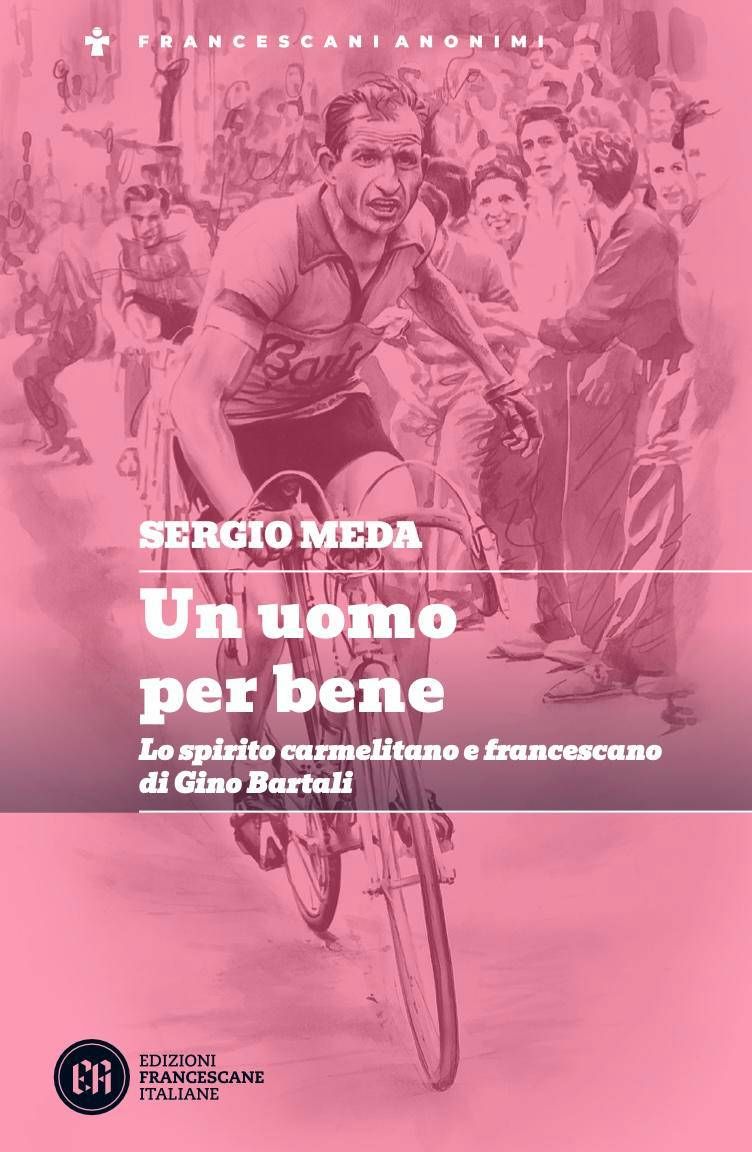
There are champions who remain engraved over time for their sporting exploits, and others who become legends for what they have been able to accomplish even far from the official goals. In the days in which the stages of the Corsa Rosa follow one another, now in its 109th edition, eighty years after his last victory in the Giro d’Italia, and on the occasion of the Jubilee Year of Saint Francis 800 years after his death, Gino Bartali returns to racing in the pages of “A good man. The Carmelite and Franciscan spirit of Gino Bartali” (Edizioni Francescane Italiane), the new book by sports journalist Sergio Meda, in bookstores from today, which will be presented as a national preview at the Turin Book Fair, Friday 15 May at 3.00 pm (Uelci Media Cei Stand, Oval Pavilion). At the Turin meeting, together with the author, Monsignor Domenico Sorrentino and the journalist Riccardo Barlaam will speak, with a video contribution from Francesco Moser who signs the preface.
«The first meeting with Gino Bartali coincides with my debut at the «Gazzetta dello Sport» a few days after being hired at the newspaper. They sent me to the Six Days in Milan, where Bartali was waiting for me in the parterre. It was 1973. Gino looked at me amazed: he had never met me before nor had he heard of me; it seemed strange to him that they would send a stranger to talk to him. I made my debut badly, telling him “Mr. Bartali…” and he scolded me with a dry: “In cycling we all address each other on first terms, there are no ceremonies”, says the author Sergio Meda.
The volume delves into the depths of Ginettaccio’s “vis polemica” to find a Carmelite and Franciscan soul, guided by the simple and solid values of loyalty and honesty. It is the portrait of a man of faith who, in the darkness of the Second World War, became a humanitarian relay, from Florence to Assisi, to save the persecuted Jews. In contact with Msgr. Giuseppe Placido Nicolini, bishop of Assisi, and with Don Aldo Brunacci and Father Rufino Niccacci, Gino transported false documents hidden in the frame of his bicycle, produced by the Brizi printing house of Assisi. In this way he contributed to saving at least 800 Jews, who thanks to those cover identities found refuge and escape from Nazi-fascist deportation. “Good is done, but not said” was his mantra, a philosophy of life that led him to act in the shadows to save human lives, with the same determination with which he challenged Coppi on the most impervious peaks.
A silent anti-fascist, coherent and faithful to his conscience, capable of transforming the bicycle – a symbol of effort and competition – into an instrument of freedom and salvation. That freedom which had led him, in 1936, to appear at Palazzo Venezia in front of Mussolini in casual clothes, with the Catholic Action badge clearly visible on his lapel and without a black shirt, refusing the pressure of those who wanted to force him to join the Party. Even the threats of suspension from racing and the withdrawal of his passport failed to break him: it was his popularity that defended him and gave him courage and strength.
The book contains the testimonies of great names in journalism, of relatives, of those who knew him closely. In the pages of Corriere della Sera, Indro Montanelli writes: “Bartali is the De Gasperi of cycling, not because he belonged to the same political party, but because he is made of the same human fabric. He is not ‘a champion,’ he is ‘the’ champion, the only one who conceives of racing as a priestly mission to which every other activity and pleasure must be sacrificed.”
And again, Gianni Mura: “Bartali was anti-fascist by culture, a peasant culture, practical, not derived from books. His deeply rooted Catholicism knew how to tell him what was good and what was bad. As an honest man he could not tolerate bullies, therefore he was humanly incompatible with fascism.” The words of his son Andrea are touching: “When he got on the saddle he was one with the bike, which he adored to the point of taking it into the bedroom for fear that someone might tamper with it. He talked to it, he took care of it: it was his life, his work tool.”
Making this story even more vivid is the preface by Francesco Moser, who recalls an unpublished Bartali: not a distant and nostalgic monument, but a comforting presence, capable of encouraging young talents: «When I also started running, I moved to Tuscany, the region that taught me, and I had the opportunity to see Bartali often. He inquired about young talents and discussed them with Vannucci, the sporting director of the Bottegone di Pistoia for whom I raced for a couple of years as an amateur. I remember that, at the start of a race, Bartali approached me to say: “I have no advice to give you, you have the right mentality, you never give up”. Some young cyclists were in awe of it: for them it was a monument; I, on the other hand, considered him an excellent example, also because he didn’t do like others, who were a bit blunderbuss, who never forgot to tell you: “In my time…”. He often attended minor races, he often started the race, he was a comforting presence in a land where you had to keep your passion for cycling in check.”
In the afterword Msgr. Domenico Sorrentino reflects on the deeper and less well-known figure of Gino Bartali, going beyond the sporting myth. Alongside the two-wheeled hero and the “Righteous Among the Nations” for the help given to the Jews persecuted during the Shoah, a man of intense and reserved faith emerges, who chose not to talk about either his works of charity or his spiritual commitment. In the itinerary of the Museum of the Memory of Assisi, conceived and curated by Marina Rosati, Bartali’s private chapel becomes a symbol of this internal “beyond”: a faith lived in silence, the hidden source of his moral strength and his courageous choices. The essay thus contributes to restoring the unity of his person, showing how sport, solidarity and spirituality were for Bartali the expression of a single, profound human and Christian vocation.
Sergio Meda, from Milan, made his debut at La Gazzetta dello Sport in 1973. In 1982 he left the Rizzoli Group to found, with Beppe Viola, Magazine, a communications agency. Back in Gazzetta in the mid-nineties, in the press office of the women’s events, in particular the Giro d’Italia, and until 2009. Since then he has been involved in journalism and creative writing courses, as well as publishing books on sports topics.
https://namezorigins.com/choosing-the-right-moving-partner-in-london-a-complete-guide/
https://agreatertown.com/stone-harbor-nj/reliable-solutions-with-a-london-storage-company-0002300355493
https://www.bignewsnetwork.com/news/279034492/stackt-self-storage-smart-secure-flexible-storage-solutions-for-modern-needs
https://allbuzz.co.uk/london-apartment-moving-a-clear-step-by-step-approach-to-an-easier-move/
https://punscorner.com/the-rise-of-on-demand-storage-removals-a-smarter-way-to-move-and-store/
https://todaydinehours.com/stackt-storage-uk/
https://punoramaa.com/stackt-london-redefining-urban-storage-with-simplicity-and-flexibility/
https://gisuser.com/2026/05/stackt-comparison-how-it-stacks-up-against-traditional-storage-options/
https://powderrooms.co.uk/self-storage-insurance-why-it-matters-more-than-you-think/
https://fintechxoom.com/storage-insurance-uk-guide/
https://englishguidex.com/storage-unit-insurance-uk-what-you-really-need-to-know-before-you-store/
https://mozydash.com/self-storage-costs-explained-what/
https://anationofmoms.com/2026/05/storage-unit-cost.html
https://techtidesynth.com/how-much-does-a-storage-unit-cost-a-real-world-pricing-guide/
https://skopemag.com/2026/05/06/furniture-storage-london-the-smart-way-to-protect-your-space-and-your-belongings
https://subways-menu.co.uk/business-storage-solutions-a-strategic-tool-for-growth/
https://sonicmenuusa.com/packing-services-turning-a-stressful-move/
https://crewcuthair.com/london-packing-service-a-practical-guide-to-stress/
https://captionology.com/self-storage-in-streatham-a-smarter-way-to-manage-space-locally/
https://chatingidea.com/self-storage-putney-making-space-work-better-for-you/
https://huzzmeaning.com/self-storage-battersea-a-practical-playbook/
https://symbolostic.com/self-storage-fulham-a-step-by-step-guide-to-managing/
https://punsfly.com/storage-units-clapham-a-local-playbook-for-stress-free/
https://whataburgersmenu.us/storage-units-croydon-a-practical-roadmap/
https://sweatynames.com/self-storage-watford-a-simple-framework-for-smarter/
https://sparktime.co.uk/self-storage-kensington-a-refined-guide-to-managing/