The extraordinary strengthening of the shekel in recent times brings to center stage the arsenal of measures that various countries take to protect their currencies from appreciation. The fear of a local currency that is “too strong” compared to foreign currencies, of the damage to exports caused by this, of economic contraction and the effect on price levels and competitiveness, has accompanied Western countries for decades.
From the “Dutch disease” to the run to the Swiss franc last year, economists are paying more and more attention to the threats of a strong currency, and countries and central banks are taking various policy measures in an attempt to adapt solutions to the problem.
The Norwegians advanced a cure for the Dutch disease
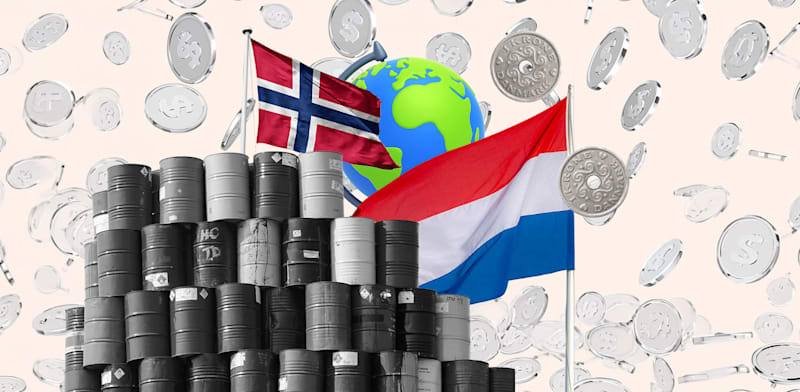
When Norway decided to become Europe’s gas station for decades to come, following the discovery of large-scale oil and gas fields in the North Sea under its economic control, it also realized that it would have a problem with the national currency, the krona. The fact that a lot of foreign exchange would flow into the country threatened to increase the krona to such a level that the very production of fossil fuels would become economically unviable and harm Norwegian competitiveness in every other field, and finally lead to an economic contraction.
The Norwegians looked south, not far, at what happened to the Netherlands and Guilden after the discovery of the huge gas field in Groningen in the 1950s, and found a way to avoid the disease that hit the Dutch economy: to prevent the entry of foreign currency through direct investment in world markets. This is how the Norwegian Wealth Fund was established, one of the largest in the world today, with a value of 2.2 trillion dollars.
Over the years, energy exporters such as Qatar and Saudi Arabia also imitated the mechanism (as well as Israel, on a smaller scale after the discovery of the gas fields in the economic waters). The idea is to prevent foreign exchange from reaching the Norwegian economy by investing in foreign exchange in other markets.
In Qatar, the authorities “perfected” the investment instrument, so that it would also yield them political profits and advance their interests, with controversial success. All the hundreds of billions of dollars and euros that reach the Norwegian treasury every year go into the wealth fund, which in turn invests it in an international portfolio of stocks, bonds and some real estate. The fund is prohibited from investing in fossil fuels, for the purpose of hedging risks.
The Norwegian government is authorized to “shave off” only a few percent of the fund’s annual return for the benefit of the annual budget (governments in Oslo stood up and fell over the question of what this percentage would be), thus economic stability is maintained and the krona is not shaken by energy crises, or global crises like the koruna. The value of the Norwegian currency against the euro, for example, has hardly changed in the past year, even though Norway sells much more fossil fuels, at higher prices.
The complicated Israeli dynamics
“It is difficult to compare Israel’s situation with Norway from this aspect,” Prof. Zvi Eckstein, head of the Aharon Institute at Reichman University, and former deputy governor of the Bank of Israel, tells Globes. “The structural problem of the Israeli economy now is that we have a hi-tech exporting industry that was not harmed by the war, while the rest of the economy – including imports – are in low activity, and even getting smaller. As a result, the surplus in Israel’s balance of payments is only increasing, which has a positive effect on the shekel exchange rate.”
According to him, while in Norway the government controls the oil revenues, in Israel it is a completely different situation, because the revenues derive from the private high-tech sector, and it is not possible to create an overall institutional solution, similar to Norway’s ability to channel the foreign exchange received abroad.
In addition to that, Prof. Eckstein explains, another issue affecting the exchange rate is the high interest rate in Israel at the current point of the situation, and the hedging of the institutional factors that force them to buy shekels in huge quantities due to consumer preferences regarding their savings. “Israeli pension funds are huge, about 10% of GDP, and if the Israeli consumer had held 50% of them in investments abroad, compared to 17% today, there would not have been a problem of the shekel being too strong,” he says.
Switzerland: Interest rate decisions of the central bank
Another case of currency protection is that of Switzerland. The independent and rich country manages one of the strongest currencies in the world, the Swiss franc. In the last year in particular, the currency became a refuge for those who lost faith in the dollar or the euro (or in other non-currency assets), and the franc soared against the basket of currencies. The central bank’s way of dealing with the resulting inflation, which threatened to drop inflation in the country into negative territory and suppress growth, was to sharply reduce interest rates. The interest rate in Switzerland is now at zero, and there are calls to return the country to an era of negative interest rates, which lasted until the corona epidemic and was its main solution to the appreciation of the currency.
Another way in which the Swiss central bank maintained an exchange rate that “made sense” in terms of inflation and national economic interests was through market intervention. These days the bank is a little afraid to do this – like other central banks around the world (including Israel) – due to the American attention to the move and accusations of currency manipulation that may involve American sanctions. Although most of the attention is focused on China, the Americans did not hesitate to also accuse the Swiss of these actions during a conflict over trade between the countries.
Prof. Eran Yeshav from the School of Economics at Tel Aviv University tells Globes that the intervention of the Bank of Israel is a possible step. “Israel has previously intervened in the market, especially during the great financial crisis under Governor Stanley Fisher, and it can do it again.” So, the governor led a major move to buy dollars, but the interest rate in the economy at that time was zero, and the range of possible measures to influence the exchange rate was limited. At the same time, another step that can help deal with the strong shekel, according to Prof. Yeshiv, is “trading in foreign exchange directly with the institutional bodies, which may moderate their great influence on the exchange rate.”
According to Prof. Eckstein, the possible solutions to the current situation include fiscal and monetary measures together. The Bank of Israel, for example, can act by lowering the interest rate (the first tool that needs to be considered, according to him) or by intervening in trade, as was done during the financial crisis. From the government’s perspective, opening the market to imports and increasing it for the Israeli consumer can also moderate the strengthening of the shekel, and also improve the consumer situation of the average Israeli.
Denmark: Fixing a currency as a way to protect it from appreciation
According to Dr. Yanei Spitzer, who until recently was an economics lecturer at the Hebrew University, the mechanism operating in Israel involving institutional investors is a phenomenon that is not entirely unique to us. “The phenomenon of financial markets in which institutional entities influence currency exchange rates is not unique to Israel, and occurs in different ways and with different severity in open Western countries with an independent currency,” he says.
Spitzer says that he focused on what was happening in Denmark, and examined why the Scandinavian economy, which has a similar scope to that of Israel, is not so dramatically affected by the increases in the American indices and the tide in the US markets.
“In Denmark, there are pension funds and insurance companies that hedge a large part of their assets that are invested in dollars. But there this does not translate into great volatility in the exchange rate because the policy of the Danish bank is to peg the krona to the euro. They recognize the fact that when there are rate increases there is an appreciation pressure, but because they hedge between the krona and the euro this does not significantly affect the exchange rate.”
Fixing the exchange rate, either slightly flexibly as in Denmark against the euro or rigidly as in Saudi Arabia and the United Arab Emirates to the dollar is an unusual choice, especially in advanced economies. “In the Danish case, this is of course due to integration with the surrounding Eurozone, and there is a “trade-off” – it is easy to sign contracts and IJA, without introducing the uncertainty of exchange rates, but you lose part of your monetary independence,” says Spitzer. Such a solution is not considered realistic for the Israeli economy.
For your attention: The Globes system strives for a diverse, relevant and respectful discourse in accordance with the code of ethics that appears in the trust report according to which we operate. Expressions of violence, racism, incitement or any other inappropriate discourse are filtered out automatically and will not be published on the site.
http://www.thelululist.com/brown-and-black-owned-legal-services/new-jersey-license-plate
http://dailycategories.com/directory/listingdisplay.aspx?lid=98569
https://www.findabusinesspro.com/general-business-1/new-mexico-license-plate-134337
http://www.digitalizze.com/directory/listingdisplay.aspx?lid=79023
https://www.homepros411.com/business-services/new-york-license-plate
http://www.thelululist.com/brown-and-black-owned-legal-services/new-york-license-plate
https://www.countrypwr.com/legal-services/new-york-license-plate
https://www.nextbizmaker.com/business-services/north-carolina-license-plate
https://gab.com/NorthCarolinaLicensePlate/posts/116418139848513573
https://www.findabusinesspro.com/general-business-1/north-carolina-license-plate
http://www.virtualmallspace.com/legal-services/north-dakota-license-plate
https://www.countrypwr.com/legal-services/north-dakota-license-plate
https://www.bizbangboom.com/business-services/north-dakota-license-plate
https://www.successcenter.com/columbus/services/ohio-license-plate
https://www.a-zbusinessfinder.com/business-directory/Ohio-License-Plate-Columbus-Ohio-USA/34496878/
https://www.find-us-here.com/businesses/Ohio-License-Plate-Columbus-Ohio-USA/34496878/
https://www.homepros411.com/business-services/ohio-license-plate
https://www.mediics.co/wellness/oklahoma-license-plate
https://telegra.ph/Oklahoma-License-Plate-04-17
https://www.nextbizmaker.com/business-services/oklahoma-license-plate
https://www.bizbangboom.com/business-services/oregon-license-plate
https://www.nextbizthing.com/business-support-20-supplies-20-services/oregon-license-plate
http://www.thelululist.com/brown-and-black-owned-legal-services/oregon-license-plate
https://telegra.ph/Pennsylvania-License-Plate-04-09
http://www.detroitbusinesscenter.com/legal-services/pennsylvania-license-plate