In 2021, after the initial shock of the Corona epidemic, the countries of the Union accused each other of mutual neglect in closing borders, and the future of the organization was in doubt. Then it was decided on a precedent-setting step: for the first time to take a joint debt for all 27 countries of the organization, in favor of a fund of more than half a trillion euros that will be allocated for economic rehabilitation. Criteria for distributing the money were drawn up, the funds were raised, and commentators have mentioned that this was also the process by which the North American colonies came together to become the United States.
● A blow to Elon Musk: lost the lawsuit against Sam Altman
● Adani will pay the US $275 million after purchasing Iranian gas in violation of sanctions
Five years later, the joint debt allocation is once again making headlines on the continent. In recent days, a Spanish newspaper published the findings of a special investigation by the Spanish Office of Budgetary Control, according to which the government in Madrid took the money, and in the last two years at least, used part of it not for the defined purposes – but for the benefit of paying pensions to public employees.
With the help of some accounting exercises, revealed in a report by the Spanish official body in May, according to the newspaper “El Mundo”, at least 13 billion euros out of the approximately 79 billion euros that Spain received and were supposed to go to green or digital infrastructures and economic rehabilitation during 2024 and 2025, were allocated to the government’s current budget needs.
Madrid even increased the pensions during this period in several rounds to make it easier for the pensioners to cope with the cost of living as a result of the European wave of inflation. The Spanish government, for its part, denies that it violated the rules allowed as part of receiving the funds.
Fund in a huge amount
At the heart of the dispute is the fact that the European Union, and especially the Eurozone within it, is divided into two different economic camps. On one side are Southern European countries with a high debt-to-GDP ratio (Spain, Italy, Greece and France). These countries distribute government funds and conduct expansionary policies, either for government spending or to support residents in various ways.
On the other side are the Northern European countries, with a low debt-to-GDP ratio (Germany, the Netherlands, Finland, and others) that manage an economical policy. Although the euro is common to all, each of the member countries of the eurozone has its own government bonds.
The difference between the two camps is expressed, for example, in the yield spread between Germany’s 10-year bond (3.18%) and Italy’s 10-year bond (3.98%) – 80 basis points.
The European Reconstruction Fund, which was established in 2021 after Germany and other countries removed their long-standing opposition to a joint debt, together borrowed a huge sum of 577 billion euros and divided it among the EU countries.
Now, against the background of the latest revelations, Germany and the Netherlands feel cheated: the money that went to Spain as a result of their thrift and fiscal discipline was used by it to continue the policy that created the need for a joint loan in the first place.
The government in Spain denies the claims. She points out that even if the funds were transferred to cover pensions, it is a temporary step, which is possible according to the laws of the European Commission in Brussels – to deal with liquidity difficulties by using the funds. In the official reasons she published in the records it is stated that “the money is not required at this stage”.
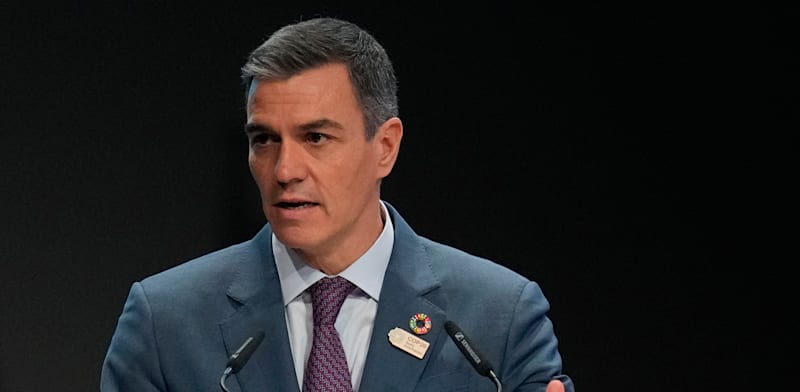
The Prime Minister of Spain, Pedro Sánchez, runs a social-democratic policy, which includes increased government spending, and boasts an annual growth of 2.9% in the past year. Its large part is explained by massive immigration to the country, and also by European aid funds in recent years.
But politicians from the right side of the political map in Germany and the Netherlands were quick to treat the case as a warning sign. “This case highlights the point that the established fund is simply budget support by another name,” Dutch conservative lawmaker Dirk Gutnik told the “Politico” website. In Germany, the leader of the “Alternative for Germany” party, Alice Weidel, wrote on the X network: “German taxpayers’ money finances the poor management of the socialists in Europe.” The Union agency responsible for accounting monitoring of the expenses is also now demanding “greater transparency”.
President of the European Central Bank, Christine Lagarde / Photo: Associated Press, Michael Probst
What will happen to the bond?
Another reason why the issue is in the headlines in recent days is that Spain, France and Italy are constantly promoting their vision to issue “Eurobonds” – pan-European bonds that will operate according to the formula of the European Reconstruction Fund. Instead of deepening their deficit and raising the astronomical debt-to-GDP ratio, and paying high interest rates for it, they will benefit from the move of a new type of bond at a subsidized price.
Macron proposed to finance AI infrastructures, quantum computing, semi-conductors and robotics with the help of the fees. “I am in favor of the move,” said Italian Prime Minister Giorgia Maloney. Sánchez himself also pushed in favor of joint debt, among other things for security investment needs.
Now, the fact that Spain is suspected of having used the money to help itself with its current expenses further increases German-Dutch opposition to the possible move. Already when it was decided to establish the rehabilitation fund in 2021, Berlin clarified that it was a “one-time step”. The current chancellor, Friedrich Mertz, also strongly opposes the move.
This issue is also expected to play a role in filling one of the most important positions in the Union in the coming months – the President of the European Central Bank. France is pushing to replace Christine Lagarde with a candidate who supports issuing joint bonds, while Germany and others oppose it.
For your attention: The Globes system strives for a diverse, relevant and respectful discourse in accordance with the code of ethics that appears in the trust report according to which we operate. Expressions of violence, racism, incitement or any other inappropriate discourse are filtered out automatically and will not be published on the site.
https://tailorenglish.jp/814
http://reporter.zp.ua/ru/russkyj-stavky-na-sportyvnye-sorevnovanyya-v-bk-parymatch.html
http://nabludatel.od.ua/actual/sajt-bukmekerskoj-kontory/
http://codingrus.ru/readarticle.php?article_id=9181
https://khustinfo.com/lifestyle/poradi/inshe/stavki_na_sport_s_bonusami/27-1-0-10768
http://xtgamers.com/page-id-17742.html
https://tocrypto.ru/1proisshestviya/stavki-na-futbolnye-matchi-v-internete/
https://eizvestia.com/sport/2021/07/20/matchi-euro-2020-dlya-stavok-na-futbol/
https://pravda.cn.ua/postavit-na-ishod-finalnogo-matcha-euro-2020/
https://ihdd.ru/stavki-na-basketbol-nba
https://vpl.in.ua/stavki-na-basketbol-v-parimatch/
http://www.kianews.com.ua/news/stavki-na-basketbol-v-parimatch
https://cherkasy-trend.in.ua/ru/fullnews-2647
http://electro-tools.net/news/publ/395-stavki-na-hokkey.html
https://vinbazar.com/journal/nshe/stavki-na-kibersport
https://creativpodiya.com/posts/64924