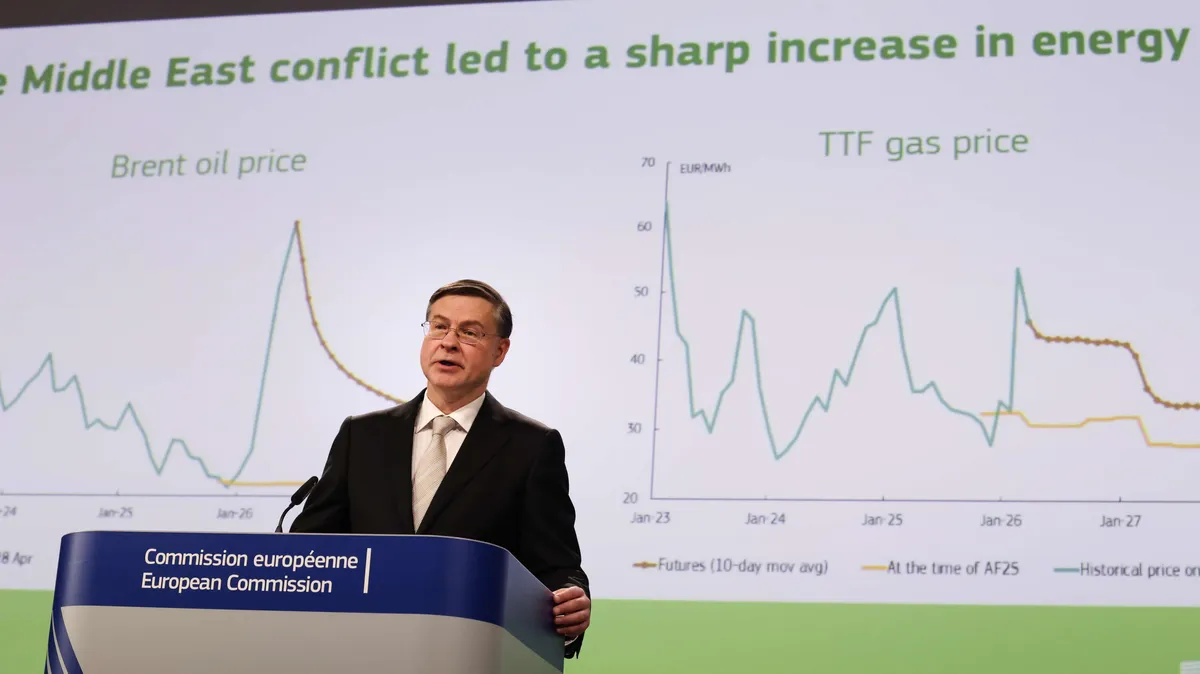
The spring 2026 economic forecast published by the European Commission on Thursday paints a darker picture of the EU’s economic development than before. The conflict in the Middle East has turned the outlook weaker: growth slows down, inflation accelerates and uncertainty increases.
“The conflict in the Middle East has caused a significant energy shock, which puts Europe to an even tougher test in an already unstable geopolitical and trade environment,” said the Commissioner responsible for the economy and productivity Valdis Dombrovskis on Thursday.
According to the commission, even at the beginning of the year, the economic development looked stable. The EU was expected to continue its moderate growth with inflation slowing at the same time. However, the situation changed quickly after the attack on Iran launched by the United States and Israel, when energy prices started to rise sharply. This has increased inflation and weakened economic activity.
The growth of the EU’s gross domestic product is predicted to slow down to 1.1 percent in 2026, after it was 1.5 percent in 2025. The estimate is 0.3 percentage points lower than in the Commission’s autumn forecast. In 2027, growth is expected to pick up slightly to 1.4 percent. In the euro area, growth will be even weaker, i.e. 0.9 percent in 2026.
Inflation will rise clearly higher than previously estimated. In the EU, the price increase is predicted to reach 3.1 percent in 2026, which is one percentage point more than in the autumn forecast. In 2027, inflation is expected to slow down to 2.4 percent if tensions in the energy market ease.
The rise in energy prices burdens both households and companies. Higher bills cut purchasing power and increase costs, which weakens the profitability of companies. At the same time, income flows to countries that export energy outside the EU.
Consumer confidence has fallen sharply, but according to the forecast, private consumption will remain the most important driver of growth. Instead, investments are held back by tight financial conditions, lower profits and uncertainty. Exports also suffer from weak external demand.
The employment trend is weakening slightly. Employment growth will slow to 0.3 percent in 2026, and the long-term decline in the unemployment rate will stop at around six percent by 2027. However, wage increases are expected to remain strong due to inflation.
Middle East forecast risk
The energy shock is also reflected in the public finances. The EU deficit is predicted to grow to 3.6 percent of GDP by 2027. At the same time, the debt ratio rises to more than 85 percent. The background is weak growth, rising interest costs and measures to support households and businesses.
There are significant risks associated with the forecast. The main uncertainty concerns the duration of the conflict in the Middle East and the development of the energy market. If prolonged, the crisis could keep energy prices high, prevent inflation from slowing down, and slow down economic growth in 2027 as well.
On the other hand, the Commission also sees positive opportunities. Public investments, especially in defense and energy transition, can support the economy. In addition, speeding up structural reforms and increasing productivity with the help of, for example, artificial intelligence could strengthen growth in the longer term.
Economy and Productivity Commissioner Dombrovskis stressed on Thursday that the EU must learn from past crises by keeping fiscal policy support temporary and targeted and by further reducing its dependence on imported fossil fuels.
Finnish economy to cautious growth
According to the Commission’s forecast, the Finnish economy is transitioning to cautious growth. The economy is recovering slowly based on domestic demand, but high unemployment, rising interest rates and public finance deficits keep the outlook cautious.
According to the forecast, the gross national product grew by only 0.2 percent in 2025, but growth is estimated to strengthen to 0.8 percent this year and further to 1.4 percent in 2027.
The growth structure changes. Last year, economic growth was supported by net exports, but after 2026 the driving force will shift to domestic demand – especially consumption and investments.
According to the Commission’s forecast, the beginning of 2026 has been stronger than expected: in the first quarter, GDP grew by 0.9 percent from the previous quarter, driven by services, retail trade and industrial production.
There is still uncertainty associated with growth prospects. The conflict in the Middle East is estimated to slow down economic development, especially through the rise in energy prices and general uncertainty. However, the effects are estimated to be smaller in Finland than in other EU countries, because Finland is less dependent on fossil energy.
The pillars of growth
Private consumption is expected to turn to growth in 2026 and increase by 0.6 percent. The background is the growth of household incomes and the salary increases agreed for the years 2025–2027, which will raise the earnings level by a total of about eight percent. A gradual improvement in employment also supports development.
However, consumption is held back by high unemployment, an uncertain economic picture and a high household savings rate. The effects of the conflict in the Middle East can be seen more indirectly: the expected rise in interest rates in the euro area will increase household debt servicing costs. This especially burdens Finns, who have a lot of variable-rate mortgages. In addition, the slow development of the housing market weakens perceived wealth and curbs consumption.
Investments are expected to grow clearly in 2026, especially when machine and equipment purchases increase. On the other hand, residential construction will still remain weak due to high interest rates and reduced housing prices, and the recovery will mostly be postponed until 2027.
This year, growing domestic demand will increase imports faster than exports. Because of this, the effect of net exports on economic growth turns negative, even though exports continue to grow supported by strong order backlogs.
Employment is improving slowly
The unemployment rate was already 10.5 percent in March 2026, and it is predicted to average 10.1 percent in 2026 and 9.8 percent in 2027. Employment is growing slowly, 0.2 percent in 2026 and 0.5 percent in 2027.
Inflation is expected to accelerate temporarily. The average price increase is estimated to be 2.4 percent in 2026, while it was 1.8 percent in 2025. The strong rise in the price of electricity at the beginning of the year and the increase in fuel prices will increase inflation, but the effects are expected to be largely temporary. In 2027, inflation is predicted to slow down to 1.9 percent.
Indebtedness continues
The public finances clearly remain in deficit. The deficit is predicted to grow from 3.4 percent in 2025 to around 4.5 percent of GDP in 2026 and further to 4.6 percent in 2027.
Expenditure growth is particularly accelerated by defense investments, such as fighter jet acquisitions, rising interest costs and salary increases in the public sector. However, some of the social benefits have been frozen due to index increases, which restrains the growth of expenditures.
Income growth will remain muted due to the weak labor market situation, and in addition, the planned income tax reductions will reduce tax collection.
Indebtedness continues: public debt was 88.5 percent of GDP in 2025 and is projected to rise to 91.2 percent in 2026 and further to 93.1 percent in 2027.
https://pub16.bravenet.com/forum/static/show.php?usernum=1314092243&frmid=2162&msgid=1287491&cmd=show
https://www.ezega.com/Communities/Forums/ShowThread/55139/Hotel-WiFi-mistake
https://www.ezega.com/Communities/Forums/ShowThread/50480/What-Makes-FileBoomPorn-Stand-Out-in-Adult-Content-
https://www.veganbodybuilding.com/forums/topic/26835-how-has-technology-shaped-the-adult-industry-over-the-past-decade/
https://intua.net/forums/index.php?p=/discussion/14995/free-adult-videos-what-sites-are-worth-checking-out-lately
https://convivea.com/forums/index.php/topic,15882.0.html
https://www.reddotforum.com/forums/topic/bachelor-party-prep/#post-51903
https://megagrass.com/community/question-and-answer/forums/4133-general-questions/topics/3390752-curiosity-after-a-breakup
https://www.theint.co.uk/forums/topic/girlfriends-suggestion/
https://kenzerco.com/forums/topic/home-alone-weekend/
https://academy.esmoa.org/forums/topic/late-night-disaster/
https://intua.net/forums/index.php?p=/discussion/15392/hotel-room-boredom/p1?new=1
https://www.nedrago.com/forums/topic/awkward-conversation/
https://www.betarazi.com/blog/community/main-forum/rainy-weekend-search/
https://180degreehealth.com/180forums/topic/awkward-friend-talk/
https://www.veganbodybuilding.com/forums/topic/27561-nostalgia-hit-hard/
https://pub16.bravenet.com/forum/static/show.php?usernum=1314092243&frmid=2162&msgid=1287491&cmd=show
https://www.ezega.com/Communities/Forums/ShowThread/55139/Hotel-WiFi-mistake
https://www.ezega.com/Communities/Forums/ShowThread/50480/What-Makes-FileBoomPorn-Stand-Out-in-Adult-Content-
https://www.veganbodybuilding.com/forums/topic/26835-how-has-technology-shaped-the-adult-industry-over-the-past-decade/
https://intua.net/forums/index.php?p=/discussion/14995/free-adult-videos-what-sites-are-worth-checking-out-lately
https://discuss.ilw.com/forum/immigration-discussion/607180-adult-toy-discount-online-for-premium-pleasure-products
https://discuss.ilw.com/forum/immigration-discussion/621862-can-you-tell-me-where-i-can-find-hot-videos