In the fall of 1940, an invisible web vibrated over Great Britain. Sir Robert Watson-Wattin built by the Chain Home radar system gave the Royal Air Force (RAF) two crucial minutes of head start and information on what kind of German planes were attacking Britain and where they were coming from. The information was vital to save Britain from the clutches of the Nazis.
The British radar system proved that the one who gets the right information first and is able to act on it – wins.
The same is now being tried to be applied in NATO, when the alliance is building a next-generation air and combat control system that will decide how NATO countries perceive and conduct air warfare in the future. The name of the new system is eAirC2 and one of its developers is a Finnish physicist Jarkko Surakka.
He is not a traditional NATO systems architect who advanced through his military career, but a physicist, teacher, entrepreneur, coach and networker whose route to the alliance’s headquarters went through the world – literally.
Fact
Let’s eAirC2
Enhanced Air Command and Control, i.e. eAirC2, is a system complex with which NATO manages and monitors the use of airspace and air operations.
The system supports air surveillance in peacetime and the management of operations in crises and war.
It enables the creation of a situational picture, air surveillance, target identification and the management of air operations by connecting the sensors, radars and command centers of different NATO countries into one network.
The real-time situational picture (Recognized Air Picture, RAP) enables an up-to-date overall picture of the airspace in the NATO area.
Uses digital communication and standardized interfaces so that systems in different countries can exchange information.
Enables Quick Reaction Alert (QRA), for example alerting fighters against unidentified machines.
Modular and scalable, meaning it can be used in both local and large-scale multinational operations.
Security is based on high-level cyber and information security solutions, as it is a critical military infrastructure.
Surakka now works in Brussels as a technical engineer at NATO’s Independent Project Office, which builds the eAirC2 system for all 32 countries of the alliance.
Surakka says that at the heart of his work is the question of how to turn a huge mass of data into information that serves decision-making.
“The problem is not a lack of data, but that there is too much of it,” says Surakka.
“It comes from satellites, drones, air, sea, under the surface – everywhere. Some person is still in the loop, and you have to be able to present the right information at the right time in an understandable way.”
If this fails, the consequences are dire.
“If the opponent gets the information in a couple of seconds and we’re stuck with our emails and phones for half an hour, the game is lost.”
At NATO headquarters.
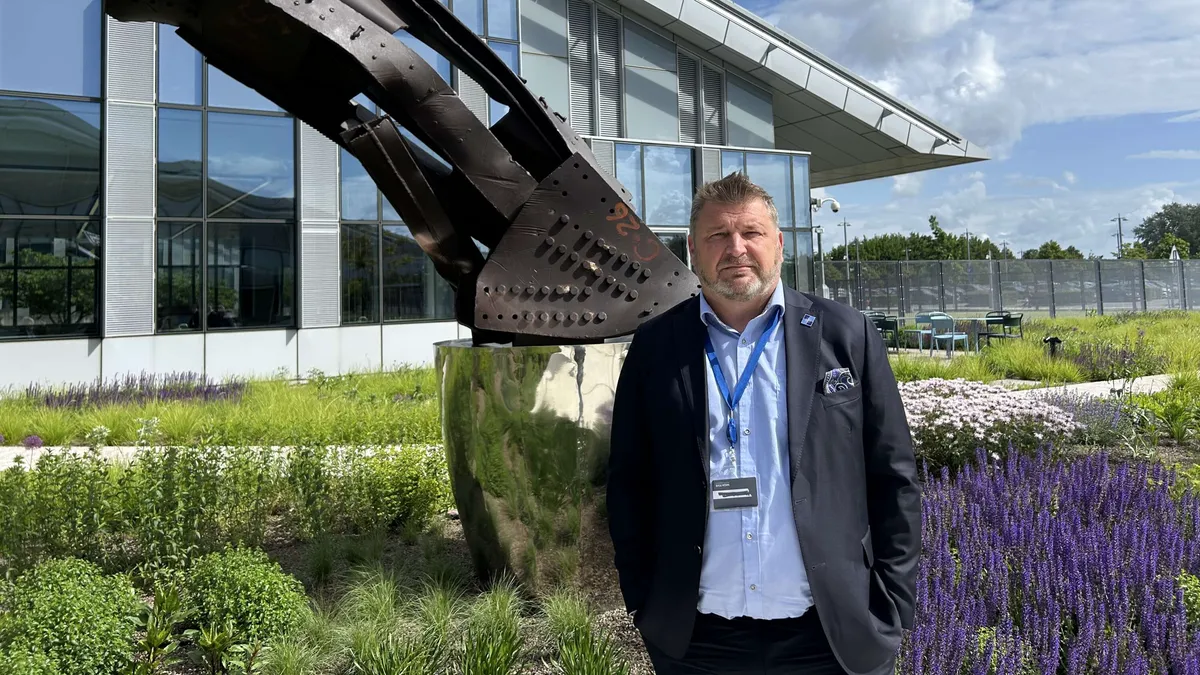
Jarkko Surakka works in Brussels at the NATO headquarters and participates in the development of the air and combat control systems of the alliance of 32 member countries.
PHOTO: Kreeta Karvala
Data war capability
NATO’s eAirC2 is not just a new system, but a change in mindset. In the past, air defense has been managed through platforms, for example from AWACS surveillance planes. Now the data is in the center and the platforms around it.
“It’s not about one device or one system, but about the architecture,” Surakka describes.
“It has to be built in such a way that it is modular, open and able to withstand the fact that the parts become obsolete. Not so that the entire system is renewed every time.”
The goal is a decentralized and resilient system that combines airspace surveillance, combat management, air traffic control and air defense, and includes cyber and space dimensions. At the same time, the system must work in situations where connections are interrupted, data is disturbed, and some of the information is deliberately incorrect.
Surakka highlights perhaps the most difficult problem in the industry, i.e. the reliability of data, which the opponents of the union are also actively trying to influence.
“Garbage in, garbage out. Decision-making is only as good as the data that is fed into it, and we actively try to contaminate that data. A surprisingly small amount of wrong information can ruin even a large data set,” says Surakka.
There is no perfect solution yet. That’s why development is done quickly, accepting imperfection.
“One of our favorite quotes comes from the inventor of the radar system, Sir Watson-Watt: ‘Give me the third best, because the second best comes too late and the best never comes.’ We cannot afford to wait for a perfect solution”, says Surakka.
The development of the program is in a hurry, because the opponents Russia and China are advancing at a fast pace.
“If we are lazy for a day, we know that the opponent is not lazy,” says Surakka.
They should not be underestimated either.
“It is completely wrong to think that the Russians or the Chinese are stupid or slow. They are not. They have abilities where we are not at the same level,” Surakka admits.
Therefore, solutions are sought everywhere, not only from large suppliers, but also from small startups.
“It’s very likely that some of the solutions we’re looking for are right now in the heads of a couple of people in a small fist shop. We just don’t know it yet.”
NATO was contacted
Suraka’s road from Eastern Finland to NATO headquarters is not a traditional military path.
At the age of 17, Surakka founded an American soccer club, made international contacts, studied physics, taught engineers, wrote textbooks, traveled the world with his own money and started helping Finnish companies enter the American market. Eventually, the defense and dual-use sectors became the focus of his work.
“It all started from me asking stupid questions to as many people as possible,” he says. “Education as a physicist helps you break down complex things into small ones.”
Then the phone rings.
“Headhunter said you’ve been hanging around here (NATO’s) lobby long enough – should we pick up a broom and get to work. That was my interpretation of this contact.”
Several days of interviews at NATO followed. Surakka himself did not believe that he would be elected, but it turned out differently.
“And here it is,” Surakka laughs as he sits in the cafeteria of the NATO headquarters.
He lavishly praises his work with top international talents.
“I’m such a curious puppy and so far this job has been really interesting.”
Northern Laboratory
Finland and the Nordic countries play a special role in eAirC2. The area practically serves as a test laboratory for difficult conditions, as weather, fragmentation, electronic warfare and proximity to Russia form a combination that is difficult to simulate elsewhere.
Surakka considers systems thinking to be Finland’s strength.
“Our role is not so much to build large platforms, but architecture, data and how it all works together.”
Suraka’s own role in eAirC2 is not only technical. He also acts as an interpreter between end users and engineers and searches the world for new solutions.
He says that not all problems can be solved on the market yet.
“The end user doesn’t care how great the system is. They care that it works.”
The way of thinking changes.
In the past, air defense has been managed through platforms, for example from AWACS machines, but now data is at the center. In the archive image, the Air Force’s F/A-18 Hornets and NATO’s E-3A Sentry AWACS radar surveillance aircraft are flying cooperation rounds in Finnish airspace.
PHOTO: Defense forces
When you listen to Surakka, it becomes clear that the man is driven by genuine passion and curiosity.
“We really try to find the best solution, not the one that happens to come from the biggest supplier.
The work requires humility because “we don’t even know what we don’t know yet”.
Although Suraka’s work is centered on technology, human contacts are crucial.
“Business always happens between people”, he reminds.
Surakka says that his own career has been built on the fact that he has dared to go out into the world and met people in conference corridors, coffee tables, bars, churches and cheap hotels.
“The worst that can happen is that you lose the price of the plane ticket, but what you can win is much more.”
Tips for Finnish companies
Suraka’s message to Finnish companies is that right now the opportunities are greater than ever, but the situation can pass quickly.
In the defense and security sector, the demand is now particularly focused on systems: data, sensor fusion, cyber resilience and decision-making support, and it is an area where the Finns have a technical advantage.
However, according to Suraka, Finnish companies too often do a “reverse supplier lock”, i.e. companies first try to sell their products domestically to the defense forces and are left waiting.
“It can take months or years. At the same time, someone else takes a slightly worse solution to the international market and takes the whole market.”
Surakka says that Finnish companies should focus more on the end user.
“Finnish companies too often solve problems that are not the end user’s problems, and then nothing happens on the market.”
Suraka’s advice is simple: get out into the world and immediately.
“It doesn’t work like holding seminars in Helsinki for other Finns. The customers are all over the world and you have to go there.”
Surakka emphasizes doing things in practice: meetings, networks and trust.
“If you don’t have direct contacts, business is always more difficult.”
Another key mistake is related to risk aversion.
“With zero risk comes zero result.”
He also challenges the public sector. According to Suraka, small companies should be given more resources to develop their solutions from the beginning.
“If a small part of the acquisition of one billion was distributed to hundreds of startups, a huge number of new solutions would be obtained.”
Surakka encourages to look for partners from the United States, for example, but reminds that Finnish directness does not work across the Atlantic.
“In Finland, they try to sell their own product too directly, while in the Yankees, they do ‘exchanged business’, i.e. they help each other both ways.”
“The opportunity is now open, but not for very very long”, Surakka stresses.
The same applies to his work in NATO. As in 1940 in Britain, the decisive factor now is not just the system, but what can be done with it and whether it can be done in time.
Fact
Suraka’s tips for Finnish companies and the government
Advice for companies:
Solve the real problem, focus on the end user’s need, not the technology.
Go to the international market immediately, the customers are not in Finland.
Build relationships, business is born of trust: meetings, networks, direct contacts are decisive.
Avoid waiting in place, the home market must not be a bottleneck for growth.
Take advantage of partnerships, joint ventures, licensing and cooperation to speed up market access.
Adopt the “exchange business” thinking, – mutual benefit and building networks is important
Advice for the public sector:
Financing also for SMEs, for example smaller development funds for several operators.
Investing in early-stage innovations, the biggest impact occurs at the beginning of development, not at the end.
More risk with smaller companies, new solutions emerge through experiments.
Actively support the promotion of exports, companies must be brought to the international market quickly.
Build ecosystems and not individual “winners”, critical mass is created from a wide field, not from one project
Strengthen Finland’s engineering education and skill level
https://comic.studio/c/rabonzigil
https://hackaday.io/JanRichter
https://www.trackyserver.com/profile/248035
https://www.gaiaonline.com/profiles/jonas-weber/50668729/
https://www.notebook.ai/users/1334924
https://disqus.com/by/cameliasanti/about/
https://www2.archivists.org/comment/reply/7924
https://codeberg.org/amandaalisia3/asterixA/issues/124#issuecomment-13721849
https://balonmano.mforos.com/71436/13321808-plataforma-confiable-para-casino-y-apuestas-deportivas/#123585246
https://hackmd.io/@digitalexperts21/rylsqqMQ-g?utm_source=preview-mode&utm_medium=rec
https://www.livinlite.com/forum/index.php?topic=8054.0
https://elgruposortario.mforos.com/2133175/13276430-transparencia-y-equidad-del-juego/#123606896
https://vocal.media/authors/javier-ortiz-op5q301q2
https://www.todocircuito.com/perfil/Alex_Telles
https://robertsspaceindustries.com/en/citizens/javiermelltron
https://bsky.app/profile/cameliasanti06.bsky.social
https://hub.docker.com/u/cabrerasanta
https://www.econjobrumors.com/topic/mi-opinion-sobre-pin-up-casino-guatemala-lo-que-nadie-te-cuenta?replies=3#post-11165835
https://es.niadd.com/statuses/1002633.html
https://monicanaranjo.mforos.com/1545541/13319003-recomienden-una-plataforma-de-apuestas-de-casino/#123585258
https://myanimelist.net/profile/godosoj461#lastcomment
https://codeberg.org/amandaalisia3/asterixA/issues/112#issuecomment-13243404
https://www.atrapadaenmicocina.com/2021/02/pan-con-masa-madre-sin-levadura.html?sc=1776330882749#c9213031549622603868
https://www.jigsawplanet.com/CarlosMendezz
https://about.me/romancasino