The US decision to narrow the ocean monitoring network of 900 devices has many experts concerned about the risk of missing important data in the context of an impending super El Nino.
Late last month, the US National Science Foundation (NSF) announced it would begin dismantling the equipment of the Ocean Observing Initiative (OOI) – a $368 million network that helps collect data on ocean conditions, including changes in ocean currents, climate fluctuations and marine biodiversity. Experts are concerned that the US is “neglecting” the ocean right at a dangerous period, when sea temperatures are at record highs, super El Nino may be about to happen and the important AMOC ocean circulation system is at risk of collapse, leading to global chaos.
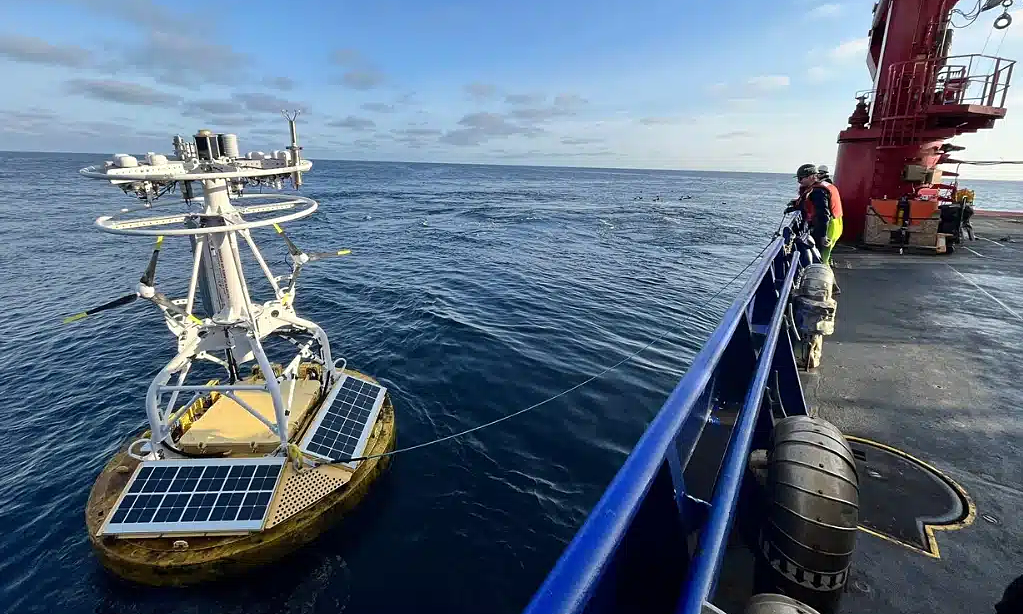
Theo New York TimesOOI deployed in 2016, including about 900 fixed and mobile devices such as floating buoys, sensor anchor cables, seabed connection boxes, depth sounding machines, submarine gliders and autonomous underwater vehicles (AUV). They are located at multiple locations in the Pacific and Atlantic oceans and continuously collect data in real time
The devices are also specially designed to withstand the enormous pressure and high salinity that cause corrosion in the deep sea. Marine meteorologist Jim Edson, who heads OOI, calls it “the world’s most advanced continuous ocean observation network.”
OOI is expected to operate for three decades, but NSF, the network’s sponsor, announced it would significantly scale back its scope. Over the next 15 months, infrastructure off the coasts of Alaska, Washington, Oregon, North Carolina, and southeast Greenland will be dismantled.
According to Mike England, head of communications at NSF, the initiative has not been completely canceled. England told Guardian: “The decision to scale back is consistent with NSF’s broader strategy to use a more flexible approach that supports changing scientific priorities and new technologies, as well as effectively manages the lifecycle of research infrastructures.”
This is another step in the process of US President Donald Trump’s administration scaling back science and climate initiatives. The move comes after Mr. Trump pushed to expand deep-sea mining and loosen fishing regulations, causing concern among marine scientists and climate experts.
The float is pulled close to the ship’s side for recovery. Image: OOI
The global oceans are undergoing a period of enormous change, many processes of which are still not fully explained. Ocean temperatures are skyrocketing in some places, causing stronger storms, rising sea levels and mass bleaching of coral.
Helen Findlay, an oceanographer at the Plymouth Marine Laboratory (UK), told CNN: “Continuous ocean monitoring helps us detect new risks in real time. Without it, we are likely choosing to move forward in an increasingly volatile ocean with diminishing visibility.”
Hilary Palevsky, professor of marine and oceanographic biochemistry at Boston University, points out the importance of the amount of data that will be lost. “One of the real strengths of OOI and many automated data acquisition systems is that scientists like me don’t need expertise or resources to deploy them. Having instruments that work on the ocean surface as well as in mixed deep water and strong ocean wave conditions is extremely valuable,” she told Guardianand said it was “very disappointing” that this important data chain could not be maintained.
Palevsky also warned that rebuilding such a network in the future will be very difficult. “If we want to get the devices back online, we need people who know how to do it, and the team of experts and the program itself are being disbanded. We risk lacking the ability to regain the expertise to do the things we used to be able to do,” she explained.
For Palevsky and her students, the OOI data have helped shed light on biological production in the ocean and its role in carbon sequestration – the process of capturing CO2 – as well as the processes at work in the deep ocean, marine ecosystems, and fisheries.
Data from OOI also contributes to research on the Atlantic Meridional Overturning Circulation (AMOC) – an ocean current system that plays an important role in regulating Earth’s climate but is at risk of collapse due to global warming. According to SmithsonianAMOC collapse could bring catastrophic consequences. Water levels along the East Coast of the United States will rise, temperatures in Europe will decrease, and rain patterns will change, causing drought in Europe and Africa.
According to Palevsky, the consequences of dismantling OOI are not limited to ocean research, especially as climate change increases extreme weather events around the world. “With reduced data, observations and general scientific information – which help us understand what’s happening in the climate system – it becomes harder to understand what we’re facing and what we need to do to plan and adapt,” she said.
https://members4.boardhost.com/businessbooks/msg/1765187989.html
https://www.audiologicalscience.com/group/as-2023-site-group/discussion/6a37dc10-6f02-4f16-95d9-8266f4fc1ec6
https://www.ezega.com/Communities/Forums/ShowThread/44488/HGH-stable-when-traveling
https://www.posersoftware.com/users/FraneWatson12
https://www.reddotforum.com/forums/topic/concerns-about-counterfeit-steroid-products-and-how-to-recognize-legit-batches/
https://kenzerco.com/forums/topic/small-shifts-in-recovery/
https://www.martview-forum.com/dev/index.php?threads/55361/
https://www.wikiwicca.com/forums/topic/shipping-reliability-and-waiting-times-for-orders-from-different-regions/
https://members.boardhost.com/RickXTN/msg/1765189992.html
https://www.stylebuddy.fashion/group/happening-now/discussion/ecd96af1-aa0b-44d3-823a-9384a29388b0
https://www.giveme5.co/group/discussions-about-episodes/discussion/94338509-5839-47f1-ac97-adf651c860df
https://blankslate.io/?note=1242793
https://specialties.bayt.com/en/specialties/q/464401/discussing-lab-testing-and-how-people-verify-product-purity/?first_p=1&fb_share=0
https://codeberg.org/Novustin/Useful/issues/401
https://hedgedoc.eclair.ec-lyon.fr/s/D5SmczF319
https://international.projectwet.org/discussion/innovation-lung-navigation-technology-and-modern-diagnostics
https://mysportsgo.com/Blog/69061/modern-navigation-technologies-in-lung-diagnostics
https://pad.stuve.de/s/ixPEa5is6T
https://social.cigar-cloud.com/blogs/41374/Advancing-Lung-Diagnostics-Through-Innovative-Navigation-Systems
https://www.glbrain.com/index.php?r=content/view&id=48861
https://vybz.live/read-blog/34945
https://doks.komun.org/s/DD3Mf_TN9
https://healingxchange.ning.com/profiles/blogs/innovations-in-electromagnetic-navigation-for-peripheral-lung
https://blogfreely.net/dantera0009/veran-medical-premium-hgh-and-peptides-for-sale-online
https://vishalbharat.in/read-blog/30762