Sebastian Thrun is one of the most influential computer scientists and technology entrepreneurs in the fields of artificial intelligence and self-driving cars. He was a professor at Stanford University before joining Google, where he led pioneering projects on autonomous vehicles, then co-founded the famous innovation lab Google X. He is currently the founder of Udacity, an online education platform with the goal of spreading technology skills to millions of people around the world.
On the sidelines of the 2026 South Summit conference taking place in Madrid, Spain on June 3-5, Thrun shared with VnExpress and a number of international newspapers about the impact of AI on life.
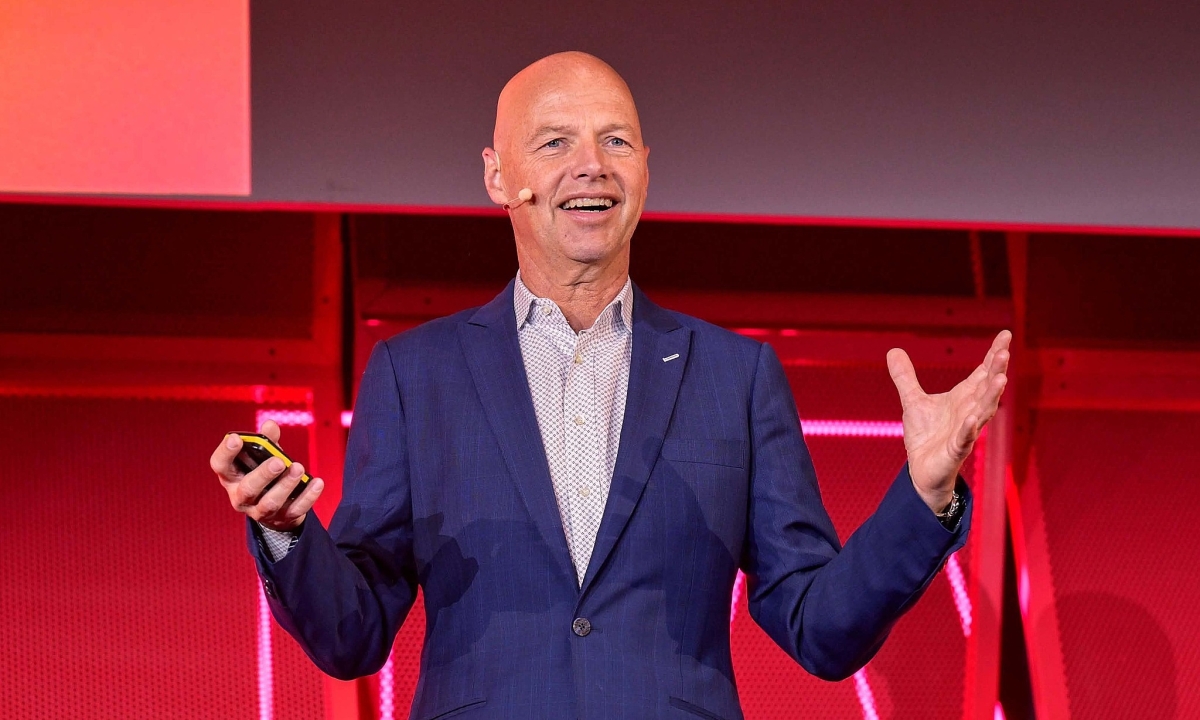
Sebastian Thrun, co-founder of Google X, at South Summit Madrid. Image: South Summit
– What will AI be like in the next 10 years?
– We are in a very special period.
If I asked this question two years ago, I would say AI is basically like a mirror. It reflects what has been put in, and is very good at synthesizing and re-presenting information.
Now, AI creates truly new things, things that never existed before. If we fast forward to the future, the idea of AI performing better than humans in 99% of the jobs we do is no longer so far-fetched. Many people may see this as scary, because the skills available today may become obsolete in a few years. But clearly, AI also helps us communicate better, access more information and understand the world better.
You may not see a similar period in history again.
– Have we reached AGI yet?
– In many aspects, AGI (artificial general intelligence) is quite close.
AI can already do most of the jobs of normal people relatively well. The “ordinary person” here could be an office worker, a retail worker, or even a psychologist to some extent. Even in fields that require high intelligence such as chess and Go, AI is currently better than humans.
In that sense, we already possess many of the characteristics of AGI, at least from a technical perspective. Does that threaten us? I think not, because it is empowering people more than anything else.
Some people think that AGI is the day when you no longer need to consult humans and simply let machines do everything. But in my opinion, it’s a much further step forward, and to get there, we not only need machines to become intelligent, we also have to be willing to give them control.
– What technological consequences do you worry about?
– Any technology has good and bad sides. I have mentioned cash and kitchen knives, which can be used for different good and bad purposes.
AI is an extremely powerful tool. Imagine that right before the election, someone posted fake news on social networks about a bombing happening in Washington. That news could change the election results before people even realized the tampering. Or imagine a person being charged based on an AI-generated video, shown to a jury as real evidence, and resulting in that person’s wrongful death.
We must relearn how to define truth and the true meaning of belief in a world flooded by artificial content. Now we no longer know for sure what is true.
– How far are we from self-awareness AI?
– I don’t like to mystify this concept. I like to use specific examples. For example, my dishwasher can detect whether the door is open or closed, and when it runs out of detergent. My car can also detect problems and send alerts. In a simple sense, it is also a form of “awareness” of its own state.
When it comes to human self-awareness, we often think of more things: creativity, originality, free will. Should my dishwasher have free will? Hope not. I would hate it if one day he said he loved the refrigerator and decided not to work anymore. I just want it to work reliably.
In general, we already have machines that can reason on their own. Look at generative AI models, they can review their own reasoning process, self-criticize, self-correct errors and come up with a better argument. That feels and looks quite similar to self-awareness.
– In education, many people worry that AI will become a “shortcut” that causes people to lose critical thinking. Do we need to redesign teaching and learning to adapt to AI?
– Sure. And universities are struggling with this.
For most homework, if you put it into ChatGPT, you will get the perfect answer. Teachers still haven’t found the right way to create more interesting learning situations.
Machines can already solve problems. So there’s really no reason to continue teaching the old way anymore. No one ever taught me how to hunt for my own lunch, because I just went to the supermarket and bought food.
The story here is similar. I think critical thinking will not disappear, on the contrary, it will increase. Let’s say we go back 500 years, and none of us would be here doing our current jobs. Most are farmers. Women will give birth to many children. Children have to work in the fields. No vacations, no weekends, no learning opportunities. Back then, the space for critical thinking was much less than it is today.
The way of teaching in the future will also be very interesting. Almost everyone in this room can write an application using AI, for example to track how often their children do housework. In other words, almost anyone can become a software engineer. That was completely non-existent before.
– What do young people need to do, when AI is capable of doing so many things?
– The generation of students graduating from university right now really faces challenges. You will see this reflected in labor statistics. My advice to young people is to stay on top of AI, be the best in your class at using AI for whatever you need. Play with it. Test it.
Try writing six different applications using AI just to see how smart it is. Don’t be afraid of it. Because right now, the best people are already doing it. I’m optimistic that this is just a transition period. Everything will be balanced again. Because if we use AI properly, we can become much more productive in any job.
AI won’t necessarily cause jobs to disappear, but it could create more jobs. Historically, that has happened many times. Going back 150 years ago, childhood back then was not like it is today. No weekends. No vacation. Only work. Today we live in a world with more conveniences, and many people have more time for things they care about outside of work.
I think the future is going to be amazing. The pace of human invention in the first thousand years was relatively slow, then exploded around the 1800s and 1900s, then continued to accelerate in the 2000s.
I also believe only 1% of the interesting things that can be invented have already appeared. The remaining 99% are yet to arrive. Why do I say that? Let’s look back just 5 years ago. None of us here predicted the emergence of large language modeling (LLM) at the current level of breakthrough. No one saw self-driving cars going this far. No one witnessed flying taxis. And there are countless other technologies such as humanoid robots and brain-computer interfaces like Neuralink.
If you believe 99% of inventions are still ahead and connected to the current rate of progress, every day, every week, every month will become exciting. That’s how I see the world today.
You are very lucky to be alive during this period.
And I think the times ahead are going to be extraordinary.