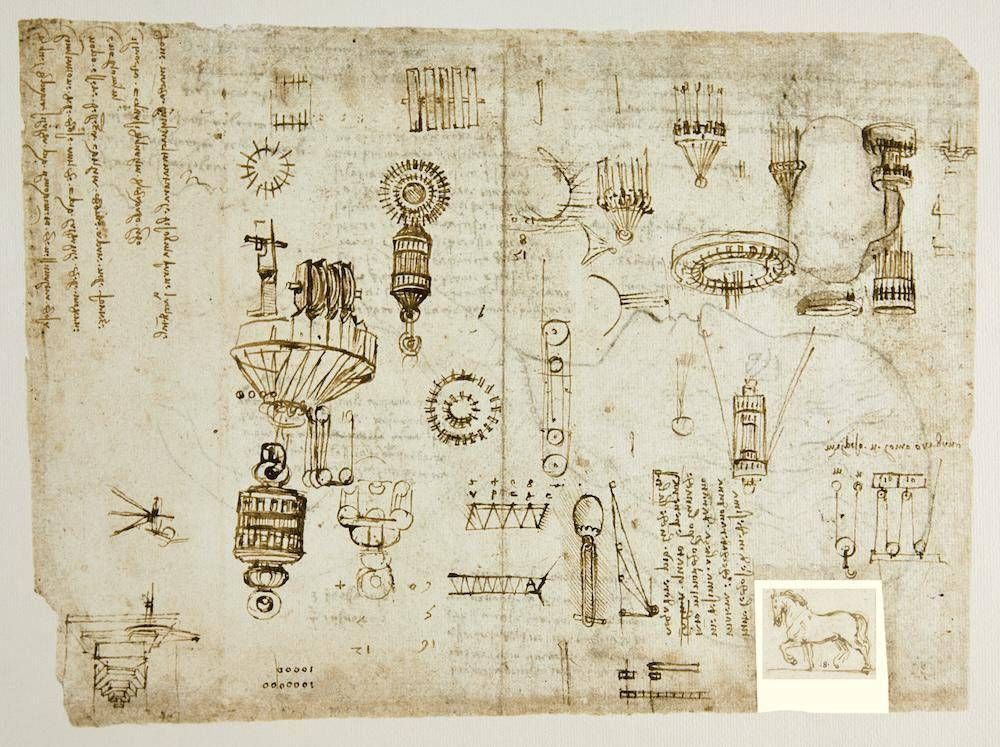
A new online platform that brings together for the first time after over 400 years the two main collections of Leonardo da Vinci’s writings and drawings: available from today, 8 June 2026, at teche.museogalileo.it/leonardo, Leonardotheka constitutes the largest digital resource in the world dedicated to Da Vinci’s manuscripts. The presentation launch took place today at the Italian Embassy in London, in collaboration with the Museo Galileo in Florence and the Ministry of Culture. As the culmination of a ten-year project conceived by Museo Galileo and developed in partnership with the Royal Collection Trust, the Veneranda Biblioteca Ambrosiana and the Biblioteca Leonardiana of Vinci and carried out thanks to the commitment of illustrious scholars and IT experts, approximately 3,500 pages of Leonardo’s manuscripts, which had remained separate since the end of the 16th century, have finally been reunited.
Leonardotheka offers a new perspective on Leonardo’s thought, vision and working method. Thanks to the digital restoration of part of the sheets, the platform highlights the connection between the scientific studies and the figurative drawings of the Tuscan genius, arbitrarily separated by Pompeo Leoni at the end of the 16th century. The Galileo Museum has promoted collaboration between various institutions – integrating the skills of the world’s leading experts with the knowledge accumulated over centuries of studies – with the aim of expanding access to Leonardo’s rich legacy through a public platform.
Leonardotheka reunites the 1,119 sheets of the Codex Atlanticus – the largest collection of Leonardo’s writings belonging to a single corpus, kept at the Veneranda Biblioteca Ambrosiana – with the most important nucleus of figurative, anatomical, landscape and naturalistic drawings by the Genius of Vinci, i.e. the approximately 550 sheets of the Royal Collection of Windsor. These two collections – originally coming from the same set of manuscripts written by Leonardo from the mid-1470s until his death in 1519 – are now digitally reunited in a platform accessible to all.
Upon Leonardo’s death, Francesco Melzi – his last pupil – inherited all the manuscripts. The latter then ended up in the hands, however, of the Arezzo sculptor Pompeo Leoni, who dismembered notebooks and loose sheets, distributing the material thus obtained into two albums: in the first – the most substantial – he placed illustrations and writings relating to technical and scientific topics, reserving the second for artistic and figurative studies. At the beginning of the 17th century Polidoro Calchi, Leoni’s son-in-law, inherited the manuscripts and sold the larger album, later called the Atlantic Codex, to Count Galeazzo Arconati, who donated it to the Veneranda Biblioteca Ambrosiana in 1637. The other album, containing the figurative works, was brought to England in the 1620s and became part of the Royal Collection around 1670, probably as a gift intended for King Charles II.
The new version of Leonardotheka has allowed the recomposition of 50 manuscripts, thanks to the insertion of small fragments preserved in Windsor within the pages of the Codex Atlanticus, thus restoring their original context. This result is the result of complex work, which required the analysis of the dimensions and preparation of the paper, the writing media and the watermarks – all elements available as filters within Leonardotheka. A particularly significant reconstruction made it possible to match the drawing of a horse (sheet 912345r of the Royal Collection) to a note on the late antique equestrian monument of the Regisole in Pavia (sheet 399r of the Codex Atlanticus). The sheet thus restored ‘photographs’, in all likelihood, the moment in which Leonardo conceived the sketch for the horse intended for the ambitious, and never completed, equestrian monument dedicated to Francesco Sforza.
Leonardotheka’s advanced tools allow users to navigate the labyrinth of Leonardo’s papers thanks to detailed data on physical and material properties (the watermarks were acquired and digitized by Haltadefinizione, a tech company of Gruppo Panini Cultura) and on writing and drawing techniques. The platform also contains links to related sheets, transcriptions, critical notes, thematic indexes and bibliographies, including those to the materials of the Galileo Museum’s digital library.
Ambassador Fabio Cassese, who opened the conference “Leonardotheka, an innovative tool for the study of Leonardo’s codices” at the Italian Embassy in London, declared: “Leonardo’s importance transcends national borders. Leonardo does not belong only to Italy, but to the cultural and scientific heritage of all humanity. His work represents the extraordinary encounter between art and science, imagination and observation skills, creativity and rationality. For this reason, projects like Leonardotheka are of crucial importance, which goes far beyond academic research. The collaboration between the Museo Galileo of Florence, the Royal Collection Trust of Windsor and the Veneranda Biblioteca Ambrosiana of Milan constitutes a virtuous example of this spirit of cooperation and demonstrates how institutions from different countries can work together to make knowledge more accessible, interconnected and alive”.
Professor Paolo Galluzzi, president emeritus and former firettore of the Galileo Museum, creator and scientific director of the Leonardotheka, underlined: “Leonardotheka is a tool that makes unprecedented possibilities available to scholars throughout the world for exploring the enormous and precious treasure of information contained in Leonardo da Vinci’s manuscripts. Thanks to the scientific collaboration agreement of the Galileo Museum with the Veneranda Biblioteca Ambrosiana and the Royal Collection Trust, Leonardotheka 2.0 allows integrated exploration of the Codex Atlanticus and of the precious complex of Vincian sheets preserved at the Royal Library in Windsor. This innovative tool marks the start of a new and extremely promising season of studies on the artistic, scientific and literary legacy of the Genius of Vinci”.
Professor Michele Ciliberto, president of the National Institute of Renaissance Studies, Florence, explained: “Leonardotheka 2.0 is a work of great importance that will favor the development of Leonardian studies on new bases. Thanks to the Galileo Museum, at the forefront in Italy and internationally in outlining new perspectives of investigation on protagonists of humanistic and Renaissance culture, this revolutionary project not only contributes to bringing a complex author like Leonardo back into focus in his original form, but contributes to the new interpretation, underway for some years now, of this crucial era in European history. Through innovative digital tools designed to analyze the original texts, Leonardotheka 2.0 will make this challenge possible.”
Finally Roberto Ferrari, executive director of the Galileo Museum: “Leonardotheka represents an unavoidable precedent that demonstrates how cultural institutions can and must maintain the intellectual property of their digital initiatives, resisting the temptation to delegate such responsibilities to commercial platforms. This model stands in deliberate contrast with two equally reductive trends: the proliferation of generic digital libraries, which favor the quantity of content to the detriment of scientific depth, and the growing attempt to transform Leonardo’s legacy into a commercial resource, disguised under the respectable guise of the so-called ‘cultural industry’. In an era of very rapid evolution of artificial intelligence, this project reminds us that the true value of digital humanities lies in the willingness of scientific institutions to take direct responsibility for shaping the tools through which our common heritage is explored and understood.”
The Galileo Museum – Institute and Museum of the History of Science, founded in 1925, has been located in Palazzo Castellani since 1930, a building on the banks of the Arno dating back to the 11th century. Its collections of global importance include over 5,000 scientific instruments dating from the 11th to the 19th century, mostly coming from the Medici and Lorraine collections. It is an international research and documentation center. He designs and produces exhibitions that explore the relationships between science, technology and art.
https://vulkanvegas-sk.eu.com/
https://vulkanvegas.com.lv/
https://vulkanvegas1.com.lv/
https://vulkanvegas1.lv/
https://vulkanvegas7.lv/
https://vulkan-vegas-sk.com/
https://vulkanvegas-sk.org/
https://vulkanvegas-sk.sk/
https://vulkanvegas.sk/
https://vulkan-spiele.de.com/
https://vulkanspielecasino.eu.com/
https://wazamba-gr.com.gr/
https://wazamba-gr.net/
https://wazamba-si.eu/
https://wazamba-si.eu.com/
https://wazamba-si.net/
https://wazamba-si.org/
https://wazamba-sk.eu.com/
https://wazamba.mobi/
https://wazamba1.gr/
https://wazambacasino-si.org/
https://wazamba-sk.org/
https://wazamba-sk.sk/
https://wazambacasino.sk/
https://wazambask.com/